
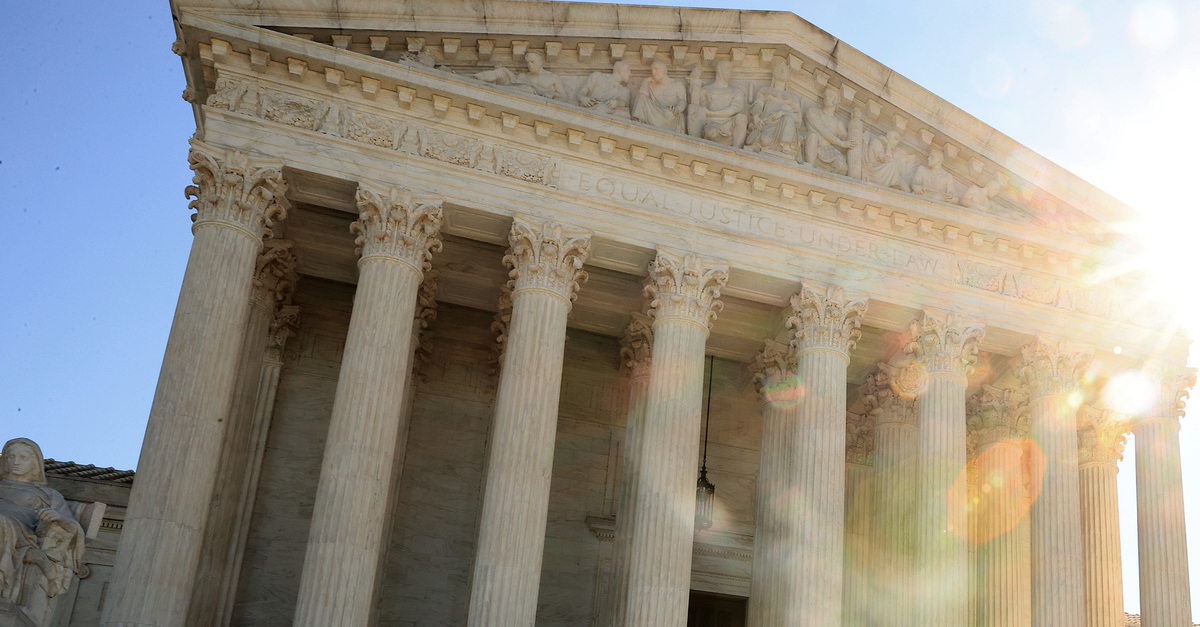
The sun shines on the Supreme Court building in Washington D.C.
The Supreme Court of the United States on Monday morning heard oral arguments in a case about a state worker compensation law targeting one of the country’s most notorious and dangerous toxic waste dumps–and federal efforts to avoid paying injured and sick workers there.
The Hanford Site is a 586-square-mile decommissioned federal nuclear production site in southeastern Washington State that was built as part of the Manhattan Project in 1943 on land sacred to numerous Native American tribes–who were evicted, along with several other families, in order to build the facility. From 1944 to 1989, the Hanford site produced about two-thirds of the American weapons grade plutonium. The production generated over 50 million gallons of toxic waste, which has been stored in 177 underground holding tanks for the last 70 years. The site also produced billions of gallons of contaminated groundwater, and millions of cubic feet of solid waste.
Stylized as United States v. Washington, the case is a classic federal-versus-state battle that will determine whether thousands of employees injured by working amid toxic waste at the Superfund site are entitled to bring workers’ compensation claims and whether the federal government must continue to pay out claims for already-approved workers employed by private federal contractors.
Procedurally, the case comes before the nation’s high court on appeal from the U.S. Court of Appeals for the Ninth Circuit brought by the federal government against the State of Washington. Before that, the federal government sued and lost in federal district court. The appeals court also sided with Washington State on the grounds that over the many years of negotiation and legislation over this matter, the federal government waived its claim to immunity in the context of the portion of Washington’s workers’ compensation statute at issue.
The issue before the nine justices is whether employees of private contractors may bring state workers’ compensation claims for any injuries sustained in the course of their work.
Under a 2018 amendment to state law that applies specifically to workers at Hanford, contractor employees have a rebuttable presumption that certain conditions and cancers are occupational diseases and are thereby entitled to workers’ compensation payouts.
Washington views the 2018 amendment as a necessary effort to clear away red tape and make it easier for workers at Hanford to make their cases and, ultimately, obtain benefits.
The federal government believes the 2018 change is not broadly applicable and discriminates against the federal government on its face in violation of the the intergovernmental-immunity principle of the U.S. Constitution’s Supremacy Clause. The doctrine of intergovernmental immunity generally mandates that activities of the federal government are free from regulation by any state.
Washington, however, has since 1997 also relied on a 1936 federal law that waives federal immunity from state workers’ compensation laws in order to cover some Hanford cleanup workers. The Department of Energy (DOE) and Washington, over the years, have entered into numerous discussions and agreements about the scope of the contractors and subcontractors who are allowed federal workers’ compensation benefits.
But the 2018 rebuttable presumption was a bridge too far for the federal government. The Biden administration said, in their petition for certiorari, that the appeals court’s ruling in favor of Washington is likely to cost the United States tens of millions of dollars annually for the remainder of the 21st century.”
Washington believes a recent amendment to the law renders the case moot but, as for the merits of the rebuttable presumption itself, notes that thousands of workers harmed by toxic waste could be denied benefits simply because it is too difficult to prove a causal link between their illnesses and the conditions to which they were exposed.
While skeptical of the mootness argument presented by Washington State Deputy Solicitor General Tera M. Heintz, the merits of underlying case seemed to work against the federal government on Monday.
Chief Justice John Roberts appeared largely unconvinced by the arguments advanced by U.S. Deputy Solicitor General Malcolm L. Stewart that sought to read away the language of the 1936 waiver.
Justice Samuel Alito picked up on the chief justice’s train of thought, ultimately unmoved by Stewart’s efforts to frame the issue as possibly turning on legislative intent.
Justice Elena Kagan said that none of the federal government’s textual arguments were very strong.
“If you look at the text here, I’m struggling to read it your way,” she said, while suggesting that the federal government might have a better argument making a slippery slope argument about a potentially broad “stretch” that Congress might not have envisioned.
Justice Sonia Sotomayor indirectly responded to Kagan’s question by saying that the 1936 waiver might very well be ambiguous but noted the ambiguity might be read in Washington State’s favor to accept “that the scope is as broad as the language supports.”
Stewart replied that the non-discrimination requirement should naturally be imported into the 1936 waiver–and that Congress manifested their intent to do so–while also saying that no state before Washington has, in 80 years, tried to avail themselves of such a generous law.
“There aren’t many places like Hanford, right?” Roberts interjected–citing the extreme danger and safety hazards at the toxic waste dump. The government’s attorney conceded there were no such “analogues” but attempted to liken the employees to those who work in the “atomic weapons sector.”
Kagan, transfixed on what she called “the breadth” of the argument advanced by Washington, asked Stewart if there had to “an express waiver of immunity.” He conceded that the general waiver was fairly standard but that, in terms of anti-discrimination, “we don’t know of any analogues” that would support the Washington language singling out the Hanford Site specifically.
Never moving from that particular point, Kagan later expressed outright hostility to Washington’s argument.
“We can’t really believe this is what Congress meant to do,” she told Heintz.
Retiring Justice Stephen Breyer also offered some skepticism by laying out where a state writes an extremely broad workers compensation statute that textually aligns with the 1936 waiver.
“Congress has the ultimate political check here,” Heintz ventured. “They can always amend this statute.”
Kagan then suggested that the Evergreen State’s attorney didn’t really answer Breyer’s question–but most of the court’s sharp questioning was reserved for Washington’s late-coming argument that the case was actually moot.
“Why did you wait so long to make it?” Justice Amy Coney Barrett wondered–prompting Heintz to concede that the state probably should have made that argument well before they finally did late last month.
“Why do you care?” Alito asked at one point.
“The state has an interest in ensuring this court address live cases or controversies,” Heintz replied. “But the old law fell under the waiver.”
Owning up to the merits of the case after a lengthy series of questions from Justice Neil Gorsuch–the only justice who seemed to warm to that argument—Washington’s attorney brushed away discrimination concerns.
“I think that this waiver permits differential treatment of the federal government,” Heintz said.
On rebuttal, Stewart noted that several cases have already been impacted by the 2018 version of the law–with substantial numbers of federal dollars stake.
“There is still a sufficient possibility this will end up happening,” he said. “The case is not moot.”
Elura Nanos contributed to this report.
[Image via Chip Somedevilla/Getty Images]
Have a tip we should know? [email protected]
Source: This post first appeared on


