
A senior commander from Iran’s Islamic Revolutionary Guard Corps (IRGC) issued a warning over the weekend that Tehran, currently under pressure from Israel’s persistent attacks on its leadership, military resources, and energy infrastructure, might take action to close the Strait of Hormuz.
It’s a threat the Mullahs regularly resort to at times of tension or when their backs are against the wall.
This strait connects the Persian Gulf with the Indian Ocean and broader sea routes, playing a crucial role as 30 percent of the world’s transported crude oil and 20 percent of its liquefied natural gas (LNG) pass through it. At only 21 miles wide at its most narrow point, it remains one of the world’s most critical passageways for global energy resources.
Decapitated
The prospect of closing the Strait always looms large, causing alarm in the West that fears the ensuing energy crisis and economic turmoil such a blockade would trigger. However, this drastic action has never been executed, likely because Iran stands to lose as much, or possibly more, than any other nation if this crucial channel is obstructed.
My instinct is that it won’t happen this time either. But I wouldn’t entirely rule it out. Tehran is rapidly running out of options.
Their military and intelligence leadership is being decapitated. Israel has air supremacy over Iran, including the capital, giving it a free hand to hit whatever assets it feels like, including oil and gas facilities, thus crippling an already clapped-out economy.
Retaliatory missile attacks on Israel are painful but not a game-changer. Iran’s allies in the axis of autocracy — China, Russia and North Korea — are not exactly rushing to its aid either.

Locals and rescuers look for survivors from a residential building in Tehran hit by Israeli missiles
So it was no surprise when we learned last night that Iran is secretly signalling to America, via Arab intermediaries, that it seeks an end to hostilities. It’s even been making conciliatory noises to Israel about avoiding further escalation — and indicating a willingness to resume talks with the US on its nuclear weapons programme.
President Trump is anxious not to get dragged into yet another Middle East conflict. The Israelis, for all their spectacular military successes, are still not sure they can destroy Iran’s nuclear bomb facilities (though UN inspectors are saying that Natanz, one of the two sites used to produce weapons-grade uranium, might have been rendered useless by Israeli bombing).
So the renewed prospect of a negotiated settlement has some appeal in Washington and Jerusalem. But the US red line remains: Iran must give up all efforts to develop a nuclear bomb — and must be verifiably seen to do so.
That could be too much for the hardliners in Tehran to stomach. They are more likely to argue that pressure can be brought to bear on Israel by threatening the West with an economic Armageddon — by closing the Strait of Hormuz.
The pain for Western economies, at least in the short-term, could certainly be intense. Energy costs would soar as oil prices spiked well above $100 a barrel (versus around $70 at the moment). Gas prices would shoot up too, in a repeat of what happened after Russia invaded Ukraine in 2022. Inflation would reignite and industrial production would plummet.
The European economic recovery, such as it is, would be halted in its tracks. Recession would loom on both sides of the Atlantic. Chancellor Rachel Reeves’s fiscal rules would be shot to smithereens.
Given the levels of debt and deficit Britain has racked up there would be very little scope to borrow more to cushion the blow from rising fuel bills, as the government did in the aftermath of the Ukraine invasion.

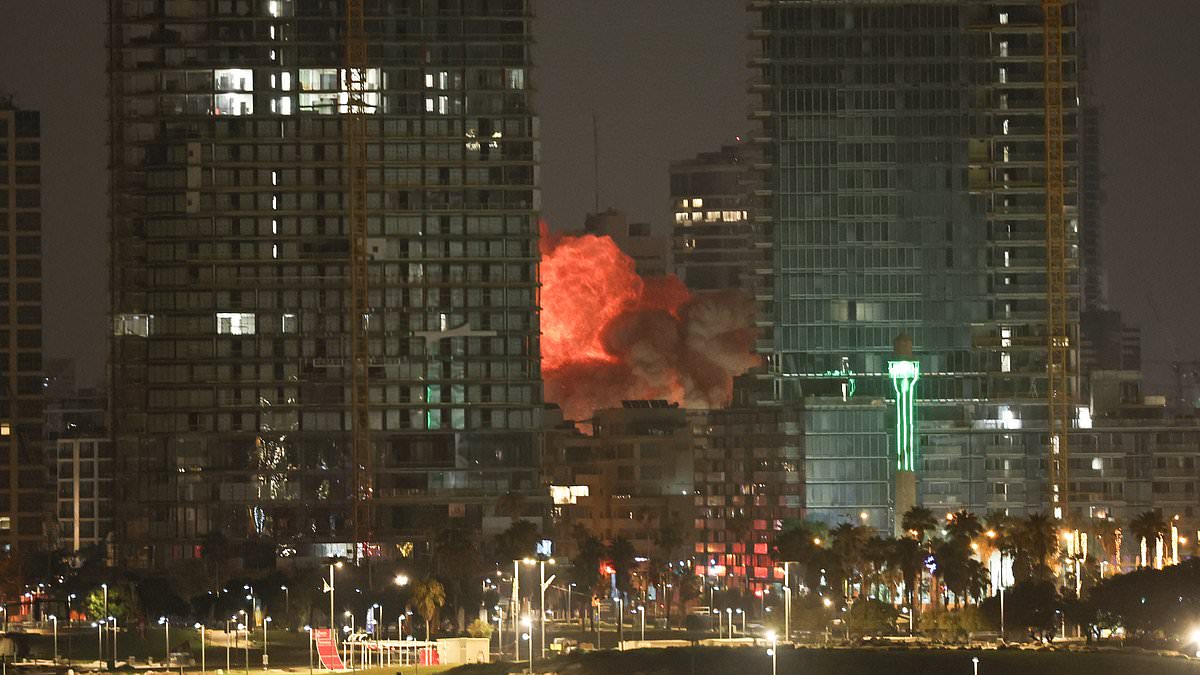
An Iranian missile hits a target in Tel Aviv, Israel
Real hardship for those already struggling to meet their energy and food bills would beckon. Dole queues would lengthen.
But the West wouldn’t be the only region to suffer. China imports 50 per cent of its crude oil from the Middle East via the Strait of Hormuz and takes between 15 to 20 per cent of the LNG coming out of the Gulf. Its economy would be crippled too, as would other Asian economies. Iran is likely to think twice about hitting a major ally so hard.
It would also be hitting itself. Iran exports over 1.5million barrels of oil a day, all of it through the Strait of Hormuz, 90 per cent of it to China. If it was to lose that revenue the Iranian economy would be quickly on its knees.
The Mullahs, already deeply unpopular with most Iranians, would face a wave of unrest provoked by economic hardship which could easily sweep them from power. Israel’s dream of regime change in Tehran would be realised. Whatever short-term pain they might cause other economies, closing the Strait of Hormuz could be tantamount to suicide for its theocratic regime.
Mission
Even so, Iran does have the ability to disrupt the Strait using mines, drones, land-based missiles and artillery along the coast and swarm tactics involving IRGC speedboats. But sustaining closure against US naval might, backed by British and French naval forces, would be mission impossible.
The US maintains a formidable naval presence in the region, built round its massive Fifth Fleet, based in Bahrain, which includes a carrier strike group, amphibious landing forces, the Marine Corps and Navy Seals, minesweepers, destroyers and submarines. Then there are its extensive missile capabilities and jet fighters, including state-of-the-art F-35s and F-16s.
As if all that wasn’t enough, the USS Nimitz carrier strike group is heading to the Middle East, joining the USS Carl Vinson carrier strike group which has been there since April.
Britain and France have much smaller but still significant naval presences in the Gulf, with France operating from its base in the UAE and Britain out of Bahrain, an old ally. French frigates and British mine-hunters would enhance US-led efforts to keep the sea lanes open.
President Trump can be counted on to act quickly. He will not want his second term to be marred by inflation and recession.

Thirty per cent of the world’s seaborne crude oil and 20 per cent of liquefied natural gas (LNG) shipments pass through the Strait of Hormuz, making it one of the world’s most critical chokepoints for global energy supplies
The so-called Gulf Tanker War in the 1980s between Iraq and Iran saw attacks on hundreds of vessels from each side, with several sinking and running aground. But oil supplies through the Strait of Hormuz were never that severely disrupted, and when the US got involved the Iranian navy was pretty much destroyed. Iran now risks a repeat.
Nightmare
It does, however, have a card potentially more lethal than closing the sea lanes out of the Gulf. Most of the region’s largest oil and gas production sites are within reach of Iranian missiles.
Protecting them is well-nigh impossible, especially in Saudi Arabia, since they are spread over huge distances. Were Iran to attack them, then energy prices could spike even if the Strait of Hormuz stayed open.
But my understanding is that America has quietly but firmly made clear to Tehran that any attacks on US regional allies — and the United Arab Emirates, Saudi Arabia, Kuwait and Qatar are all America’s allies — would see America entering the conflict on Israel’s side.
That is Tehran’s worst nightmare, especially since it would likely result in the US unleashing its B2 bombers with massive ‘bunker buster’ bombs capable of destroying Iran’s nuclear bomb facilities no matter how deep they’re buried.
The Hormuz option, once seen by Tehran as a move guaranteed to strike fear into the hearts of Western governments, increasingly looks more like a forlorn last throw of the dice by a desperate dictatorship now too feeble to risk it — and destined to lose if it does.