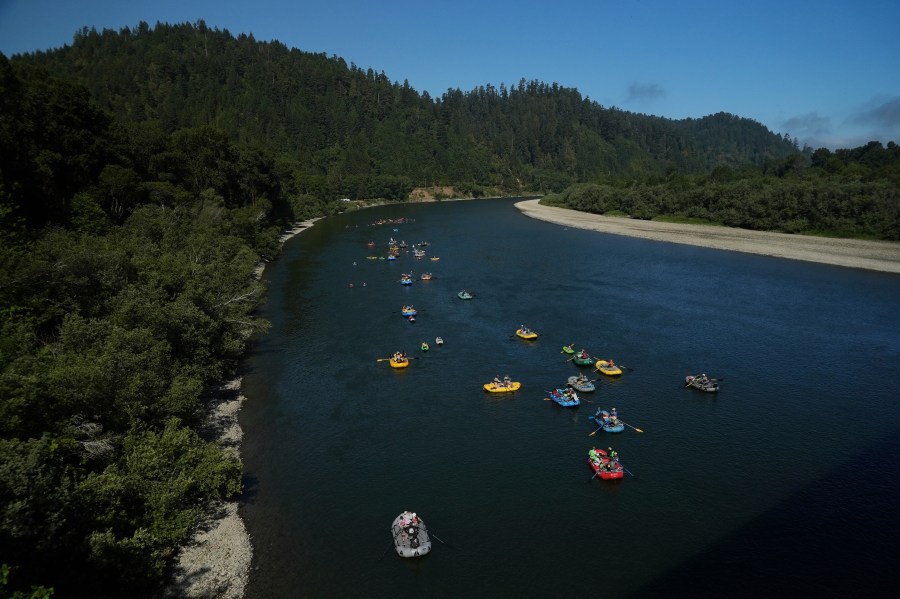


KLAMATH, Calif. (AP) — As vividly colored kayaks glide through dense fog, the sounds of voices and drumbeats grow louder as they near a gathering on the shore. Cheers break out as the kayaks reach the sandy spot that partially divides the Klamath River from the Pacific Ocean in Northern California.
Native American teens from various tribes around the river basin lift themselves out of their kayaks and make their way across the sand, some breaking into a run. They joyfully kick at the chilly ocean waves that they have been paddling towards throughout the past month — an ocean that has seen a dwindling return of salmon over the century due to four hydropower dams obstructing their prime upstream spawning areas.
“I believe our ancestors would feel proud because this is the cause they have been fighting for,” remarked 15-year-old Tasia Linwood, a member of the Karuk Tribe, on Thursday night, looking forward to the group’s final stretch on Friday.
The Klamath River is newly navigable after a decades-long effort to remove its four hydropower dams to help restore the salmon run — an ancient source of life, food and culture for these paddlers’ tribes who have lived alongside the river for millennia. Youth primarily from the Yurok, Klamath, Hoopa Valley, Karuk, Quartz Valley and Warm Springs tribes paddled 310 miles (499 kilometers) over a month from the headwaters of the Wood River, a tributary to the Klamath that some tribes consider sacred, to the Pacific Ocean.
The teens spent several years learning to navigate white water through Paddle Tribal Waters, a program set up by the nonprofit Rios to Rivers, to prepare local Native youth for the day this would be possible.
During their last days on the water, the group of several dozen swelled to more than 100, joined by some family members and Indigenous people from Bolivia, Chile and New Zealand who face similar challenges on their home rivers.
Dams built decades ago for electricity
Starting in the early 1900s, power company PacifiCorp built the dams over several decades to generate electricity. But the structures, which provided 2% of the utility’s power, halted the natural flow of a waterway that was once known as the third-largest salmon-producing river on the West Coast.
With the dams in place, tribes lost access to a reliable source of food. The dams blocked the path to hundreds of miles of cool freshwater streams, ideal for salmon returning from the ocean to lay their eggs. Salmon numbers declined dramatically along with the water quality.
In 2002, a bacterial outbreak caused by low water and warm temperatures killed more than 34,000 fish, mostly Chinook salmon. That galvanized decades of advocacy by tribes and environmental groups, culminating in 2022 when federal regulators approved a plan to remove the dams.
Through protests, testimony and lawsuits, the tribes showcased the environmental devastation caused by the dams, especially to salmon. From 2023 to 2024, the four dams were dynamited and removed, freeing hundreds of miles of the Klamath.
The renewable electricity lost by removing the hydropower dams was enough to power the equivalent of 70,000 homes, although PacifiCorp has since expanded its renewable sources through wind and solar projects.
Two dams used for irrigation and flood control remain on the upper stretch of the river. They have “ladders” that allow some fish to pass through, although their efficacy for adult salmon is questionable. On the journey, the paddlers got out of the river and carried their kayaks around the dams.
For teens, a month of paddling and making memories
The journey began June 12 with ceremonial blessings and kayaks gathered in a circle above a natural pool of springs where fresh water bubbles to the surface at the headwater of the Wood River, just upstream of the Klamath River.
The youth camped in tents as they made their way across Upper Klamath Lake and down the Klamath River, jumping in the water or doing flips in their kayaks to cool down in the summer heat. A few kayakers came down with swimmer’s ear, but overall everybody on the trip remained healthy.
Nearly everyone had a story to share of a family’s fishing cabin or a favorite swimming hole while passing through ancestral territory of the Klamath, Modoc, Shasta, Karuk and Yurok.
More than 2,200 dams were removed from rivers in the United States from 1912 through 2024, most in the last couple of decades as momentum grows to restore the natural flow of rivers and the wildlife they support, according to the conservation group American Rivers.
“I believe that it was kind of symbolic of a bigger issue,” said John Acuna, member of the Hoopa Valley Tribe and a leader on the trip.
Removal of dams represents end of long fight with federal government
The federal government signed treaties with these tribes outlining their right to govern themselves, which is violated when they can’t rely on their traditional food from the river. Acuna said these violations are familiar to many tribal communities, and included when his great-grandmother was sent to boarding school as part of a national strategy to strip culture and language from Native Americans.
That history “comes with generational trauma,” he said.
Their treaty-enshrined right to fish was also blatantly disregarded by regional authorities in the 1970s but later upheld by various court decisions, said Yurok council member Phillip Williams.
Standing on a fog-shrouded boat ramp in the town of Requa awaiting the arrival of the youth, Williams recounted the time when it was illegal to fish here using the tribes’ traditional nets. As a child, his elders were arrested and even killed for daring to defy authorities and fish in broad daylight.
Fifty years later, with the hydropower dams now gone, large numbers of salmon are beginning to return and youth are paddling the length of the Klamath.
“If there’s a heaviness that I feel it’s because there’s a lot of people that lived all in these places, all these little houses here that are no longer here no more,” said Williams. “They don’t get to see what’s happening today. And that’s a heavy, heavy, feeling.”
Even as a teen, Linwood says she feels both the pleasure of a month-long river trip with her friends and the weight of the past.
“I kind of feel guilty, like I haven’t done enough to be fighting,” she said. “I gotta remember that’s what our ancestors fought for. They fought for that — so that we could feel this joy with the river.”
___
The Associated Press receives support from the Walton Family Foundation for coverage of water and environmental policy. The AP is solely responsible for all content. For all of AP’s environmental coverage, visit