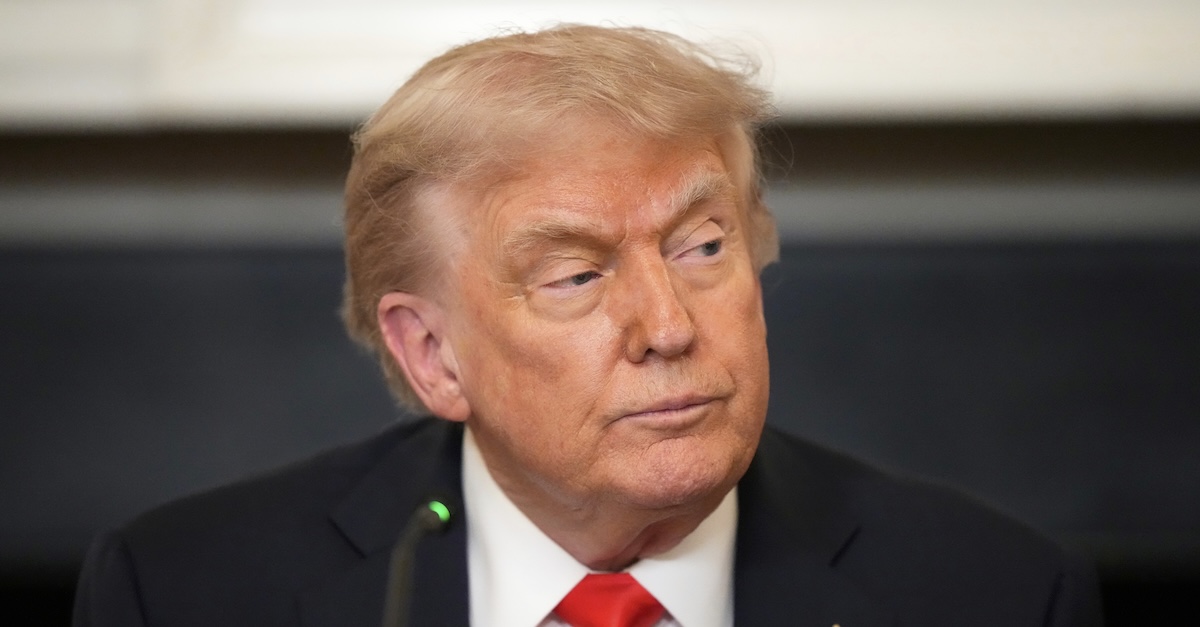

President Donald Trump participates in a session with the Fraternal Order of Police in the State Dining Room of the White House on Thursday, June 5, 2025, located in Washington (AP Photo/Alex Brandon).
A federal judge on Friday dismissed the Trump administration”s sanctuary lawsuit against Illinois, Cook County, the City of Chicago and various elected officials in the Land of Lincoln.
On Feb. 5, the U.S. Department of Justice filed a relatively terse 23-page complaint accusing the combined governments and officials of violating the supremacy clause of the U.S. Constitution. The lawsuit alleged the “so-called” sanctuary policies at issue provide non-citizens “safe havens from federal law enforcement detection.”
“The challenged provisions of Illinois, Chicago, and Cook County law have the purpose and effect of making it more difficult for, and deliberately impeding, federal immigration officers’ ability to carry out their responsibilities in those jurisdictions,” the original petition reads.
Now, U.S. District Judge Lindsay C. Jenkins, a Joe Biden appointee, has tossed the lawsuit for lack of jurisdiction, lack of standing, and failure to state a claim in a 64-page memorandum opinion and order.
The court, in a lengthy analysis, views many of the issues through the lens of the the Immigration and Nationality Act (INA).
“The United States alleges that federal immigration law preempts the Sanctuary Policies expressly and because they obstruct the accomplishment of federal objectives,” Jenkins summarizes. “The collective thrust of Defendants’ response is that the INA provisions indicated have no preemptive effect, do not preempt the Sanctuary Policies, and indeed cannot be found to preempt them without running afoul of the Tenth Amendment.”
In other words, the Trump administration argued the sanctuary policies were little more than efforts to obstruct federal law. The collective defendants argued, oppositely, that the federal laws simply do not bind them this way.
Specifically, in one major point of contention, the federal government argued the defendants should be forced to comply with detainers issued by Immigration and Customs Enforcement (ICE) agents. The court describes detainers as: “requests that a state or local law enforcement agency advise ICE before releasing non-citizens whom ICE wishes to detain so ICE can arrange to assume custody of them.”
The defendants, for their part, in line with their sanctuary policies, expressly do not comply with such detainer requests.
The court considered the detainer issue in light of the statute.
“While the INA requires agents to issue detainers in some situations, no provision of the INA requires a State to take any action in response to one,” the opinion explains. “The INA directs the actions of federal agents, but goes no further, implicitly acknowledging that a State’s response to detainers is outside of its control.”
Another major issue in the case is the federal government’s claimed right to access Illinois’ information on non-citizens – and, in turn, to easily access the non-citizens themselves when the state, county, or city has such people in custody.
“While phrased in different ways, the Sanctuary Policies prohibit their corresponding governmental units from sharing with ICE any person’s custody status, release date, or contact information,” Jenkins explains. “Dovetailing with its argument concerning detainers, the United States argues that these prohibitions make it ‘nearly impossible’ for it to detain removable individuals with the expediency required by the INA.”
Again, the court notes, the INA does not actually say anything about the states providing such information or access.
“The INA directs immigration officers to wait to take a person into custody until after their criminal custody concludes,” the court observes. “But any intention on the part of Congress to require States to do anything in response is not reflected in the text of the provisions before the court.”
Jenkins goes on to offer a lesson on the concept of “mandatory” compliance and “agreement” to comply with federal designs.
The court explains here, at length:
To be sure, the INA reflects Congress’s intent to allow States to enter into agreements with the federal government so that state officers can perform the functions of immigration officers. That collaboration may include “allow[ing] federal immigration officials access to detainees held in state facilities.” But once again, such assistance is permissible under the INA, not mandatory. Even [one section of the INA] does not mandate any state action. It disclaims the need for a formal agreement before state officials “communicate with the Attorney General regarding the immigration status of any individual.” It “leaves room” for State action, as the Supreme Court recognized in Arizona. Ultimately, like the other INA provisions discussed, [the INA] reflects only Congress’s hope that States participate in immigration enforcement.
After all is said and done, the court summarizes again – landing on the side of the state, county, and city defendants.
“There’s no doubt—particularly at the motion to dismiss stage where well-pleaded allegations are presumed true—that, absent the Policies, it might be easier for immigration agents to discharge their obligations under the INA,” Jenkins writes. “Some line agents might choose to assist the United States in its civil immigration enforcement efforts. But because the INA merely offers States the opportunity to assist in civil immigration enforcement, the Polices don’t make ICE’s job more difficult; they just don’t make it easier.”
In another section of the opinion, Jenkins takes a hard look at a section of the INA that negatively proscribes the states’ ability to “prohibit, or in any way restrict, any government entity or official from sending to, or receiving from, the Immigration and Naturalization Service information regarding the citizenship or immigration status, lawful or unlawful, of any individual.”
This part of the law, the court finds, is irredeemably in tension with the 10th Amendment of the Constitution.
“This ‘constrain[t] on local rule-making’ is antithetical to State sovereignty and prevents the passage of ‘locally-preferred policies,'” the opinion goes on. “If elected officials cannot translate voter preferences into policy, some of federalism’s most celebrated features also suffer: ‘citizen involvement in democratic processes’ and ‘innovation and experimentation in government.'”
The court then opines again, at length:
[The constraint] also inverts the structure of state and local governance. Instead of legislatures prescribing regulations for government employees to implement, [the constraint] “strip[s] [decision-making] from local policymakers and install[s] it instead inline-level employees who may decide whether or not to communicate with [the Department of Homeland Security]. This too denigrates state autonomy by denying a State control over its own employees. “A state’s ability to control its officers and employees lies at the heart of state sovereignty.”
Finally, if the State, County, and City cannot control whether and how their employees share information with the federal government, they cannot affirmatively opt-out of enforcing federal immigration laws. This conflicts with the guiding principle of anticommandeering: knowing and voluntary cooperation.
Jenkins, notably, dismissed the lawsuit without prejudice – giving the Trump administration one last shot to re-file and re-state some of their claims by Aug. 22.