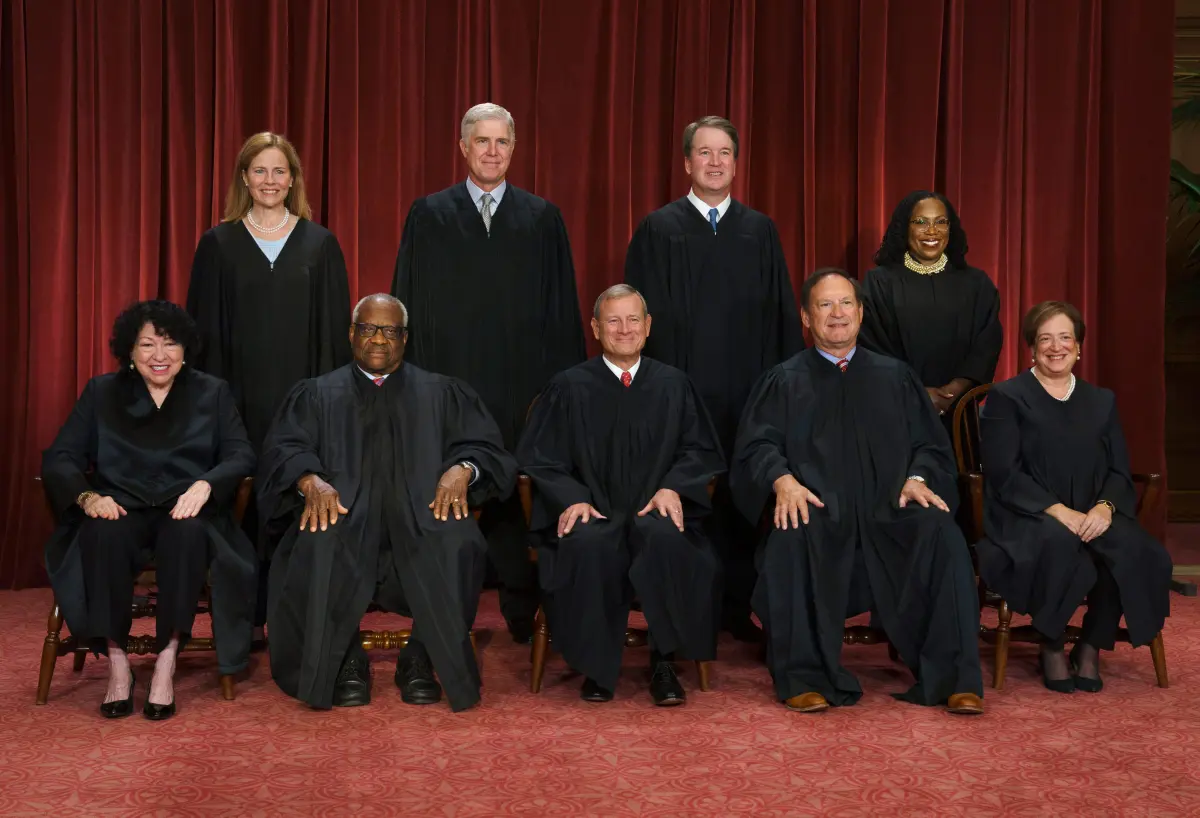

WASHINGTON — President Trump criticized three of his Supreme Court appointees in a new interview, saying their decisions on issues including his tariff policy have been “very disappointing” despite the fact that he “gave them the position of a lifetime.”
Trump made the comments to Time magazine while discussing a previous social media attack on Justices Amy Coney Barrett, Neil Gorsuch and Brett Kavanaugh. The three had voted against the administration’s proposed restrictions on mail-in voting.
“I put them in. They voted against me too often,” Trump said. “I gave them the position of a lifetime, and they vote against me often. They vote for me too.”
Trump contrasted the justices’ decisions with what he described as the unity of Democratic-appointed members of the court. “The Democrats stick like glue — those three, they virtually never vary,” he said. “You can come up with the worst thing in the world and they’ll vote as a group.”
Although he said he disliked that pattern, Trump added that he admired the loyalty he believed it represented. “So they have loyalty to Barack Hussein Obama,” he said. “They have loyalty to Biden, even though Biden doesn’t even know who the hell they are. He wouldn’t know. He doesn’t even know what the Supreme Court is. And me, I gave them the chance of a lifetime, and it’s unfortunate what they did.”
Trump pointed to Supreme Court decisions from the past year involving tariffs and birthright citizenship as examples of rulings that frustrated him.
“I don’t want loyalty. I want good decisions,” Trump said. Calling the tariff ruling “disastrous for the country,” he argued that the justices could have exempted previously collected funds from repayment. “All they had to do was a little clause saying any money paid does not have to be paid back…would have saved $400 billion. They chose not to save that.”
Gorsuch and Barrett joined a February decision invalidating Trump’s new 10% baseline tariff on most countries, as well as a separate levy on imports from China, Mexico and Canada imposed as punishment for fentanyl smuggling. The ruling made businesses eligible for more than $100 billion in refunds.
Trump also condemned the court’s handling of birthright citizenship. “It’s unfortunate what they did—not to me, to our country,” he said. “Birthright citizenship. It’s becoming a major industry now. People are making millions and millions of dollars, and we’re losing trillions of dollars.”
He called birthright citizenship “a corrupt business” that had expanded because of the Supreme Court’s decision. Trump said the constitutional principle was intended for “the babies of slaves,” not for Chinese nationals — wealthy or otherwise — entering the United States.
Barrett joined the majority in overturning Trump’s executive order that sought to deny U.S. citizenship to children whose parents were neither citizens nor permanent residents. Kavanaugh agreed with part of the ruling while dissenting on another portion.
Trump had previously turned against his Supreme Court nominees in a Sept. 15 social media post, writing: “These are not the people I interviewed.”
Despite the criticism, Trump later allocated four of the 134 invitations to a Sept. 24 U.S.-China state dinner to Barrett, Kavanaugh and their spouses.