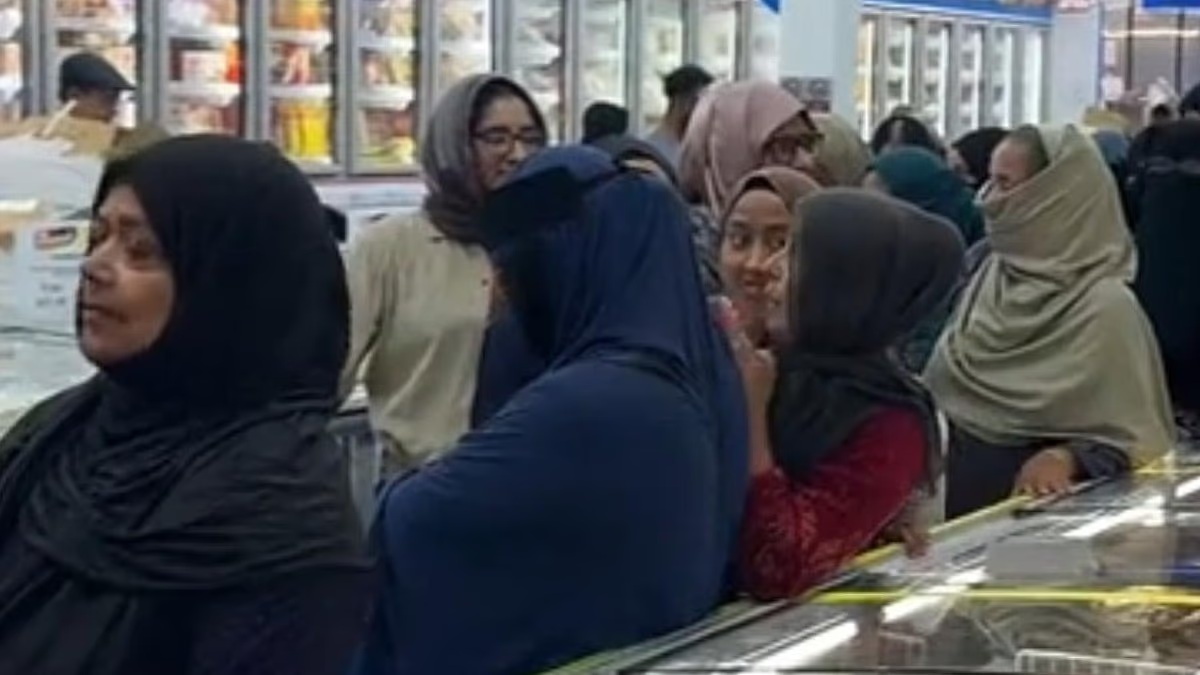


Each week, hundreds of millions globally gather in peace to worship. However, there are instances when violence invades these sacred spaces, disrupting the sense of sanctuary and safety.
Recently, such incidents occurred at a synagogue in England and two churches in the U.S. Prior to these, there were well-known attacks at mosques in New Zealand, a synagogue in Pennsylvania, and a Sikh temple in Wisconsin. This violence elevates anxiety and fear among clergy and worshippers worldwide.
Despite bolstered security measures and alert congregants, a pressing question remains: Can believers continue to worship together safely and peacefully?
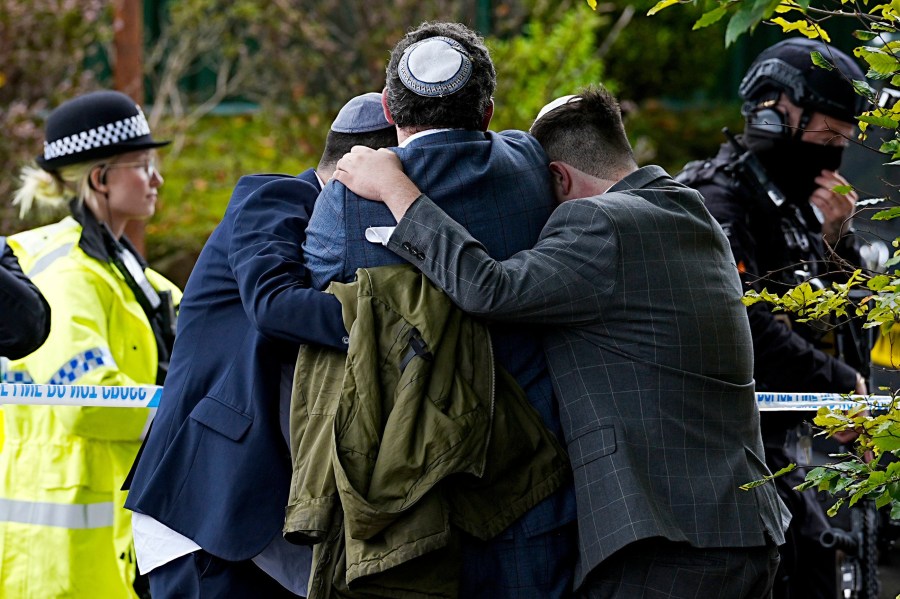
The attack on October 2 at a synagogue in Manchester, England, resulted in the deaths of two congregants, with police attributing the attack to a man who had pledged allegiance to the Islamic State group. Following this, a mosque in an English coastal town was hit by a suspected arson attack two days later.
“There is real fear,” stated the Right Rev. Toby Howarth, a Church of England bishop, in response to these attacks. “People must feel safe when attending places of worship.”
Creating that sense of safety presents a continual challenge. In Germany, many synagogues are now surrounded by barriers and protected by heavily armed police due to several attacks. In the United States, most synagogues, along with many non-Jewish worship places, have implemented layered security measures. These strategies might include guards, cameras, and systems for controlling access to events via ticketing, registration, or other vetting methods.
Seeking security without heightening anxiety
The deadliest attack on Jews in the United States occurred in October 2018, when a gunman killed 11 worshippers from three congregations at Pittsburgh’s Tree of Life synagogue.
Eric Kroll, deputy director of community security at the Jewish Federation of Greater Pittsburgh, said synagogues there had begun systemic security trainings before the attack.
Some of the training recommendations — such as keeping a phone on hand for emergencies even on the Sabbath, when observant Jews normally wouldn’t use a phone — helped save lives during that attack, he said. The federation continues to evaluate attacks such as the one in Manchester to prepare for assailants’ evolving tactics.
“The wounds still run deep here in Pittsburgh for a lot of people,” said Kroll, adding that preparations help them to worship together confidently.
“It’s so easy to talk about all these things and be frightened,” he said. “But if you teach ways to respond to those things, it empowers people to go and live their lives.”
A similar tone was sounded by Bishop Bonnie Perry, leader of the Episcopal Diocese of Michigan, in a letter to her congregations two days after a gunman killed four people inside The Church of Jesus Christ of Latter-day Saints in Michigan’s Grand Blanc Township on Sept. 29.
“Many of us feel grief, fear, and deep unease,” Perry wrote. “It is natural to wonder whether the places where we pray and gather are safe.”
She proceeded to detail a balanced approach to security, rejecting suggestions to lock church doors during worship but encouraging greater vigilance and preparedness, including formation of emergency response teams at the diocese’s churches.
“We do not want our churches to feel like fortresses; they are houses of prayer for every person,” she wrote. “At the same time, love of neighbor includes readiness to act swiftly should danger appear. … Our goal is not to shut people out but to keep everyone safe while maintaining the radical hospitality of the Gospel.”
Differences over guns in church
While some Christian pastors in the U.S. encourage congregants to bring firearms to church as an extra security measure, numerous denominations and individual houses of worship forbid this. After the Grand Blanc attack, The Church of Jesus Christ of Latter-day Saints affirmed that it prohibits carrying firearms and other lethal weapons inside its meetinghouses and temples, except for current law enforcement officers.
Black churches in the U.S. have withstood a long history of violent attacks, from decades of church burnings and bombings to the murder of nine Bible study participants in 2015 at Mother Emanuel AME in Charleston, South Carolina. The perpetrator of that attack, now on death row, posted selfies with a Confederate flag to flaunt his racist rationale for shooting Black churchgoers.
A member of Metropolitan AME in Washington, D.C., Khaleelah Harris, 29, said the threat of violence is often on her mind.
“It can be difficult to be a part of a worship service, and you look around and five police officers are in the service because somebody just walked in, and they look a little suspicious. It shifts the atmosphere,” said Harris, who is in the AME ordination process.
Her church won a lawsuit earlier this year against the Proud Boys, after the far-right group vandalized the church’s property in 2020. The congregation has increased security, at one point paying $20,000 per month.
It’s a struggle to balance being a welcoming congregation with tightened security protocols, Harris said. “How does welcoming all and not being quote-unquote judgmental prevent someone from using their discernment or engaging security measures?”
A worldwide problem
In various forms, attacks on houses of worship have occurred through history. At present, attacks on individual houses of worship in places like the United States and Western Europe tend to draw the international spotlight more than attacks that are part of broader ongoing conflicts — such as Christian churches burned by Islamic militants in parts of Africa or the destruction of many mosques in Gaza through Israeli strikes mounted in its war against Hamas.
Attacks on mosques — usually blamed on Islamic militants with rival ideologies — have taken place in other Middle Eastern countries.
Egypt reeled in 2017 from the killing of more than 300 people in a militant attack on a mosque in Sinai frequented by Sufis, followers of a mystic movement within Islam. On March 4, 2022, an Afghan suicide bomber struck inside a Shiite mosque in Pakistan’s northwestern city of Peshawar, killing at more than 60 worshippers. The Islamic State group claimed responsibility.
Between those attacks was a day of horror in Christchurch, New Zealand, when a white supremacist gunman killed 51 worshippers at two mosques during Friday prayers in 2019. It prompted new laws banning an array of semiautomatic firearms and high-capacity magazines. They also prompted global changes to social media protocols after the gunman livestreamed his attack on Facebook.
During a wave of antisemitic incidents in Australia, a synagogue in Melbourne was firebombed in December 2024. Australian authorities have accused Iran of directing that attack.
Australia is among several countries, including South Africa and Britain, that have engaged with the U.S.-based Secure Community Network to share information regarding possible antisemitic threats, according to SCN’s national director, Michael Masters. The network provides security advice and training to Jewish institutions across North America.
“We act more like Interpol than we’d like to,” Masters told The Associated Press. “So many of these bad actors and their ideologies cross borders. So all of us have recognized that we are stronger when we work together.”
Next steps
In the United States, religious leaders are urging Congress to expand the Nonprofit Security Grant Program. It helps nonprofits and houses of worship pay for security system upgrades and emergency planning.
In Britain, after the recent Manchester attack, Prime Minister Keir Starmer said more police resources would be deployed at synagogues.
From both the Jewish and Muslim communities in Britain, there are calls for authorities and civic leaders to curtail antisemitic or anti-Muslim vitriol that might incite future attacks.
Dave Rich of the Community Security Trust, a charity providing security to the Jewish community, told the BBC, “There is an inability to recognize antisemitism or a reluctance to deal with incitement in ways that have just allowed it to grow.”
“I think a lot of Jewish people will be saying OK, the sympathy is great, but where’s the action?” Rich added.
Wajid Akhter, secretary-general of the Muslim Council of Britain, said expanded police deployment is only a partial answer.
“There must be a reckoning with the hate being stoked in our public discourse,” he said. “The safety of British Muslims, and of all faith communities, depends on it.”
___
This story has been updated to correct the name of the security network. It is the Secure Community Network, not the Secure Communities Network.
___
AP journalists Sylvia Hui and Lydia Doye in London; Geir Moulson in Berlin; and Mariam Fam in Cairo contributed.
___
Associated Press religion coverage receives support through the AP’s collaboration with The Conversation US, with funding from Lilly Endowment Inc. The AP is solely responsible for this content.