

We are currently witnessing a transformative phase in technology and economics. Historically, such pivotal moments are characterized by individuals who not only see the potential but also actively engage with the evolving challenges, tackling them directly.
In the last couple of years, Governor Hochul has demonstrated exceptional foresight and political courage, elevating New York’s status as a global frontrunner in artificial intelligence. With the recent enactment of the RAISE Act, she has effectively crafted a national framework to regulate major AI developers. Her commitment extends to substantial investments in scientific advancements, highlighted by funding for an unprecedented academic supercomputer to fuel innovative research. Additionally, she has allocated $5 million to foster future AI leaders, establishing AI and Society Departments at eight SUNY institutions.
The initial draft of the RAISE Act had a solid foundation but contained elements that could have made New York an exceedingly difficult environment for developing large language models. Meanwhile, California introduced a similar law, focusing on transparency for the same tech companies.
This legislative activity unfolded while President Trump issued an executive order aimed at preventing states from enacting AI regulations. While we believe states should regulate within their jurisdictions, we also recognize that a fragmented approach could undermine America’s most valuable asset—innovation.
Governor Hochul recognized this and understood that aligning New York’s interests with national priorities was crucial. She played a pivotal role in revising New York’s legislation to match California’s framework, creating a unified national standard for AI safety. This alignment allows companies to innovate and expand while safeguarding national security and public safety.
The entities subject to this law, predictably, are not its biggest fans, nor are the AI critics who advocated for its strictest measures. However, we view this compromise as a necessary step to ensure balanced, effective, and secure AI development, advancing progress both in New York and across the country.
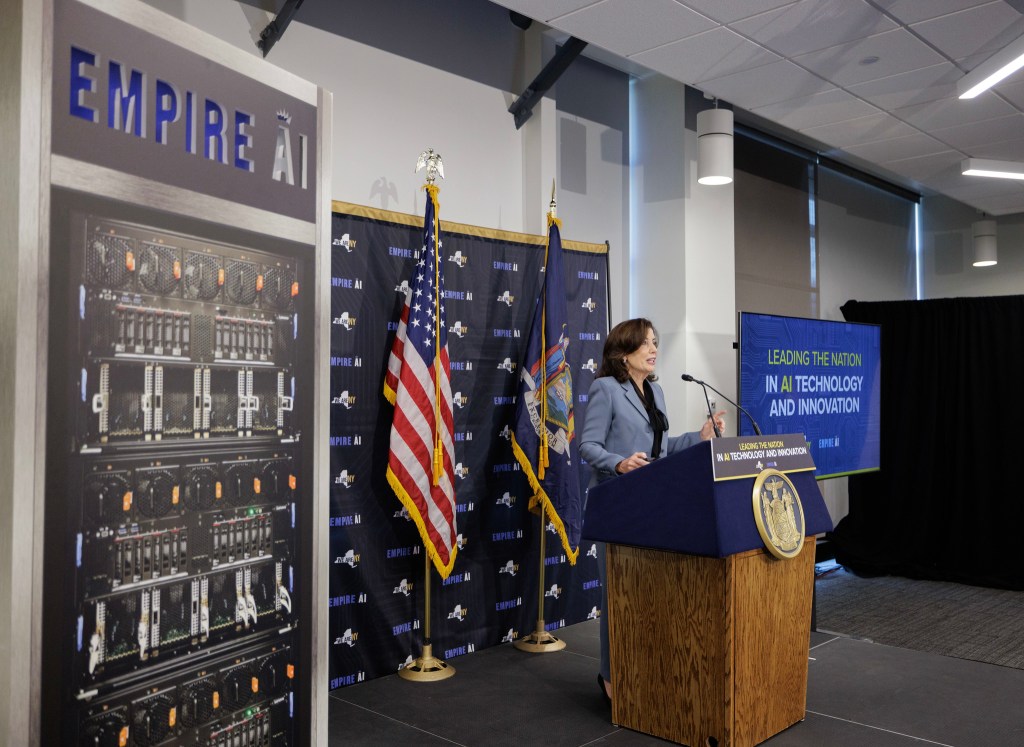
This was not Hochul’s first time showing critical national leadership on AI. In the 2024 budget, she funded a groundbreaking public-private partnership called Empire AI, an independent consortium of New York’s top public and private academic institutions and philanthropic funders. Together, they are building a first-in-the-nation high-performance computer that will give academic researchers access to computing power previously only available in the private sector. In 2025, she increased the funding to include additional institutions and further expand Empire AI.
Empire AI is already strengthening the state’s research ecosystem and has the potential to generate billions of dollars in long-term economic value as it continues to scale. The shared supercomputing resources provided by Empire AI — historically available only to the largest technology companies — are dramatically accelerating research timelines, attracting talent, and driving job-creating investment in Buffalo and across the state.
At the same time — and not coincidentally — AI continues to be an economic driver. New York City’s tech sector is one of the city’s strongest economic engines, powering a $694 billion ecosystem of more than 25,000 startups and driving growth faster than any other major sector. Over the past decade, tech has grown 64%, added more than 114,000 jobs, and accounted for roughly 40% of the city’s net job growth since 2019. Backed by nearly $180 billion in venture capital and rapid growth in AI, fintech, and health tech, the sector is expanding New York’s tax base, attracting top talent, and fueling long-term economic growth.
With this progress also comes real challenges. Our workforce will be impacted, and our education system will have to shift dramatically. That is why making AI literacy a statewide priority in 2026 across K-12, higher education, community organizations, and workforce training is essential to ensuring New Yorkers can adapt, compete, and thrive in an AI-driven economy. Additionally, we should build upon the wave of sensible policymaking in 2026 to finally establish comprehensive consumer data privacy protections that bring New York in line with 20 other states.
Moments of technological transformation call for bold leadership, and we commend Hochul for hers in positioning New York as a home for responsible and effective AI growth. Thanks to her, we’re about to see what happens when the private sector, government, and academic institutions work together to chart a responsible path for the AI economy to grow. New York is on the right path.
Samuels is the president and CEO of Tech:NYC.