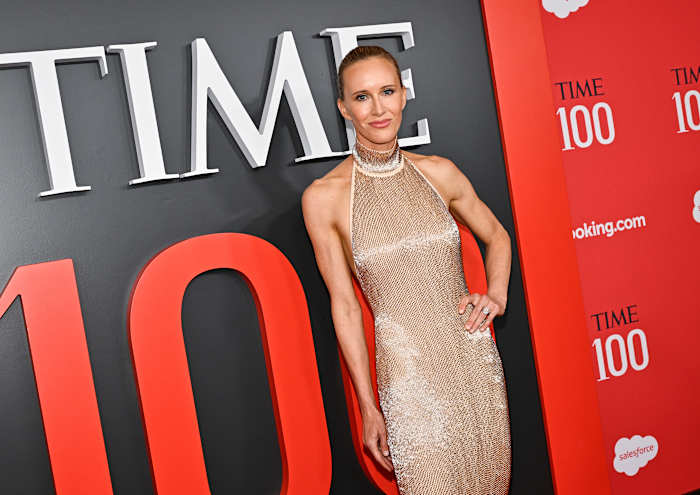


A woman has initiated legal action against Amy Griffin, a noted author and venture capitalist, claiming that Griffin’s acclaimed 2025 memoir, “The Tell,” contains depictions of childhood sexual abuse that were appropriated from her personal experiences.
Identifying herself as Jane Doe, the plaintiff filed the lawsuit on Wednesday in Los Angeles Superior Court. Griffin’s legal representative has dismissed the allegations as “absurd” and “without merit.”
Griffin’s memoir, released last year, details her revelations of suppressed childhood abuse, allegedly uncovered through MDMA-assisted therapy. She recounts being victimized by a teacher during her middle school years in Amarillo, Texas, in the 1980s.
“The memories were irrefutably real to me,” Griffin asserts in her memoir. “My body held the truth of my past.”
The book received widespread acclaim, becoming a selection for Oprah’s Book Club and receiving endorsements from celebrities like Reese Witherspoon and Gwyneth Paltrow.
In her legal claim, Jane Doe argues that the memoir’s accounts mirror her own traumatic experiences involving another teacher, during incidents at a school dance and in a restroom. The lawsuit suggests Griffin had access to this information.
“’The Tell’ constitutes neither a genuine nor harmless memoir,” the lawsuit says, alleging Griffin engaged in intrusion, invasion of privacy, publication of private facts, negligence and infliction of emotional distress. It seeks damages to be determined at trial.
The lawsuit also names Griffin’s publishers and a ghostwriter as defendants.
The New York Times published a story in September raising questions about the book. It included people who expressed doubts about the reliability of the memories. The story also pointed out financial ties between Griffin and the prominent people who helped promote the book.
The plaintiff first learned of the existence of the memoir when the Times reached out to her during its reporting.
“She immediately recognized that the character of Claudia appeared to be based on herself,” the lawsuit says. “She further recognized that a number of stories attributed to the memories of Defendant GRIFFIN that supposedly resurfaced during MDMA therapy were actually her own real life past experiences.”
Griffin’s attorney, Thomas A. Clare, said in an email: “We look forward to exposing these meritless claims in court, as well as the deeply flawed New York Times reporting that is at the center of it.”
“Just like the New York Times manufactured a false narrative about Amy Griffin and ‘The Tell,’ it also engineered the premise for this absurd lawsuit,” Clare said. “After two New York Times reporters instigated this whole situation by bringing the book to her attention, the Plaintiff made her own choice to publicize her narrative to a global audience.” He added, “For its part, the Times took full advantage, publicizing this inaccurate narrative despite receiving many red-flag warnings.”
Danielle Rhoades Ha, a Times spokeswoman, said in response, “We’re confident in the accuracy of our reporting.”
The lawsuit says that when the plaintiff was assaulted at the school dance, she was wearing a dress she had borrowed from Griffin. The lawsuit says the abuse would have been apparent to some people at the dance because of how she left and how she returned. It also says the dress was returned to Griffin with bodily fluids from the assault. The plaintiff also said she asked Jesus for forgiveness for the assault at a church youth group meeting that Griffin attended.
The lawsuit says she met with Griffin for the first time in decades at a California coffee shop in 2019, a meeting that is recounted in the book. But the woman said she did not discuss her sexual assaults during the meeting.
The plaintiff says she did describe the abuse in detail to a talent agent who called her later about her life story. According to the lawsuit, the agent told the plaintiff he learned about her and her stories through an unidentified third party. The lawsuit says the agent stopped contact when she began asking him too many probing questions about him, and that details from the conversations “found their way into ‘The Tell.’ ”
Copyright 2026 The Associated Press. All rights reserved. This material may not be published, broadcast, rewritten or redistributed without permission.