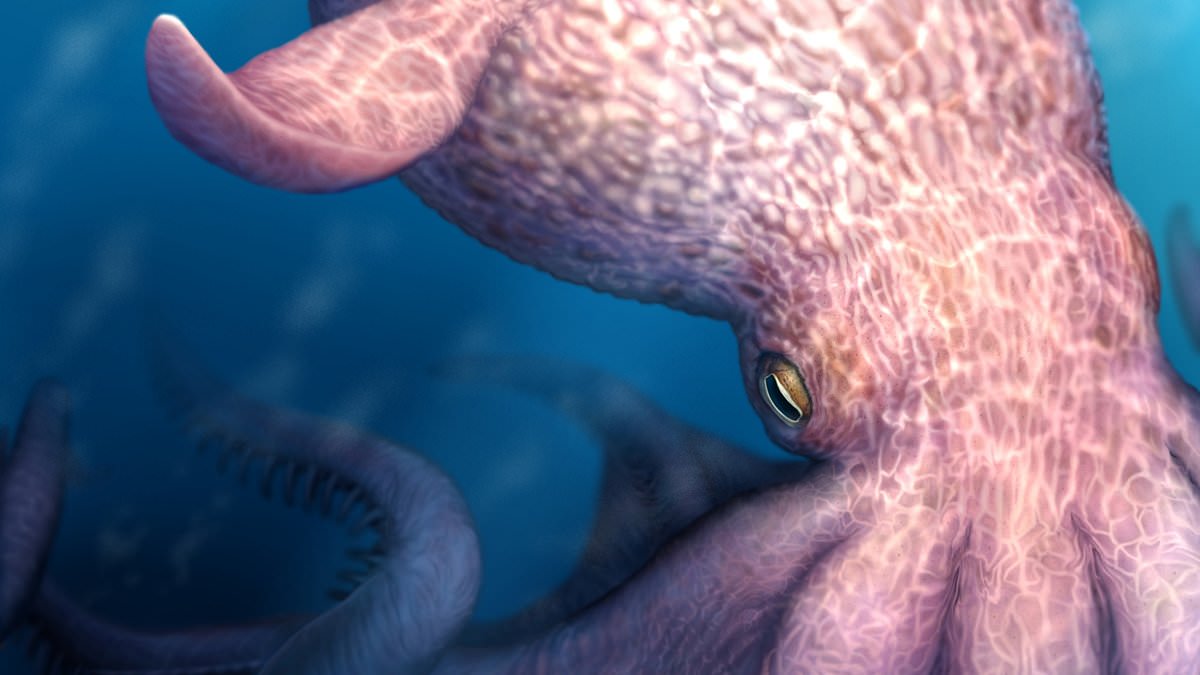

New findings indicate that ancient seas were once dominated by massive octopus-like creatures, resembling mythical krakens, stretching up to 62 feet (19 meters) in length.
Researchers have unearthed signs of these enormous beings that roamed the oceans during the Late Cretaceous period, approximately 72 to 100 million years ago.
These formidable giants not only competed with but potentially hunted large marine reptiles, including the formidable mosasaur, which were considered apex predators of their time.
What makes these creatures particularly intriguing is their evolution toward having soft bodies, a stark contrast to the heavily armored shells of other marine predators.
This evolutionary path may have endowed them with exceptional agility, enhanced vision, and superior intelligence.
The breakthrough came when a team re-evaluated 15 large fossilized jaws from ancient octopus ancestors, leading to the identification of two new species, one of which reached extraordinary sizes.
This species, called Nanaimoteuthis haggarti, featured extensive wear in their jaws, indicating they were active carnivores that routinely crushed hard shells and bones with powerful bites.
It’s also believed they used their long, flexible arms to seize large prey while dismantling it with their strong beaks – a behaviour that has been linked to advanced intelligence.

Scientists have discovered evidence of a colossal beast that hunted the Late Cretaceous seas between 72 and 100 million years ago
‘This extensive wear suggests dynamic crushing of hard skeletons,’ the team, from Hokkaido University, wrote in the journal Science.
‘With a calculated total length of (up to) 62 feet (19m) these octopuses may represent the largest invertebrates thus described, rivalling contemporaneous giant marine reptiles.’
For comparison, humans measure, on average, 5ft6 (1.7m) tall while elephants reach a height of around 10 feet (3m).
This ancient octopus would also have eclipsed a London bus, which comes in at around 36 feet (11m) long.
While it was comparable to the length of a sperm whale, at 66ft (20m) long, it wouldn’t have quite measured up to a blue whale, which can grow up to 90 feet (27m) long.
The other newly–discovered species, called Nanaimoteuthis jeletzkyi, was also a predator but was on the smaller size, growing up to 26 feet (8m) in length.
The researchers said the findings indicate these two species were not merely prey.
Instead, they were highly active participants in shaping marine ecosystems while occupying roles previously attributed only to large vertebrates such as sharks.

The team said the wear and tear found on fossilised jaws indicated they were active carnivores that routinely crushed hard shells and bone
‘In the largest individuals, the jaws showed extensive wear with once–sharp features in small juveniles becoming blunted and rounded over time,’ the scientists said.
‘The long scratches distributed on wide areas of their jaw reflect the dynamic use of the entire jaw for dismantling prey.’
They said that the loss of jaw edges isn’t even on each side, indicating the octopuses had a ‘preferred’ side to chew on.
This has been linked to a highly–developed brain and cognition, indicating ‘that the earliest octopuses already possessed advanced intelligence’.
‘Long after the rise of vertebrate top predators, octopuses evolved body plans capable of rivalling them, as demonstrated here,’ the team concluded.
Researchers previously said the skin patterns that octopuses create while they are snoozing may indicate they are capable of something similar to dreaming.
Like people, octopuses transition between two sleep stages – a quiet stage and an active stage that resembles rapid eye movement (REM) sleep in mammals.
While awake, octopuses create a number of different skin patterns which they use to camouflage themselves in different environments, and in social or threat displays, such as warning off predators and communicating with each other.

The size of N. haggarti compared to other marine predators of the time. A human is also depicted – showing the sheer size of the ancient colossal beast
The animals cycled through these same skin patterns during active sleep, the study found.
Other ancient octopus–like predators include the oldest known ancestor of the vampire squid, that had extra–long suckers and hair–like strands on its arms that it used to trap prey.
This differs from the modern–day vampire squid, which feeds only on organic drifting matter and is not built for active hunting, with less robust suckers.
A research team from Sorbonne University in France used a three–dimensional imaging technique on a 164 million–year–old fossilised specimen of this cephalopod.
They found evidence of muscular suckers on the tips of two specialised, long dorsal arms, suggesting it was an active predatory hunter.