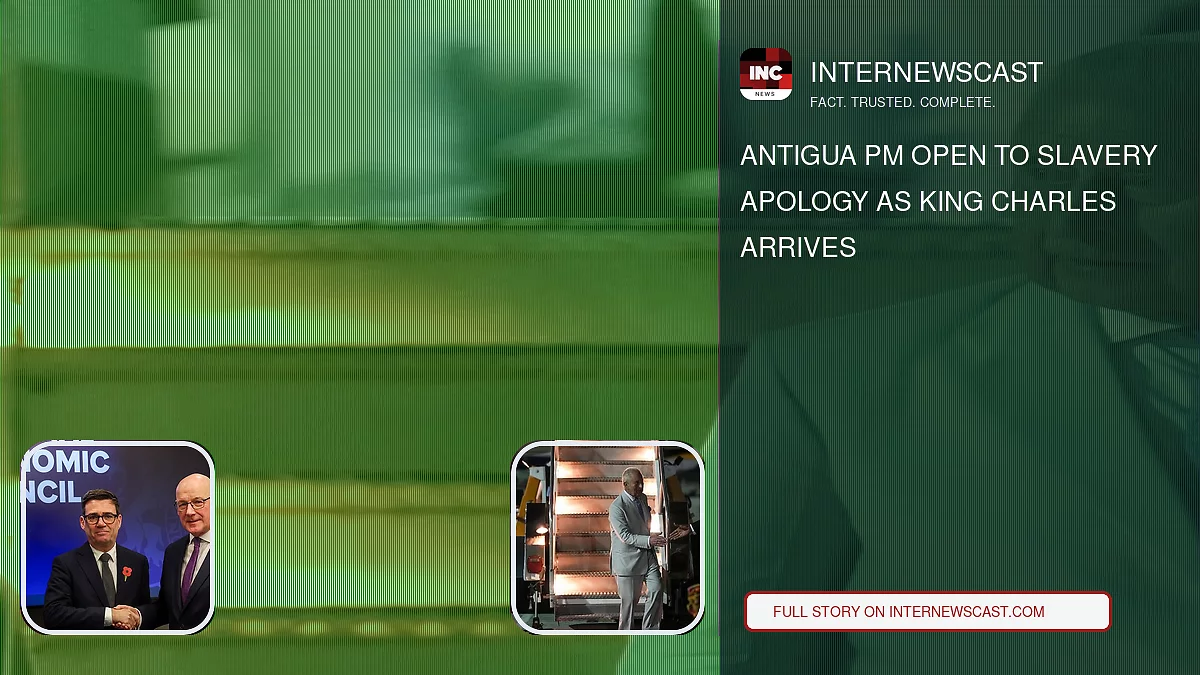

King Charles has arrived in Antigua and Barbuda, the latest stop on his Caribbean tour, as Andy Burnham indicated that the Government may consider issuing a formal British apology for slavery.
In a major shift from the UK’s previous position, the Prime Minister said he was “open” to the possibility of a state apology for Britain’s role in the transatlantic slave trade.
However, he ruled out financial reparations, saying he did not believe they were “the right answer”.
The announcement, made shortly before next week’s Commonwealth Heads of Government Meeting, puts the contentious issue back at the centre of discussions. King Charles is due to preside over the gathering.
Caribbean nations had renewed their calls for Britain to apologise for its role in the slave trade and provide reparations ahead of the King’s visit.
Labour MP Bell Ribeiro-Addy, chair of the All-Party Parliamentary Group for African Reparations, said a formal state apology would “cost nothing” and could help ease what she described as the “stench of Empire” surrounding the King’s tour for many people in the Caribbean.
She told the BBC that the issue had made relations with the monarchy and the UK “problematic” in the eyes of many people.
Bert Samuels, deputy chair of Jamaica’s National Reparations Committee, meanwhile accused Charles of “walking in a crime scene” during his Caribbean visit.

King Charles arrives in Antigua and Barbuda, the latest stop on his Caribbean tour, as Andy Burnham signals that the Government may consider a formal British apology for slavery

King Charles receives a warm welcome from Antigua and Barbuda’s Governor-General, Sir Rodney Williams, although critics say his visit carries a “stench of Empire”
Attention will now turn to Charles’s opening address on Tuesday, when he is expected to speak to presidents, prime ministers and other representatives of the Commonwealth’s 56 member states in Antigua and Barbuda.
The King is guided by ministers on what he can say, meaning his remarks are now likely to reflect the UK Government’s evolving position after years of refusing to issue a formal apology.
Before the tour began, ministers were understood not to have advised Charles to offer either an apology or reparations.
The King did, however, open his nine-day trip last Tuesday by acknowledging the “great suffering of the past” during a speech at a youth rally in the Bahamas.
Mr Burnham told The Guardian that the Government was now “offering a structured dialogue with those affected by the transatlantic slave trade”.
“Listening to calls for a formal apology on behalf of the British state will form an important part of this process and I am open to them,” he said.
Although he said people in Britain today could not “be held liable for historical wrongs, however heinous, that happened in a different age under different laws and in which they played no personal part”, he expressed “sorrow and regret for the pain and suffering of so many millions”.
Charles has faced a difficult tour, including protests during the first leg of the visit in the Bahamas.
Historian Sir Anthony Seldon described the trip as “the most perilous of his reign so far”. He said the King could respond empathetically to the history of slavery, but that offering an apology was not “his right”.
YOU MIGHT ALSO LIKE: 95-Year-Old Holocaust Survivor Wins Emmy in Defiant Message to Hitler
Mr Seldon said the Government’s “change of position in just four weeks”, after ruling out an apology at the beginning of October, could clear the way for a formal apology next year. He told the BBC that the shift might reflect an understanding of how “under pressure and beleaguered” the King has become.
Warning that Charles had “so few cards in his deck” and that there was a risk of a disruptive incident, he recalled that the late Queen had eggs thrown at her twice during visits to the Caribbean. An apology, he suggested, could “take the sting out of it — if it works”.
“There is more at stake here — it is the authority of the monarchy and it is the future of the Commonwealth, with Russia and China nibbling away at it. Putin had an African leaders’ meeting in Moscow last week and China is enormously interested in the new oil and gas reserves in the Caribbean,” he told Radio 4’s Today programme.
Before leaving Guyana for his next destination yesterday, Charles acknowledged the country’s history of slavery and resistance with a sombre visit to Independence Park in Georgetown. The site was where dozens of people involved in the 1823 Demerara Rebellion were hanged.

Andy Burnham, pictured with Scottish First Minister John Swinney on Friday, said he was “open” to the UK issuing a formal apology for its role in the transatlantic slave trade
He paused at the location of the public executions, carried out during the brutal suppression of the rebellion.
Charles also listened as Guyana’s culture minister, Steven Jacobs, outlined the history of the site during the second day of the King’s state visit.
In the early 19th century, as many as 13,000 enslaved men and women working on 60 sugar estates in the British colony of Demerara-Essequibo — modern-day Guyana — stopped working. They mistakenly believed that the British Parliament had passed laws granting them freedom, but that plantation owners and officials were withholding the news.
Governor John Murray imposed martial law, and British troops crushed the peaceful uprising. As many as 500 people died.
Ahead of the visit, Guyana’s President Mohamed Irfaan Ali said Charles had recognised slavery as one of the darkest chapters in human history, but added that an apology would be “the next step”.
Buckingham Palace had previously made clear that the monarch would not apologise for Britain’s role in slavery or discuss reparations, in line with Government policy.
The British government has never formally apologised for slavery or offered reparations.
Mr Burnham described the transatlantic slave trade, during which enslaved Africans were transported to the Americas, as a “brutal and barbaric violation”. He said Britain had to “face up to the past”.
He also acknowledged that Commonwealth countries had been calling for an “honest conversation” for years.
Downing Street believes strengthening the Commonwealth is in the UK’s interests as China and Russia seek to expand their influence across the organisation.
Barbados Prime Minister Mia Mottley welcomed Mr Burnham’s comments, saying she would engage in good faith while continuing to pursue reparatory justice.
Britain played a significant role in ending the trade, with Parliament passing legislation to abolish slavery in 1833.
The legislation also provided compensation to British plantation owners for the loss of their enslaved workers.
The UK did not finish repaying the debt taken on to fund those payments until 2015.
Ms Ribeiro-Addy said Britain had “to acknowledge what the British state did”. She argued that dismissing financial reparations was “too easy”, adding that “no-one had sent the UK an invoice” and that framing the issue solely in financial terms had “stopped the debate”.


