
WASHINGTON — The reshaping of the American political landscape gained momentum this week in both courts and state legislatures, with developments expected to favor Republicans in their bid to maintain control of Congress in the upcoming November elections.
This week saw significant legal activity in Southern states, highlighted by a pivotal state court ruling in Virginia and ongoing repercussions from a recent U.S. Supreme Court decision.
Here’s an update on the current situation.
Virginia court undoes new map drawn to help Democrats
On Friday, the Virginia Supreme Court, in a narrow 4-3 decision, invalidated a Democratic-backed congressional redistricting plan that had gained voter approval in April.
The proposed map aimed to secure Democratic dominance in 10 out of Virginia’s 11 seats in the U.S. House, an increase from their current hold on six seats. This redistricting effort was part of a broader strategy by both political parties to reconfigure electoral boundaries in preparation for the 2026 midterms.
The court’s majority opinion pointed to procedural missteps, noting that the process for amending the state constitution to allow for new district maps was flawed. To place a constitutional amendment on the ballot, it must receive legislative approval twice: once before and once after a legislative election. The court found that the first approval was improperly timed, as it occurred in October after early voting for the general election had already begun.
The result is that the state’s previous maps will remain in place for this year’s elections.
Fallout from US Supreme Court ruling leads to quick redistricting
Multiple GOP-controlled Southern states pushed this week to redraw their congressional maps in the aftermath of an April 29 U.S. Supreme Court decision that struck down a Louisiana congressional district drawn to have a Black majority of constituents.
The ruling was seen as a blow to a provision of the Voting Rights Act that requires political maps to include districts where minority populations’ preferred candidates can win elections.
Louisiana quickly suspended primaries scheduled for May 16 so lawmakers could create new districts. Voting rights activists there packed the statehouse to oppose proposals for new maps that could eliminate at least one of the two current majority-Black districts.
Republicans in Alabama enacted a law Friday that would ignore the results of its May 19 congressional primaries and instead hold a new election – if a federal court agrees to lift an order for the state to have a second congressional district where a majority or near-majority of residents are Black. Republicans currently hold four of the state’s six seats in the House and want to instead use a map that could allow them to win an additional seat.
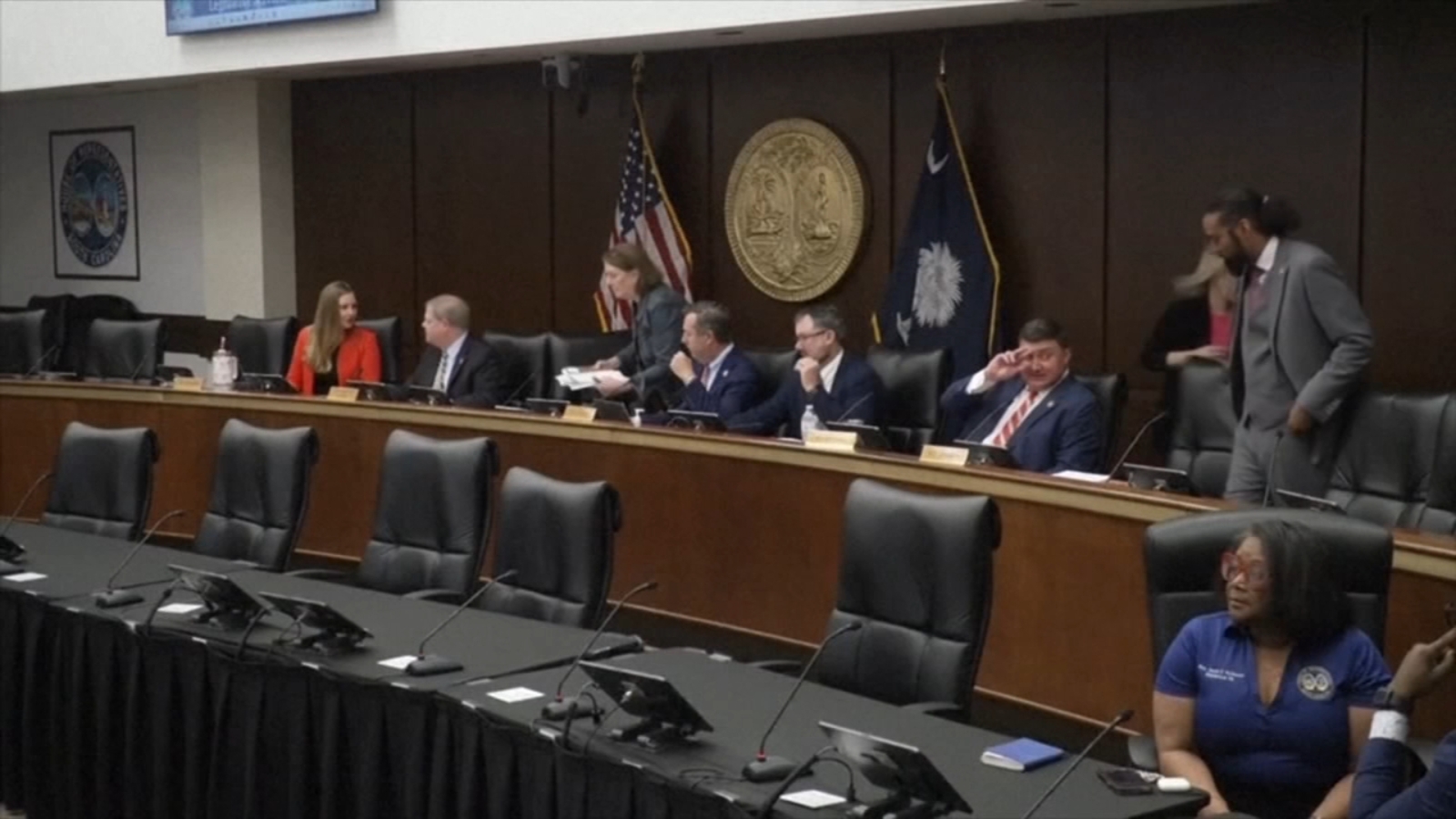
South Carolina’s GOP-dominated legislature met Friday to discuss a proposal to create a new map that gives the party a shot at winning all seven of the state’s House seats. But some worried that breaking up the one Democratic-controlled district could make some other districts vulnerable to Democratic election wins.
Tennessee enacted a law Thursday creating a new U.S. House map that carves up a majority-Black House district in Memphis, the only one now held by a Democrat. That would give Republicans a strong chance of winning all nine of the state’s seats.
The balance of power could be tipping more to Republicans
Normally, House districts are reworked only after results from the once-a-decade U.S. Census are tallied.
This time it’s different.
President Donald Trump urged Texas officials to draw new districts to help his chance of keeping Congress in GOP control after the 2026 midterm elections. Texas officials complied with a plan designed to bring them as many as five new seats.
Democratic-dominated California responded with a map intended to bring them five new seats. Other states have followed. And in the aftermath of the Supreme Court ruling, the pace has picked up, though it’s been mostly in states where Republicans have nearly all the seats already and thus not much room for gains.
Without counting the pending possible map changes in Alabama, Louisiana and South Carolina, the mid-decade redistricting has created 14 more House seats that Republicans believe they could win and six that could give Democrats an edge. Overall, that would mean a potential eight-seat advantage for the GOP ahead of a midterm election, when the president’s party normally loses seats.
But as changes and court challenges play out – along with voters having their say – the results aren’t certain.
Currently, Republicans have 217 seats in the House to Democrats’ 212. There’s one independent member. Five seats are vacant.
Copyright © 2026 by The Associated Press. All Rights Reserved.