

There’s a financial mismatch in New York City’s education system.
Despite allocating a record $43 billion to its public schools and outspending every other major U.S. district on a per-student basis, New York City faces declining enrollments and lackluster academic performance.
The already hefty cost of educating students in the city may rise further as Mayor Zohran Mamdani prepares to unveil his inaugural budget proposal. Currently, the city spends a staggering $44,000 per student, a figure that budget experts and education analysts warn is unsustainable.
This level of expenditure is particularly concerning given that New York City students only achieve average results on standardized math and English tests compared to their peers in other urban districts, according to specialists.
“Despite the city’s $44,000-per-student spending, many schools yield only average results, and more parents are opting for charter schools over traditional public schools,” remarked Andrew Rein, executive director of the Citizens Budget Commission.
“The city needs to prioritize its resources and spending on improving student learning outcomes and reduce expenditures that don’t yield results. This strategy includes aligning school funding with enrollment numbers and consolidating schools that have become too small to operate efficiently,” he added.
But right-sizing Big Apple education could be even more difficult after state lawmakers imposed an expensive class size reduction law, even as enrollment shrinks, critics said.
Gov. Kathy Hochul and her fellow Democrats in the legislature are considering giving the city more time to comply with the law — championed by the teachers’ union — as part of ongoing budget talks.
“The law is unworkable law. It’s impossible to implement,” said Daniela Souza, an education researcher with the Manhattan Institute.
The city’s Department of Education has 157,900 fewer students than a decade ago, but it operates 39 more schools.
And 15% — or 249 of the 1,600 schools — operate below 50% capacity, data shows.
Nearly half of all the city public schools now have fewer than 400 students — with 134 of those institutions educating below 150 students, according to data.
The decline will worsen in the future, a new report from the City School Construction Authority projects.
Enrollment in traditional public schools will plunge by another 153,000 students by 2034-35, falling to 721,251, the report projects.
“The New York City’s Department of Education budget keeps going up while the number of students they’re educating continues to decline,” Souza said.
“School closings and mergers are inevitable.”
New York City spends 50% more per student out of the largest urban school districts in the country, exceeding Los Angeles or Chicago, according to federal data.
But all that spending has produced less-than-stellar results, according to the 2024 National Assessment of Educational Progress, considered “the Nation’s Report Card.”
Only a third of fourth-grade students rated “proficient” in math and only 28% were proficient in reading.
In eighth grade, 23% of city students were proficient in math and 29% in reading.
Many urban school districts are also experiencing enrollment losses from declining birth fertility rates and immigration.
But Big Apple parents are also voting with their feet, looking for better opportunities for their kids elsewhere.
Independent publicly funded city charter schools now enroll 150,500 students in 285 schools, or nearly one in six across the boroughs.
Students in many charter schools perform better on the state’s math and English exams than students in neighboring traditional public schools run by the DOE.
In 2023, New York City spent 61% of its education budget on teacher compensation, compared to 52% in Los Angeles, and 43% in Miami, the Atlantic magazine reported, citing an analysis conducted by the National Center for Educational Statistics.
According to a CBC analysis of data the city spends:
- $35.3 billion on 1,600 K-12 school schools
- $13 billion on teacher/staff salaries
- $8.1 billion on pension contributions, fringe benefits, and debt service.
- $3.5 billion on charter school payments
- $3.1 billion on early childhood programs.
- $1.5 billion on due process cases for special education students and private tuition.
Spending for transportation is $1.9 billion, up from $1.4 billion in 2019.
School facilities/maintenance spending comes to $1.3 billion, up from $1 billion in 2019.
The city spends another $700 million on general contracts, including consultants.
Spending on special education has spiraled out of control, according to city Comptroller Mark Levine.
Costs for “due process” cases — where parents of special education students appeal for placement in private schools to meet their kid’s needs — has skyrocketed from $500 million in 2019 to $1.5 billion currently.
These cases involve lawyers and reimbursement to parents.
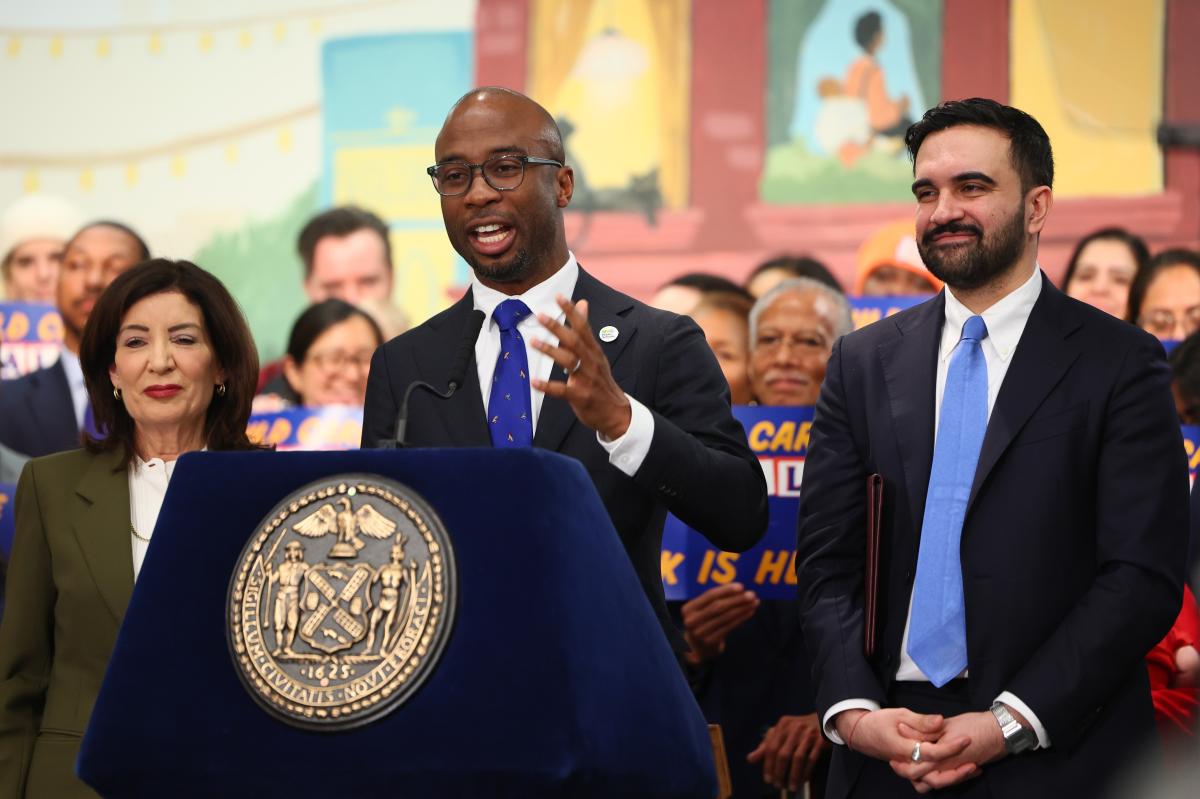
A rep for Chancellor Kamar Samuels and the DOE said the Mamdani administration will address the headwinds but stopped short of proposing major changes.
“There is no better investment than one in our children,” said DOE spokesperson Nicole Brownstein.
“New York City Public Schools always works to ensure that every student has access to a world-class education while spending every dollar thoughtfully and finding savings where possible, and as Mayor Mamdani works to make our city more affordable for families, we are working in tandem to meet the class size law, cut excess spending, and build a school system that sets every child up for lifelong success,”
“Enrollment trends reflect broader demographic trends, including changes in birth rates and population patterns,” Brownstein went on.
“As our city contends with these national trends, we will continue to look for solutions that deliver a robust and diverse education to all students while making sure every school has room to comply with the class size law – community and family driven school utilization changes are an important part of that work.”