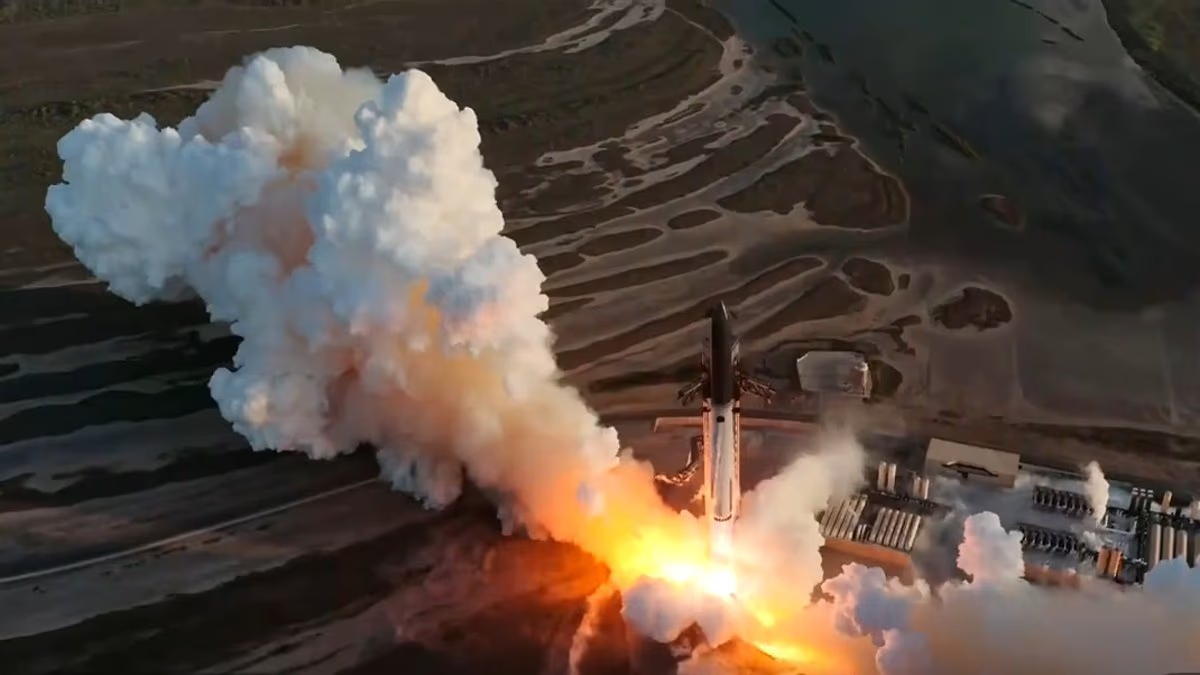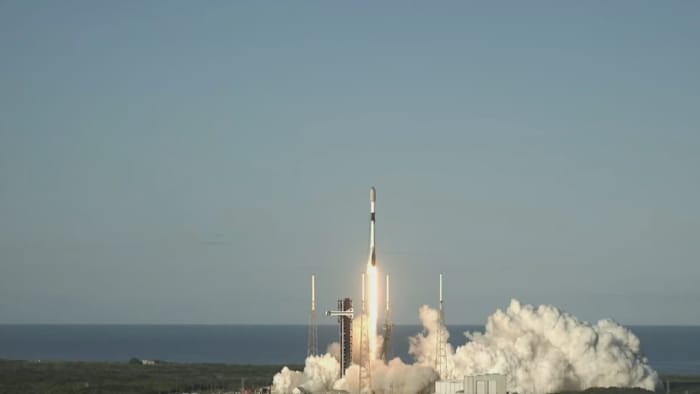


CAPE CANAVERAL, Fla. – SpaceX is poised to launch its Falcon 9 rocket on Tuesday evening, delivering around 6,500 pounds of supplies and scientific experiments to the International Space Station. This mission marks NASA’s 34th endeavor in its Commercial Resupply Services contract.
The launch is scheduled to occur at 7:16 p.m. from Space Launch Complex 40, located at the Cape Canaveral Space Force Station.
The Space Force’s 45th Weather Squadron has forecasted just a 35% probability of favorable weather conditions for the launch. Should conditions prove unfavorable, there is an alternative opportunity on Wednesday at 6:50 p.m.
Residents along Florida’s Space Coast should be prepared for a sonic boom, as the first stage of the Falcon 9 booster is planned to land back at Landing Zone 40 at Cape Canaveral shortly after takeoff.
The Dragon spacecraft involved in this mission has a history of five previous resupply trips to the ISS. The Falcon 9 booster is also a seasoned traveler, having supported missions such as KF-01, IMAP, NROL-77, GPS III-9, and one Starlink launch.
Following a flight lasting approximately 38 hours, the Dragon is set to autonomously dock with the space station’s Harmony module on Thursday at about 9:50 a.m.
Among the highlights of this mission’s science payload are five new experiments. ODYSSEY will examine how well Earth-based simulators recreate microgravity conditions by studying bacterial behavior in space. STORIE will monitor charged particles in Earth’s orbit that respond to space weather and can impact power grids and satellites.
The Laplace experiment will study dust particle movement and collisions in microgravity, with researchers hoping to better understand how planets form. Green Bone will observe bone cell growth on a wood-based scaffold in space, with potential applications for treating conditions like osteoporosis. SPARK will study how red blood cells and the spleen respond to spaceflight to help protect astronaut health on long-duration missions.
Dragon is expected to remain docked to the station for about a month before splashing down in the Pacific Ocean in mid-June. The spacecraft will return an ocular imaging device, a cabin air filtration sorbent bed, a waste system separator pump, and a pressure management device. NASA’s Advanced Plant Habitat — which supported long-duration plant biology research — will also return to Earth for eventual museum display.