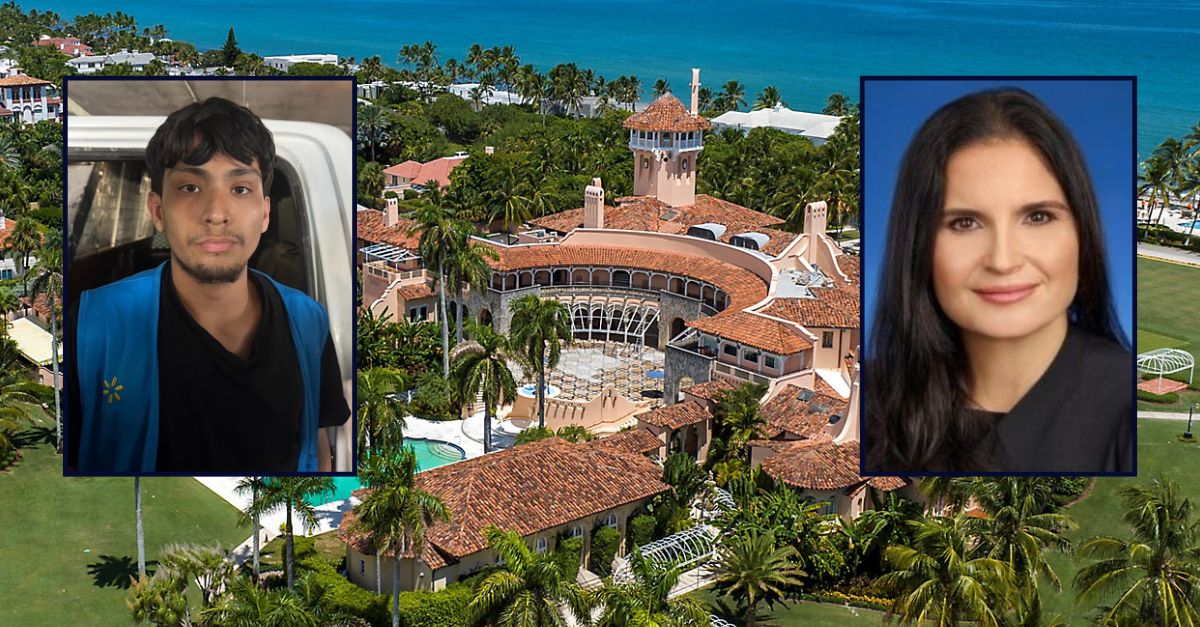

Inset left: Adrian Martinez (U.S. Department of Justice). Inset right: U.S. District Judge Aileen Cannon (U.S. District Court for the Southern District of Florida). Background: An aerial view of former President Donald Trump”s Mar-a-Lago club in Palm Beach, Fla., on Aug. 31, 2022 (AP Photo/Steve Helber/File).
An ex-employee of Walmart, who was taken into custody for demonstrating against an immigration operation in California, has moved to have his federal indictment dismissed. He is leveraging a landmark ruling that recently halted Jack Smith’s Mar-a-Lago case involving former President Donald Trump as part of his legal strategy.
In a detailed 21-page motion, Adrian Martinez’s legal team argued by referencing U.S. District Judge Aileen Cannon’s assessment, which terminated the Trump case. The ruling was based on the assertion that the special counsel’s appointment breached the Constitution’s Appointments Clause.
Martinez is now pushing for the dismissal of his indictment with prejudice, pointing out that federal prosecutor Bilal “Bill” Essayli was deemed unlawfully appointed to lead the U.S. Attorney’s Office for the Central District of California from July 29, 2025.
The charges against Martinez stem from an incident in late June 2025, when he and others protested a Border Patrol operation at a Lowe’s store in Pico Rivera, a city in the southeastern part of Los Angeles County.
Martinez participated in the demonstration during his lunch break, was caught on camera donning his Walmart vest, and subsequently lost his job following his detention and charges of assaulting a federal agent.
However, the initial accusations against him appear to be losing ground.
Martinez, from the outset, has insisted he did not physically attack anyone in the parking lot during the protest that day.
“Mr. Martinez verbally criticized the officers and protested the arrest,” the latest motion reads. “His conduct consisted of speech directed at ICE and Border Patrol officers objecting to the enforcement action.”
Several things happened in quick succession.
On June 18, 2025, a Border Patrol agent issued a memorandum that alleged Martinez “grabbed ahold of [the agent’s] vest and struck [him] in the face with a closed fist.” The motion then characterizes the memorandum as further alleging “Martinez continued to strike the agent and pull items from his vest, allegedly dislodging the agent’s radio, knife, duty magazine, earpiece, hat, and glasses.”
That same afternoon, Essayli posted on X (formerly Twitter): “Adrian Andrew Martinez, 20, of Pico Rivera, the individual in the blue Walmart vest, was arrested for an allegation of punching a border patrol agent in the face after he attempted to impede their immigration enforcement operation.”
Meanwhile, video footage seemed to vindicate the defendant entirely.
“Multiple recordings of the incident circulated publicly after the arrest,” the motion explains. “The footage clearly does not depict that Mr. Martinez struck any agent in the face or engage in the assault described in the June 18 memorandum.”
The filing explains how the video was received, at length:
As reported by Bloomberg Law, the footage “suggest[ed] it was the border patrol agents rather than the U.S. citizen employee, Adrian Martinez, using physical force.” The emergence of this video materially undermined the government’s initial assault narrative and raised serious questions regarding probable cause.
Those concerns were shared internally. Bloomberg Law reported that “Essayli […] rejected office supervisors’ advice not to charge a 20-year-old Walmart employee for assaulting an immigration officer […].” The article further explained that, after video of the arrest circulated publicly, “an FBI agent felt there was insufficient evidence and declined to sign a complaint attesting probable cause to a judge.”
The cited public reporting further quoted Essayli saying that if his office “couldn’t get an agent to sign an affidavit, he’d find one himself.”
And find one he did.
On June 19, 2025, a criminal complaint was filed alleging conspiracy to impede a federal officer. An indictment followed that August.
In the meantime, Essayli was disqualified from serving as acting U.S. Attorney, though he remains in the Golden State office as First Assistant U.S. Attorney.
Now, Martinez hopes this disqualification will inure to his benefit in the same way Smith’s disqualification was a boon for Trump.
The Florida court’s stated upshot was that “the actions of Special Counsel Smith in connection with this proceeding must be set aside.” Case law progeny further elaborated that Smith’s removal led to the case itself failing because the special counsel’s involvement was “essentially ubiquitous” and “critically included his seeking of the Superseding Indictment on which the proceeding hinged.”
Martinez insists the situation is the same in his case.
“The evidence before the Court demonstrates that Mr. Essayli was directly involved in advocating for and personally assuring the charging and resulting indictment in this case moved forward,” the motion argues. “[T]his involvement is reflected in public statements on X and in contemporaneous news reporting, which confirm his participation in the charging process itself.”
The defendant concedes that subsequent courts distinguished the Mar-a-Lago decision by maintaining indictments “where there was no evidence that the unlawfully appointed official participated in the indictments or supervised the prosecutions.” Still, Martinez says, again harkening back to the Mar-a-Lago case, “direct participation in the charging decision, not merely unlawful appointment in the abstract, justified dismissal.”
Martinez then states the idea somewhat differently, saying that courts applying later stages of the analysis “have declined dismissal where defendants could not show interference with the grand jury or prejudice flowing from unlawful supervision.” Here, he says he is not one of those kind of defendants.
“Taken together, these cases establish a clear rule: dismissal is not appropriate where defendants rely on assumption or generalized unlawful supervision, but it is appropriate where there is concrete evidence that an unlawfully authorized official directly participated in advocating for or seeking the indictment,” the motion goes on. “That standard is satisfied here in Mr. Martinez’s case.”
To hear Martinez tell it, Essayli’s involvement in his case is clearly granular and ingrained as evidenced by his efforts to corral an FBI agent to sign off on the charge and his still-extant public comments.
“Mr. Martinez presents affirmative, external evidence, including a public statement on X and contemporaneous news reporting, demonstrating that Mr. Essayli directly advocated for the charging decision and pushed the indictment in this case,” the motion continues. “This evidence places Mr. Martinez’s case squarely within the category of cases exemplified by Trump…The present record strongly suggests that the continuation of the prosecution and resulting indictment were materially influenced by Mr. Essayli’s direct involvement and intervention.”
The motion makes clear that it does not seek to relitigate Essayli’s disqualification, but relies on it as a matter of law.
“Allowing the prosecution to proceed under these circumstances would permit the government to continue relying on an indictment obtained through the material involvement of an individual the Court has already determined lacked lawful authority to act as acting United States Attorney,” the motion goes on. “Under [cases like] Williams, Trump, Giraud, and Bundy, dismissal is therefore the appropriate and necessary remedy.”