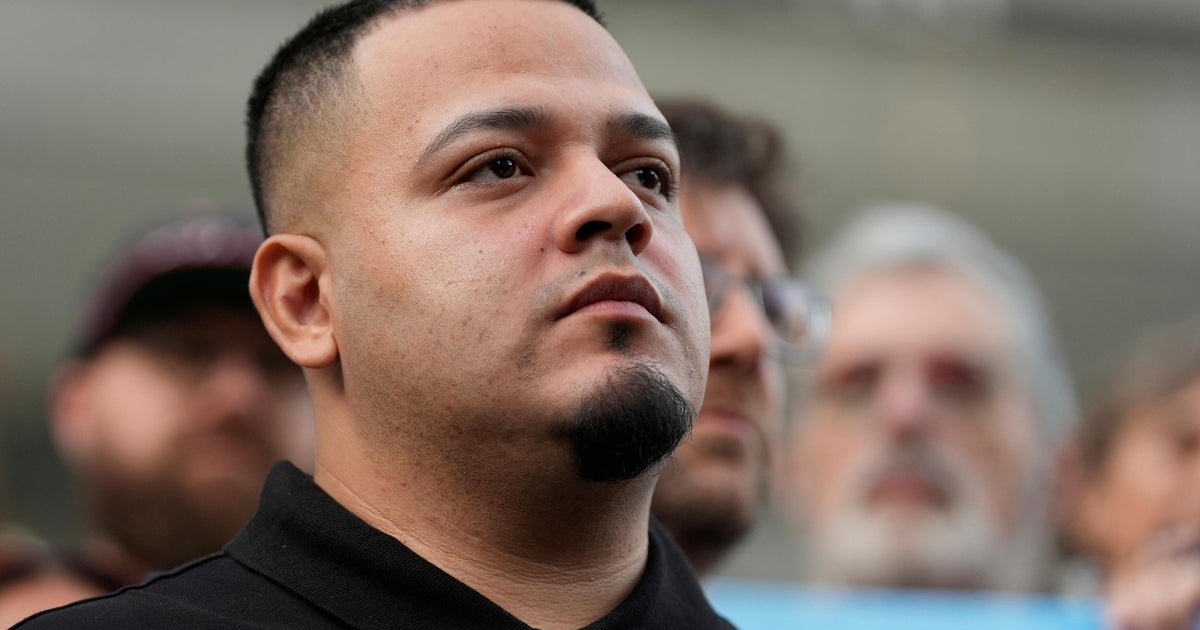

In a noteworthy legal development, a federal judge in Tennessee dismissed charges against Kilmar Abrego Garcia, a Salvadoran national wrongfully deported by the Trump administration. The indictment accused him of human smuggling.
U.S. District Judge Waverly Crenshaw sided with Abrego Garcia, ruling that the Justice Department’s case appeared to be driven by vindictiveness. Previously, Crenshaw had indicated that the prosecution might be retaliatory, placing the onus on the government to counter this presumption.
However, the judge determined that the prosecutors fell short in their rebuttal efforts, stating, “The evidence before this Court sadly reflects an abuse of prosecuting power.”
This ruling marks a significant triumph for Abrego Garcia, whose situation became emblematic of the Trump administration’s aggressive immigration policies.
The charges against him originated from a November 2022 incident in Tennessee, where he was stopped by state Highway Patrol and discovered with multiple passengers in his vehicle. He maintained his innocence to the smuggling allegations.
The indictment followed his March 2025 deportation to El Salvador, where he was initially detained in a high-security prison. Notably, an immigration judge had previously granted him a status that should have prevented his deportation, a misstep acknowledged by a Trump administration official.
Abrego Garcia filed a civil lawsuit in Maryland challenging his deportation, and a federal judge ordered the Trump administration in April 2025 to facilitate his return back to the U.S. The Department of Homeland Security, however, resisted doing so for months, but eventually returned him to the U.S. to face criminal charges two months later.
He has since been intertwined in civil and criminal legal fights, and held on separate occasions by federal authorities in Tennessee and immigration officials in Maryland. He has remained out of immigration custody for several months while his cases proceeded.
The judge’s ruling
“The Court does not reach its conclusion lightly,” Crenshaw wrote. “The objective evidence here shows that, absent Abrego’s successful lawsuit challenging his removal to El Salvador, the Government would not have brought this prosecution. The Executive Branch closed its investigation on the November 2022 traffic stop. Only after Abrego succeeded in vindicating his rights did the Executive Branch reopen that investigation.”
A spokesperson for the Justice Department did not immediately respond to a request for comment on the dismissal.
In the criminal case brought in Tennessee, Abrego Garcia and his attorneys argued that he was unfairly targeted by the federal government because of the civil lawsuit that successfully challenged his removal to El Salvador.
During a nearly six-hour hearing in February, members of Abrego Garcia’s defense team questioned two government witnesses on when the Justice Department decided to move to indict him, and whether anybody at the White House, the Justice Department, or the Department of Homeland Security were directly involved in those discussions.
The U.S. attorney who was then leading the prosecution, Robert McGuire, said he decided to bring charges years after the initial traffic stop because “the evidence pointed to Abrego Garcia having committed a crime.” McGuire also insisted it was his decision to prosecute Abrego Garcia and no one else’s, adding that no one instructed him to do so or directed him to seek an indictment.
Abrego Garcia’s legal team, however, showed internal emails from a high-level Justice Department official, Aakash Singh, that suggested there was significant interest in charging Abrego Garcia after he challenged his deportation, including one that referred to the case as a “top priority.”
In his opinion, Crenshaw said he found “insufficient evidence of actual vindictiveness,” but concluded that “the Government has failed to rebut the presumption of vindictiveness.”
The record in the case, Crenshaw said, “does not explain the Government’s change in position to remove Abrego and not prosecute him to then prosecute and not remove him,” adding there is a “retaliatory taint” that kicked off the renewed investigation into Abrego Garcia.
The judge wrote that the “objective evidence” comes close to showing that “but for Abrego’s lawsuit,” the Justice Department would not have indicted him. Crenshaw wrote that statements by then-Deputy Attorney General Todd Blanche and the involvement of Singh, who is an associate deputy attorney general, “directly tie Main Justice” to reopening of an investigation into the 2022 traffic stop in Tennessee in response to Abrego Garcia’s successful challenge of his deportation. Blanche is now the acting attorney general.
“The objective credible evidence shows that Main Justice was involved in the investigation before McGuire,” Crenshaw said, adding Singh’s involvement in the case “touched on everything from the timing of the indictment to the substance of the potential charges.”
The judge said Singh’s “sustained oversight” demonstrates the main Justice Department’s connection to the indictment against Abrego Garica.
“Notwithstanding McGuire’s purported belief that he was the sole decisionmaker, this Court cannot ignore the chain of command that McGuire reported to: Singh, Blanche, and then Bondi,” he wrote, referring to former Attorney General Pam Bondi, who was ousted last month.