

“Objection, your Honor!”
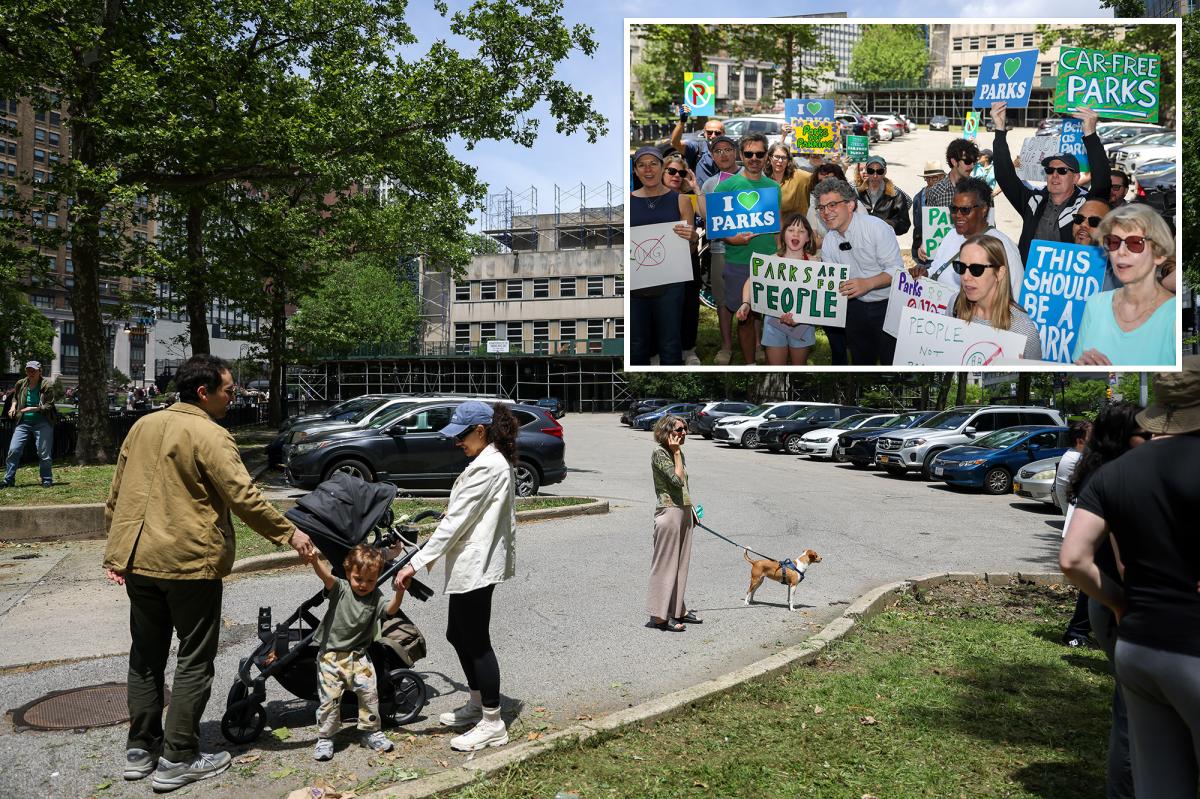
On Sunday, a large group of Brooklyn residents gathered to demand that the city finally convert a downtown parking area, currently used by judges, into the parkland it was originally intended to be.
For many years, these legal professionals and their teams have occupied roughly 36 parking spaces, covering what should be Columbus Park with concrete, and they have consistently resisted change, according to local City Council member Lincoln Restler, who spoke to The Post.
“Generations of judges have prioritized their own convenience, selfishly neglecting the community’s best interests,” Restler stated during the demonstration.
“In recent years, our community has experienced a surge in development, yet we have not seen the accompanying park spaces that should have been provided.”
“This is our chance to address that imbalance,” he concluded.
Downtown Brooklyn’s judges already have access to 250 free parking spots in the immediate area, including 170 reserved on-street spots and 80 more spaces in a city-built parking garage two blocks away, Restler said.
At the same time, more than 25,000 housing units have been built in downtown Brooklyn in recent years, leaving new neighbors scrambling for more coveted green space, locals said.
“Every summer when I walk by and it’s incredibly hot, I find myself wishing there was the shade of more trees here with some grass to cool off,” said Cobble Hill resident Kate Blumm.
“It just makes sense to me that this [park] can serve more members of the community. … It seems like a win-win for pretty much everyone.”
It’s no surprise the judges have already made a legal case out of the mess.
In July, the judges took the city and then-Mayor Eric Adams to court over claims his administration violated a 2008 agreement requiring the city seek the judges’ approval before planning to remove the parking spaces.
Restler said the alternative on-street and private parking options he has pitched — including at Brooklyn Law School, a Marriott hotel and a residential co-op building nearby — are more than adequate.
He said a change in the city’s mayoral administration has made him “hopeful” the project will come to fruition at last.
“I think [the judges] are very powerful,” he said. “And I think many elected officials in previous administrations have been fearful of taking them on, because who’s to know the next time that any of us might end up in a courtroom in downtown Brooklyn … and maybe it might not be looked upon as favorably.”
The councilman said that if the judges remain standoffish, he plans to pitch a citywide review of all of the judges’ parking spots to determine which spaces are truly necessary.
“Our community desperately needs green space … we can do this nicely, or we can do this the hard way,” he told the crowd at the rally.
“It’s time for us to evict the judges,” he said. “Many of these judges live [within] walking distance.
“They can damn well take the subway.”
Downtown Brooklyn and its surrounding neighborhoods are only composed of about 6% parkland compared to a 23% citywide average, said Kathy Park-Price of the New Yorkers for Parks advocacy group at the rally.
Columbus Park “would serve thousands [if converted to green space] versus the few dozens that it serves by being a parking lot,” she said.
“This is an emergency. … We can’t have more development without maintaining, expanding [and] improving our existing parks.”
Under an $80 million proposal, Columbus Park would be transformed into a 8-acre park with a lawn, pavilion and garden.
So far, Restler has secured $21 million of the funding — but whether the judges will agree to the plan remains up in the air.
“No alternatives have yet been proposed that would provide adequate security for our judges,” said Al Baker, a rep from the New York Office of Court Administration, told the New York Times earlier this year.
The article listed increased threats made against judges as the prime reason to hold onto the parking lot.
A Post request for comment from the office was not returned.