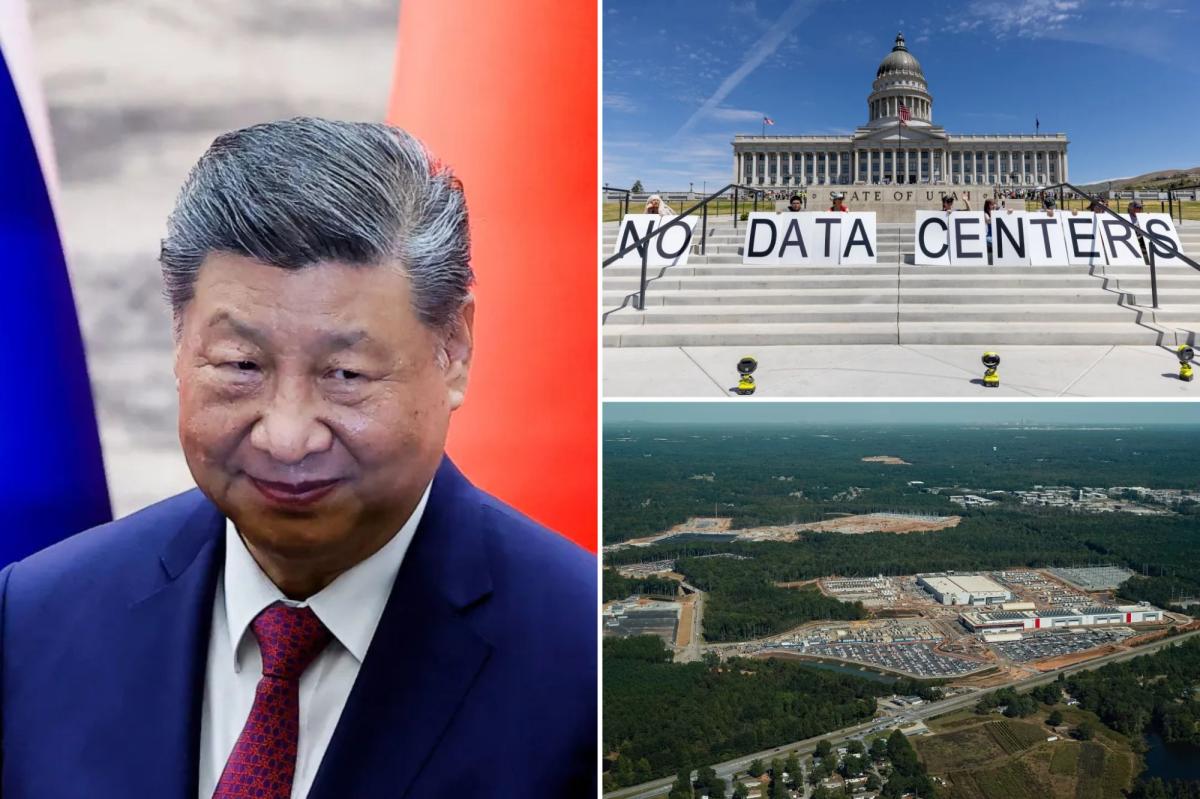


WASHINGTON — A recent warning from the House Energy and Commerce Committee highlights evidence indicating that China, along with other foreign rivals, might be orchestrating campaigns against data centers to hinder the U.S. in the race for artificial intelligence supremacy.
In a newly penned letter directed at the Trump administration, lawmakers on the committee have called for increased scrutiny into potential connections between China and anti-AI factions within the United States. They express concern that such foreign interference could jeopardize America’s leading position.
“Our nation is engaged in a critical contest with China to drive innovation and lead globally in the development of AI technologies,” explained Brett Guthrie (R-Ky.), Chairman of the House Committee on Energy and Commerce, in a statement to The Post.
“The potential involvement of Chinese Communist Party-backed organizations and other foreign adversaries in influencing decisions concerning American data center infrastructures underscores the gravity of this competition,” he added.
Guthrie, along with John Joyce (R-Pa.), Chairman of the Subcommittee on Investigations, and Bob Latta (R-Ohio), Chairman of the Subcommittee on Energy, referenced recent analyses by the Bitcoin Policy Institute (BPI) and Power the Future (PTF).
The BPI report asserts that “international entities are leveraging state media platforms, nonprofit networks, and opaque funding groups to sway U.S. policies and public perception regarding artificial intelligence.”
One example mentioned in that report was the network of nonprofits and outlets bankrolled by Neville Roy Singham, a Shanghai-based US expatriate.
Singham, who is married to Code-Pink founder Jodie Evans, previously faced government scrutiny for “activities inimical to the US.” Republicans in Congress have also long been probing Singham’s influence network in the US.
BPI cited an analysis that Singham pumped some $278 million across six American nonprofits between 2017 and 2023.
The Committee on Energy and Commerce sent a missive to President Trump’s Council of Advisors on Science and Technology and the FBI, seeking information about foreign influence campaigns to undermine US development of AI.
“Americans deserve to know who is bankrolling the disinformation campaign that seeks to block critical infrastructure investments,” Guthrie contended to The Post. “Data centers are the foundational computing structure that makes modern life possible.”
“Our adversaries in Beijing fundamentally understand this.”
The GOP lawmakers highlighted Sen. Bernie Sanders’ (I-Vt.) and Rep. Alexandria Ocasio-Cortez’s (D-NY) AI Data Center Moratorium Act, which would impose a nationwide pause on the construction or renovation of data centers.
Several Trump administration officials, such as Secretary of the Interior Doug Burgum, have expressed concerns that China is helping to gin up anti-AI sentiment in the US.
“Any place that’s trying to build data centers is getting bombarded with foreign-directed propaganda to try to block these from being built,” Burgum told Fox Business Network last month. “This is just another attack on the US and our ability to be competitive.”
Data centers provide the critical processing power for parsing through massive amounts of data needed to train and run AI models. Activists have criticized the explosion in data centers because they are energy guzzlers that can cause electric bills to spike. But AI experts say that without them, the US won’t be able to advance the nascent technology.
Critically, support for development of data centers is waning across a variety of polls.
For example, in 2023, 69% of Virginians supported construction of new data centers, but that dropped to 35% this April, a Washington Post-Schar School poll found.
The lawmakers say the issue is serious enough to warrant a federal investigation, and they are seeking a briefing from the Trump administration by June 18 on the steps being taken to combat foreign influence campaigns against AI development within the US.
“The U.S. is in a global race for technological superiority that has significantly raised the stakes for economic and national security if our nation falls behind,” the lawmakers stressed in the letter.
“It is critical that this Administration takes any effort to undermine this objective—particularly from foreign adversaries—with a great deal of seriousness.”