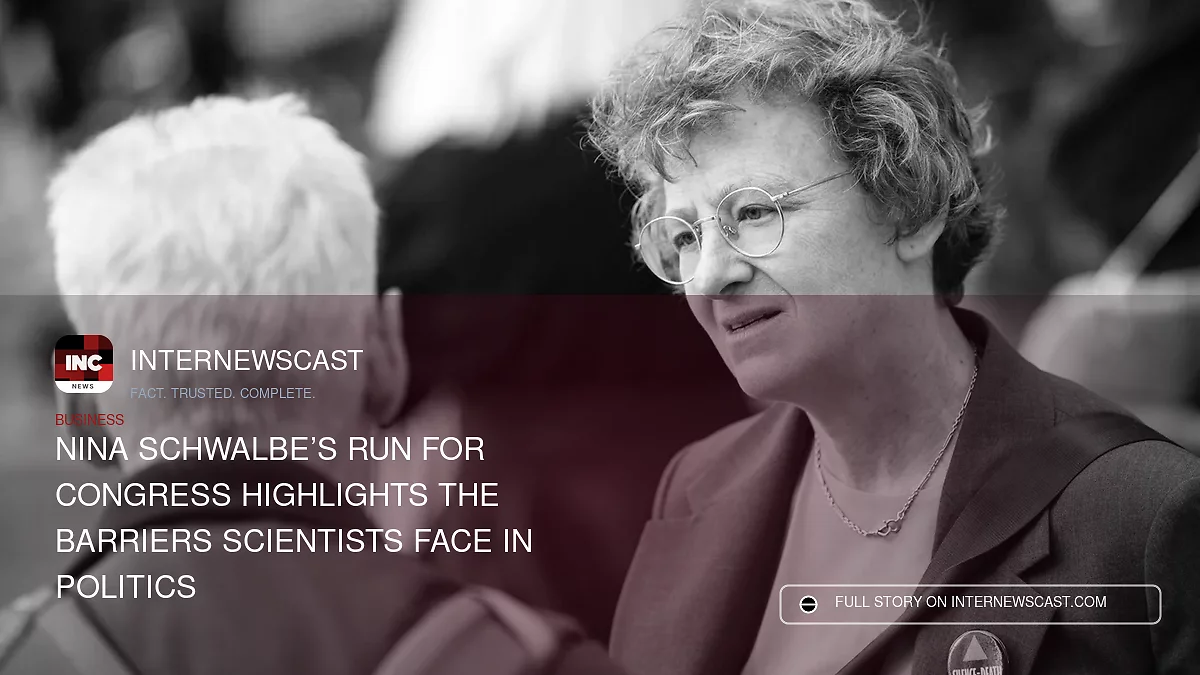


Veteran public health leader Nina Schwalbe, MPH, PhD, pictured at right, is seeking the Manhattan 12th Congressional District seat being vacated by retiring U.S. Rep. Jerry Nadler (D). (Photo: Maxim Shapovalov)
Maxim Shapovalov
The premise sounds straightforward: In a democracy, people who want government to do more to protect public health can run for office themselves. That is the path Nina Schwalbe, MPH, PhD, a longtime public health professional and leader, says she is pursuing as she campaigns to replace retiring U.S. Rep. Jerry Nadler (D) in Manhattan’s 12th Congressional District. But Schwalbe, whose background is rooted in science and global health rather than traditional politics, says her campaign has exposed barriers that may help explain why more scientists do not make it to Congress.
Schwalbe Was First Motivated By Trump Administration’s Cuts To Public Health And Lack Of Congressional Action
“What first motivated me to run for Congress is when [U.S. President Donald] Trump withdrew the U.S. from the World Health Organization and fired 200,000 plus of our peers from CDC, NIH, FDA and USAID, who all do basic functions that are required to keep people safe and healthy,” Schwalbe told me. “And then when I tried to call our Congress people, they just weren’t paying attention.” I have continued to report in Forbes on the ongoing reductions in federal health funding and personnel, the U.S. withdrawal from the WHO, threats to university funding and questions surrounding policies advanced by Health and Human Services Secretary Robert F. Kennedy Jr.
Schwalbe brings decades of experience in public health leadership. Her résumé includes serving as director of policy at the Global Alliance for TB Drug Development, deputy executive secretary and managing director for policy and performance at GAVI, and principal adviser and acting chief of health at UNICEF. In a recent piece in the scientific journal The Lancet, Faith McLellan described Schwalbe as a “global health expert and advocate” whose work has spanned complex global health challenges, from HIV and tuberculosis prevention to pandemic treaty negotiations. That is not the kind of profile typically featured in coverage of congressional candidates. It also means Schwalbe has a clear sense of what large-scale layoffs across federal science and health agencies could ultimately mean for Americans’ health.
Problems In Identifying The Cause Of An Infectious Outbreak Further Motivated Schwalbe To Run For Congress
Another turning point, Schwalbe said, came during an infectious disease outbreak in the Democratic Republic of Congo in February and March 2025, when the cause had not yet been identified. She said she was alarmed by the difficulty officials appeared to have in pinpointing the virus behind the outbreak — a troubling development, she argued, in light of the COVID-19 pandemic only a few years earlier.
“So I tried to call our Congress people, and they just weren’t listening, they didn’t care,” Schwalbe recalled. “Finally, I got [U.S. Senator Kirsten] Gillibrand’s office because she’s on the Senate foreign relations committee and has a particular interest in DRC. Then, they called the CDC, then engaged with the WHO, but that took way too many calls.” Schwalbe added, “With a lot of experiences added up like that, I realized that they had lost the plot. Nobody was following this.”
That experience helped push her toward a congressional run. “I started to think about [running for Congress] in spring 2025 and over the summer, and then I thought I would run as just a challenger to Nadler to bring up public health, to raise these issues on mistakes,” Schwalbe said. “Then Nadler decided to step down and then the whole thing changed. I spoke with a bunch of people who said I should run because we needed this voice.”
You know the song “Wake Me Up When September Ends?” Well, it was September 2025 when Schwalbe decided in earnest to run for Congress. She then entered a Democrat field that is currently led by four men who have much more traditional backgrounds as political candidates. Two of them are current New York Assemblymembers: Micah Lasher and Alex Bores. One of them is a former Republican, who garnered a fair amount of press when he turned anti-Trump despite his wife’s position in the first Trump administration: George Conway. And the last of the four, Jack Schlossberg, happens to be the grandson of President John F. Kennedy.
People Have Told Schwalbe That More Scientists Are Needed In Congress
It doesn’t take a scientific study to realize that scientists in general comprise only a very small percentage of the 119th U.S. Congress. For example, of the 535 voting members of Congress, only nine are engineers, one is a physicist, one is a chemist, one is a geologist and 30 are physicians. Every day Congress makes decisions that are science-related with direct scientific experience and knowledge in such short supply. Isn’t that kind of like getting a bunch of non-athletes to play for the U.S. FIFA World Cup team?
Schwalbe emphasized how scientists “are really good at solving complex problems. And that’s an approach which is helpful across multiple fields. Our method of inquiry is really helpful and I don’t think people really appreciate that.” She expressed concerns that politicians won’t necessarily know what laws need to be passed in health and public health, “how such laws should be implemented and how do you check and make sure that they’re implemented with the intended effect.”
And the cuts to science and health made by the Trump administration have certainly cut across many different sectors in many different ways. “Almost everybody I speak to is concerned that science has been cut,” Schwalbe related to me. She spoke of people losing jobs, not being able to find jobs, labs and studies getting cut, and “stories all day about ‘grandma was in a clinical trial for a treatment, and the trial was stopped midstream.” She told me, “People will stop and say, ’Oh, you’re the scientist. We need a scientist. We need a scientist in Congress.”
Schwalbe Found How Much Money And Connections Talk When Running For Congress
Nancy Goroff, PhD, a former chair of the chemistry department at Stony Brook University ran for the New York’s 1st congressional district seat in 2020 but lost to the incumbent, Lee Zeldin (Photo by Chris Ware/Newsday RM via Getty Images)
Newsday via Getty Images
Scientists may have problem-solving skills, insight and knowledge in abundance. But one thing they may not have in abundance is moolah, which is a technical term for money. “When I asked people how much money would I need to raise, a lot of people said like $3 million,” Schwalbe recalled. “I was like, well, that’s not gonna happen.” She indicated that everyday people “don’t realize how much of a money-run enterprise politics and running for office is, and it’s really crummy.”
The other big “c” besides “cash” and “crummy” is “connections.” Schwalbe lamented, “It’s really about whom you know, as all the endorsements come from people. You had to have had long relationships with people. There’s no sort of fair playing field here.”
Nancy Goroff, PhD, a former chair of the chemistry department at Stony Brook University who also ran for the New York’s 1st congressional district seat in 2020 but lost to the incumbent, Lee Zeldin, confirmed Schwalbe’s observations: “In order to get elected, one needs to raise millions of dollars. Candidates with large networks of wealthy friends are at a huge advantage, and most scientists do not have that kind of network.”
Scientists Like Schwalbe Face Additional Barriers To Get Into Congress
Angela Merkel (R), who served as chancellor of Germany from 2005 to 2021, holds a doctorate in quantum chemistry and spent over a decade working as a research scientist in East Germany before transitioning into politics. (Photo by CHRISTIAN HARTMANN/POOL/AFP via Getty Images)
POOL/AFP via Getty Images
Besides money, Schwalbe mentioned another “m” that can be a big barrier for scientists, namely the machine. “The Democratic machine is very much about protecting current interests,” she said. “There’s a lot of quid pro quo and deal making. And public health is so invisible. People really don’t understand what it is or how it works.”
Goroff pointed out something else “s”-y about what scientists have to face, that’s stereotypes. “Scientists running for office also have to contend with the stereotypes that voters and donors have about what a scientist is,” Goroff related. “There are positive associations and negative with being a scientist, and since there are so few in politics, any science candidate has to carry all those stereotypes, whether or not they fit.” Such stereotypes can be like some fruitcakes (not all, of course) in that they can be rather nuts yet weigh down the candidacies of scientists for leadership positions. In reality, though, you can find many world leaders past and present with deep scientific backgrounds such as the current presidents of Mexico (Claudia Sheinbaum) and China (Xi Jinping), the former chancellor of Germany (Angela Merkel) and of course many of the U.S.’s Founding Fathers like Benjamin Franklin Thomas Jefferson, John Adams, James Madison and George Washington.
Yeah, that last bunch of scientists was kind of successful in founding and growing this whole America thing. Why then wouldn’t people find scientists to be effective at leading it now?