
Warnings about artificial intelligence have dominated the public conversation for years, often centered on fears that the technology could displace workers, destabilize industries or, in the most extreme scenarios, threaten humanity itself.
But a separate technological race is drawing far less attention, despite its potentially sweeping consequences: quantum computing, a field many scientists believe is nearing a major breakthrough.
Rooted in the principles of quantum physics, the technology is being pursued aggressively by major US players including Amazon, IBM, Google, Nvidia and others. If fully realized, it could dramatically expand what computers are capable of doing.
Google recently offered a glimpse of that potential, saying its Willow quantum chip completed in five minutes a computational task so complex that today’s most advanced supercomputers would need roughly 10 septillion years to solve it, according to one of the company’s blog posts.
The promise, however, comes with serious risks. “Quantum computers are exceptionally good at breaking codes,” John Preskill, Caltech’s Director of the Institute for Quantum Information, told The Post.
Preskill warned that once quantum machines become powerful enough, the encrypted systems people rely on every day — from entering credit card numbers online to securely connecting to websites — may no longer be safe.
That possibility has raised concerns about who controls the technology. In the wrong hands, quantum computing could become a major security threat, and China and Russia have both been open about their ambitions in the field.
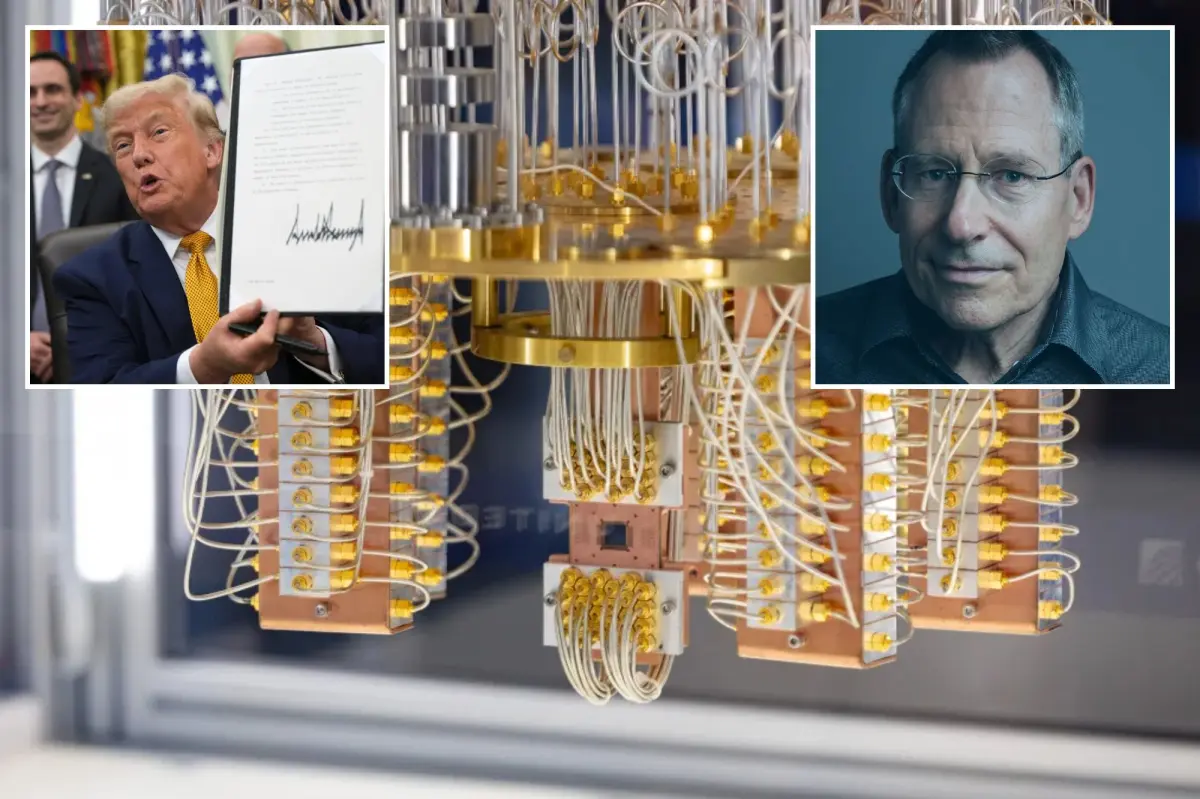
The rapid pace of development has already prompted action in Washington. On Monday, President Trump signed two executive orders aimed at accelerating federal work on the experimental technology, including a directive to fast-track a US government supercomputer and build “the first-ever quantum computer powerful enough for scientific research” within two years at a federal laboratory.
He also anticipated a looming global telecommunications security crisis by ordering quantum-safe security updates to “high impact systems” by 2031 — stepping up a previous deadline of 2035.
Google agrees with that thinking, announcing in April that “Q-Day,” the moment when quantum computers will be able to crack general encryption, is rapidly approaching — possibly as soon as 2029.
Today’s computers are binary, processing data strictly as sequential 0s or 1s, called bits. In physical terms, a bit is like an incredibly tiny electronic light switch — open represents 0, closed represents 1. Billions are packed onto a single silicon microchip, allowing computers to store data, run software, and display everything you see on your screen.
Quantum computing uses a unit called a qubit to process information in multiple states simultaneously. Rather than a 1 or a 0, a qubit can be both at the same time—called superposition— which is best compared to it being like a two-sided coin spinning, versus one being flipped from one side to the other.
It means quantum systems can analyze vast combinations at once, solving millions of complex problems simultaneously, rather than having to go through each one, as computers do now.
“To translate the information that just a few hundred qubits stores, you would need more [traditional] bits than the number of atoms in the visible universe, which will never be feasible,” explained Preskill.
ALSO READ: Former Mafia Hitman Turned New Jersey Councilman John Alite Arrested in Loan Sharking Case
In the same way the first computer researchers in the 1950s had colossal, room-sized machines powered by thousands of glowing vacuum tubes and could in no way predict tech like the iPhone, today’s quantum computer researchers tell The Post they have no idea where all this will lead — only that it will be a sea change for human civilization.
However, a quantum computer won’t fit in your pocket. Today’s machines are also room-sized contraptions, where components need to be cooled in giant cylinders to near absolute zero.
Lasers and microwaves are then used to contain and manipulate the qubits, which must be completely isolated from the outside world. Even noises and smells interact with them.
“In the 1940s the Chief Technology Officer of IBM said there will never be a market in the world for more than six computers. I have six in front of me right now,” Chris Ferrie of the University of Sydney’s Center for Quantum Software in Australia told The Post.
“The large [quantum computers] will be used to do big computations. I think that’s where medicine comes in. But if quantum computers become available to the general consumer then what happens is something experts can never envision or predict,” Ferrie added.
Most agree powerful new computational ability will be immediately useful in creating new materials and chemical catalysts, like pharmaceuticals.
“The promise is we can design drugs atom-by-atom, building up molecules and then testing what happens when they interact with other molecules.
“If we have the ability to control atoms, we can mimic what they would look like if they behaved like a specific molecule. This is something we know how to do today, but don’t have the computational ability to do,” said Ferrie, who wrote the book “Quantum Computing for Babies.“
Despite a recent $2 billion injection of government funding to quantum computer development last month, the US lags behind China, which, according to some researchers, has pumped $12 billion of state funding into quantum computers.
That rapid development lead to warnings from the US Defense Intelligence Agency in its 2025 Worldwide Threat Assessment.
The good news is quantum-safe tech already exists, thanks to an eight-year-long global competition hosted by the US Department of Commerce‘s National Institute of Standards and Technologies (NIST) to develop ultra-secure mathematical formulas.
After years of public testing, NIST officially published the world’s first quantum-resistant encryption standards in 2024.
But it may be too late for many most of the world’s digital secrets, warns Ferrie, which could be saved in their current encrypted state by nefarious actors then, once they have access to a quantum computer, broken into.
“Nothing will ever be 100% safe and secure. It’s all about making it hard enough so someone else won’t make the effort to crack in,” said Ferrie.
“I think when you adopt that point of view life gets a bit easier. You stop chasing 100 percent security and you learn to deal with uncertainties. That’s the life lesson quantum computing has taught me.”