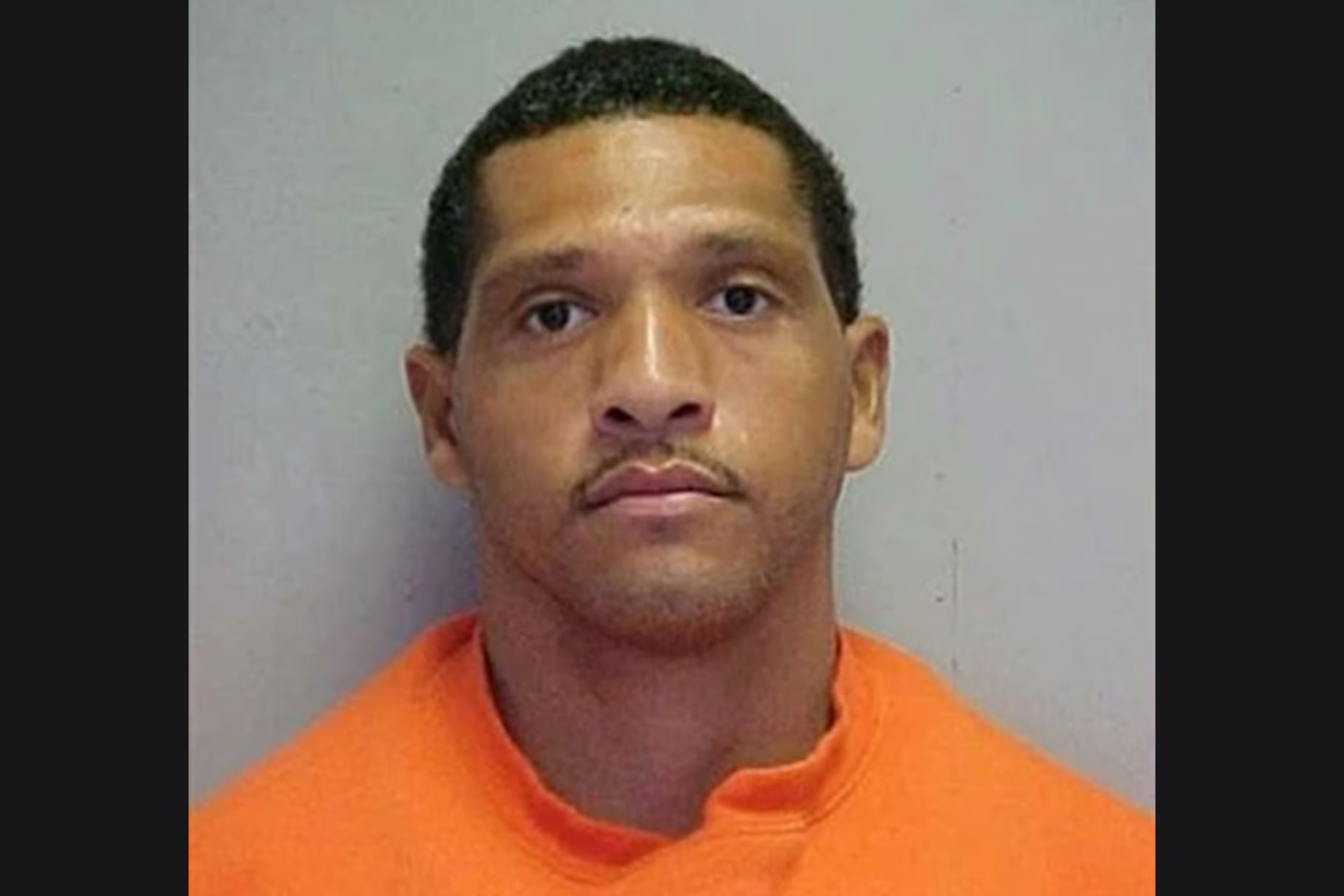

Phoenix was facing a chilling contest between serial killers.
As the Phoenix Baseline Killer targeted women—and one man—in a series of brutal attacks across the city in 2006, another pair of killers appeared determined to create a deadly reputation of their own.
Investigators featured in Oxygen’s Unknown Serial Killers of America dubbed the pair the Serial Shooters. They randomly gunned down innocent people, apparently trying to surpass the Baseline Killer’s growing body count.
“It appeared that when the baseline killer struck,” retired Phoenix homicide Sgt. Michael Palombo explained, “there would be a series of random shootings thereafter, because these serial shooters were in a body count race.”
Detectives believed the killings may have been driven, at least in part, by a desire to attract more media coverage.
“I believe they started to step up their violence,” retired Phoenix detective Clark Schwartzkopf said, “to get more attention to what they were doing.”
With multiple killers operating in the area, investigators faced a race against time to identify the perpetrators and stop the violence.
Phoenix’s Baseline Killer Targets Preschool Teacher, Woman at Apartment
The Baseline Killer investigation began on December 12, 2005, when preschool teacher Tina Washington was found lying in a pool of blood in an alley behind a sandwich shop. She had been shot to death with a .38-caliber weapon.
Her blouse had been pushed up and her pants unzipped, but investigators found no evidence that she had been sexually assaulted.
“We still believed that this is a sexual crime of violence,” Palombo said. “It appeared that the suspect fondled her in some manner, but it did not necessarily involve sexual penetration.”
An employee at the sandwich shop told police he had gone into the alley and spotted a woman on the ground with a man on top of her. The attacker was wearing a wig and hat as a disguise. After seeing the employee, the suspect pointed a gun and pulled the trigger—but the weapon failed to fire. The employee escaped and called 911.
The killer also took a ring Washington had received from her sons. Their names were engraved inside it.
When police entered the ballistic evidence into a national database, they discovered that the same weapon had been used four months earlier to kill Georgia Thompson in Tempe. Thompson was found shot in the parking lot of her apartment complex, and, as in Washington’s case, her shirt had been lifted and her pants unzipped.
Baseline Killer is Linked to Earlier Sexual Assaults
Detectives began reviewing unsolved cases involving .38-caliber weapons. That review led them to a series of sexual assaults near Baseline Road, where a Black man wearing a hat or wig had abducted women at gunpoint and forced them to perform sexual acts.
In several of those attacks, the gun had been fired, giving authorities a link to the same perpetrator. Investigators also obtained DNA from an assault involving two sisters who had been ordered to undress. The attacker threatened one sister’s unborn child by placing the gun between her legs, according to Arizona Republic journalist Michael Kiefer.
“He decided to let them live,” Kiefer explained, “but he had his mouth on their breasts.”
Although the women were forced to spit into their hands and rub dirt on their breasts, the attacker still left behind DNA evidence.
Serial Shootings Begin in Phoenix
While the Baseline Killer remained at large in Phoenix, authorities were also tracking a separate series of apparently random shootings involving a .22 rifle.
On December 29, 2005, eight random shootings were reported across the city. The targets included a vehicle, a dog and people.
“It was obvious,” Schwartzkopf said, “whoever was doing this was driving around from Central Phoenix to East Phoenix and just targeting whatever they could find to shoot.”
He described it as “random trophy hunting.”
Given that there separate weapons and different motivations to the killings, authorities concluded they were dealing with two different killers.
“One serial killer at a time is enough,” Palombo remarked. “Having two? Outrageous.”
Baseline Killer Victims Grow as Serial Shootings Continue
As investigators raced to try to identify the culprits, the killers were hunting for more victims. The Baseline Killer attacked Liliana Sanchez-Cabrera as she was leaving her first day of work at a Phoenix restaurant, also killing her male coworker Chao “George” Chou, who had offered to give Cabrera a ride home.
Then in June 2006, Carmen Miranda, 37, was killed at a Phoenix car wash, while vacuuming her car. Like others, her pants had been unzipped.
Meanwhile, there were also more killings attributed to the Serial Shooters, including the deaths of Claudia Gutierrez-Cruz and Robin Blasnek.
Investigators got a break in the serial shooters case after one of the surviving victims told police they had been shot by someone driving a Toyota Camry. Given the close range of the attack, investigators concluded that the shooter had been in the passenger seat, suggesting to authorities that two people were working together.
The Baseline Killer Case Garners More Media Attention
Still, there wasn’t much identifying information in the serial shooter case and the media chose to focus on The Baseline Killer.
Schwartzkopf also began to realize the killings seemed connected.
Who Were the Serial Shooters?
That theory proved to be true after authorities got a tip linking the Serial Shootings to Dale Hausner and Sam Dieteman. In a dumpster behind Haunser’s home, they found a map with locations of the shootings marked, Blasnek’s name written on a torn up piece of paper and a shotgun casing.
Police were able to get an emergency wire tap and—just hours later—overheard a chilling conversation between Hausner and Dieteman.
“I love shooting people’s back,” Hausner said in the recording. “It’s so much fun.”
Dieteman replied, “it is.”
The pair also referenced The Baseline Killer case, with Hausner complaining “that motherf—ker is stealing my motherf—king thunder.”
At another point Hausner instructed his toddler daughter to tell Dieteman goodnight, telling her to tell him, “don’t kill anybody.”
Schwartzkopf remarked, “It was probably the most disturbing wiretap I’ve ever heard in my life.”
What Happened to the Serial Shooters?
It was enough for police to arrest the pair. Inside Hausner’s house they found a gun, shell casings and a homemade scrapbook of the crimes. Deiteman eventually confessed, telling police he had only been involved in the last two or three killings.
He later pled guilty to one murder and conspiracy to commit murder and was sentenced to life in prison. Hauser was convicted of six counts of first-degree murder and given the death penalty. Hauser later died by suicide.
Who Was The Baseline Killer?
With one case solved, investigators set out to unmask The Baseline Killer. In August of 2006, they got a tip from a woman who had been assaulted by Mark Goudeau nearly 13 years earlier and almost beaten to death.
Goudeau had served time for aggravated assault and kidnapping but was released two years before the Baseline Killer murders began after serving 12 years in prison.
After he was released, Goudeau lived near location of the murders with his wife Wendy Carr, who adamantly believed her husband was a reformed man.
However, after investigators collected a DNA sample and compared it to evidence from the earlier rape case, it matched to Goudeau.
They also connected him the to brutal murder of Sophia Nunez, who was discovered dead in the bathtub by her 8-year-old son in April 2006. Though it was originally believed to be an isolated killing, authorities later learned she’d been an acquaintance of Goudeau’s and connected him to the case.
“My mother was a very loving woman, always cracking jokes,” her daughter Unique Martinez remembered. “She was a prize possession to everyone that she knew.”
Investigators were finally ready to make an arrest.
“We knew we had our guy,”Palombo said. “We needed to take him off the street.”
What Happened to The Baseline Killer?
Goudeau was arrested on his birthday on Sept. 6, 2006.
During a search of his home, investigators found other evidence linking him to the crimes including a mask, fisherman’s hat, shoes with blood matching several victims and ring that belonged to Washington.
They were also able to link Goudeau to additional murders including those of Mirna Palma-Roman, Romelia Vargas and Kristin Gibbons.
He was charged with nine murders and 71 associated felonies. Goudeau was found guilty in 2011 and received nine death sentences. He remains on death row.


