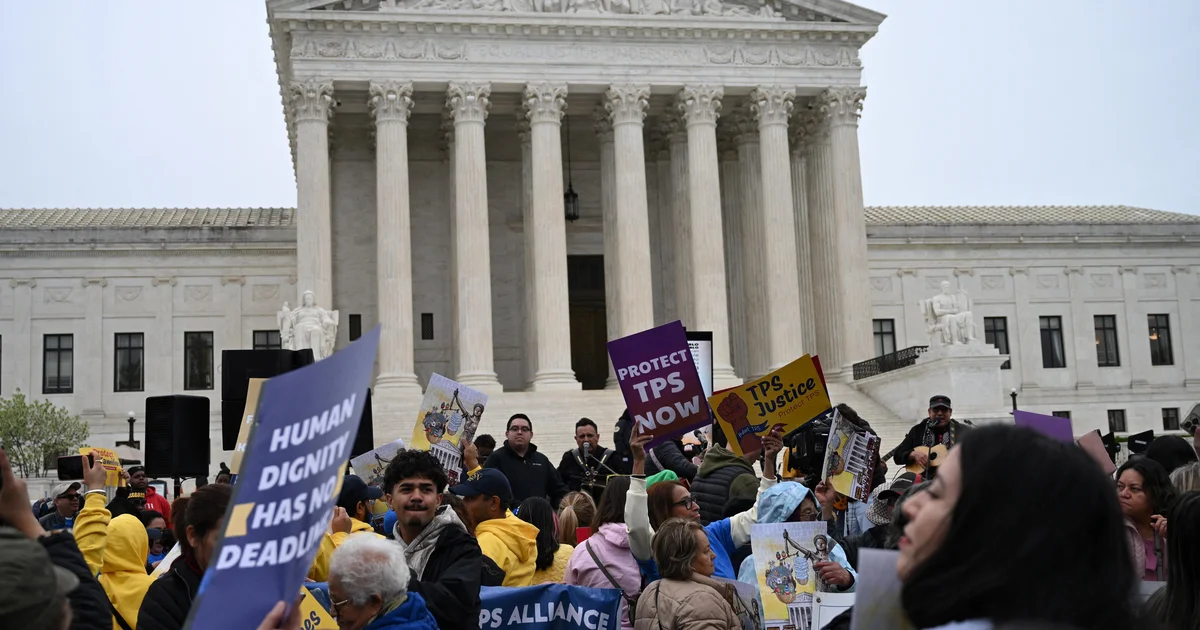

Washington — The Supreme Court said Thursday that the Trump administration may proceed with efforts to end temporary legal protections for more than 356,000 immigrants from Syria and Haiti, protections that have allowed them to remain in the United States and work lawfully.
The decision came in two cases centered on a major piece of President Trump’s broader immigration crackdown. In a divided ruling, the justices concluded that the Temporary Protected Status law prevents courts from reviewing certain claims brought under federal law.
At issue was the Department of Homeland Security’s move to terminate Temporary Protected Status, or TPS, for more than 6,000 Syrians and roughly 350,000 Haitians. Lower courts had previously delayed the end of those protections, but the Supreme Court reversed those decisions. In a 6-3 ruling, the court said immigrants from Syria and Haiti are not entitled to court orders that would postpone the termination of their temporary protection from deportation.
“The TPS statute plainly bars consideration of respondents’ non-constitutional claims,” Justice Samuel Alito wrote for the majority.
The ruling narrows the path for immigrants and advocacy organizations seeking to challenge TPS decisions in court, particularly when they argue that the government violated federal law in ending a designation. The court’s conservative majority also found that the Haitian plaintiffs are unlikely to prevail on their claim that the Trump administration violated the Constitution’s equal protection guarantee by acting with racial motivation.
Alito wrote that statements by Mr. Trump and former Homeland Security Secretary Kristi Noem reflected policy positions that could be explained on race-neutral grounds. One possible explanation, he said, is that “the current administration, which has terminated every TPS designation that has come up for renewal, simply opposes the TPS program, at least as it has been implemented in the past.”
Potential impact on immigrants from many countries
The decision may affect more than 1 million immigrants from 17 countries that have received TPS because of armed conflict, natural disasters or other extraordinary conditions. The Trump administration has sought to revoke protections for immigrants from 13 of those countries, raising the possibility that many could lose work permits and become vulnerable to arrest and deportation.
Justice Elena Kagan dissented, joined by Justices Sonia Sotomayor and Ketanji Brown Jackson, writing that the plaintiffs “deserve better than today’s decision.”
“True enough that TPS is a temporary program, and that it did not promise the plaintiffs never-ending humanitarian protection,” she wrote. “But the law prevents the program from ending as it likely did here — without the required consultations about country conditions and, as to Haiti, with impermissible race-based considerations tainting the decision.”
Kagan said that as a result of the decision, “hundreds of thousands of lives will be uprooted” while litigation continues in the lower courts.
The White House cheered the Supreme Court’s decision, saying in a statement that it affirms Mr. Trump’s belief that temporary protected status is meant to be temporary.
“It was never intended to be a pathway to permanent status or legal residency and it is committed to the discretion of the Secretary of Homeland Security,” Abigail Jackson, a White House spokeswoman, said. “The Trump Administration continues to lawfully end the egregious abuses to our immigration system that have hurt Americans for years.”
Ahilan Arulanantham, a law professor at UCLA who argued on behalf of the Syrian immigrants challenging the TPS revocation, urged Congress to act in response to the Supreme Court’s decision.
“Today the Supreme Court allowed the government to ignore a bedrock humanitarian protection that Congress, in bipartisan fashion, established three decades ago to ensure that vulnerable refugees would not be subject to partisan whims,” he said in a statement. “Without TPS, millions of individuals who are part of our communities are at risk of being sent back to countries in crisis.”
READ MORE: Trump Clashes With ‘Pro-Algae’ Protesters as National Guard Is Deployed
Syria was first designated for TPS in 2012 in response to former President Bashar al-Assad’s crackdown on anti-government protests. Haiti first received the protections in 2010 after a devastating earthquake that affected roughly one-third of its population. Its TPS designation was extended multiple times because of economic, health and political crises after the assassination of its president in 2021.
After Mr, Trump’s return to office, Noem found that neither Syria nor Haiti met the criteria for TPS and sought to rescind the protections.
The Supreme Court has already allowed the Trump administration to end the program for more than 600,000 Venezuelans while litigation over that move continued.
The Justice Department had argued that the Department of Homeland Security acted lawfully when it ended TPS for Syria and Haiti, but said courts could not review the secretary’s determinations with respect to the program.
But lawyers for the immigrants said the Trump administration failed to follow the process laid out by Congress in federal immigration law before deciding to roll back the protections. A lower court also found that the decision to end TPS for Haiti was likely motivated by racial animus, citing statements from Mr. Trump and Noem.
The president has referred to Haiti as a “s**thole country” and, during the 2024 presidential campaign, he amplified baseless claims that Haitian immigrants in Springfield, Ohio, were eating residents’ pets.
The Trump administration, though, said any assertions of racial animus were false.
Mr. Trump has undertaken sweeping efforts to curtail immigration since returning to the White House in 2025. The president invoked a wartime law known as the Alien Enemies Act last year to summarily deport Venezuelans his administration claims are gang members, and he attempted to suspend access to the asylum system for migrants crossing the southern border.
Mr. Trump also signed an executive order seeking to end birthright citizenship for babies born to undocumented immigrants or people in the U.S. temporarily. The Supreme Court is considering the legality of the directive, but appears poised to strike it down.