
Washington — President Trump and conservative House Republicans are escalating a standoff on Capitol Hill, tying other congressional business to the Senate GOP’s failure to advance a voting rules package known as the SAVE America Act.
On Wednesday, Mr. Trump unexpectedly called off a planned signing ceremony for a major housing affordability measure that enjoys broad bipartisan backing in both the House and Senate. The move marked another attempt by the president to use unrelated legislation as leverage in his campaign to push Congress toward new election requirements, including proof-of-citizenship rules and limits on mail-in voting.
The House has passed earlier versions of the proposal with more limited provisions and support from a small number of Democrats. Since then, however, the president has pressed to expand the measure to include additional Republican priorities, such as prohibitions on mail-in voting and restrictions on transgender athletes competing in women’s sports. Senate Republican leaders have repeatedly warned that the legislation lacks the votes needed to clear the chamber’s 60-vote threshold.
That reality has not deterred Mr. Trump. Earlier this year, he threatened to withhold his signature from most other legislation unless Congress approved the SAVE America Act. Earlier this month, he also refused to reauthorize a warrantless surveillance authority that supplies much of the intelligence included in his daily security briefing unless the election measure was attached. That authority remains without reauthorization.
Then on Wednesday, just hours before he was scheduled to sign what supporters described as the first sweeping housing affordability bill in decades — arriving at a time when housing costs remain a major concern for many Americans — the president again insisted that lawmakers prioritize the SAVE America Act. He said he would not sign the housing legislation until Congress approved the election measure.
With backing from conservatives, Mr. Trump has urged Senate Majority Leader John Thune to either secure the votes needed for passage or alter Senate rules to move the bill forward. Thune, a South Dakota Republican, has made clear that GOP senators do not support changing the rules for that purpose. Even so, Republican leaders have tried to accommodate conservative pressure, including by permitting an extended floor debate earlier this year so members could publicly argue their positions.
“We’ve made the point a number of times, as you know, that we don’t have the votes. But that’s not a conclusion obviously he would like to see us draw,” Thune said Wednesday.
Sen. Lisa Murkowski, an Alaska Republican, echoed that assessment, saying the president’s continued demands are effectively slowing progress on his own agenda.
“If he chooses to hold up his own agenda because he wants action on the SAVE Act, that’s, I guess, his call. It is not helpful to him,” she said Wednesday. “It’s not moving the needle. If you don’t have the votes, sir, you don’t have the votes.”
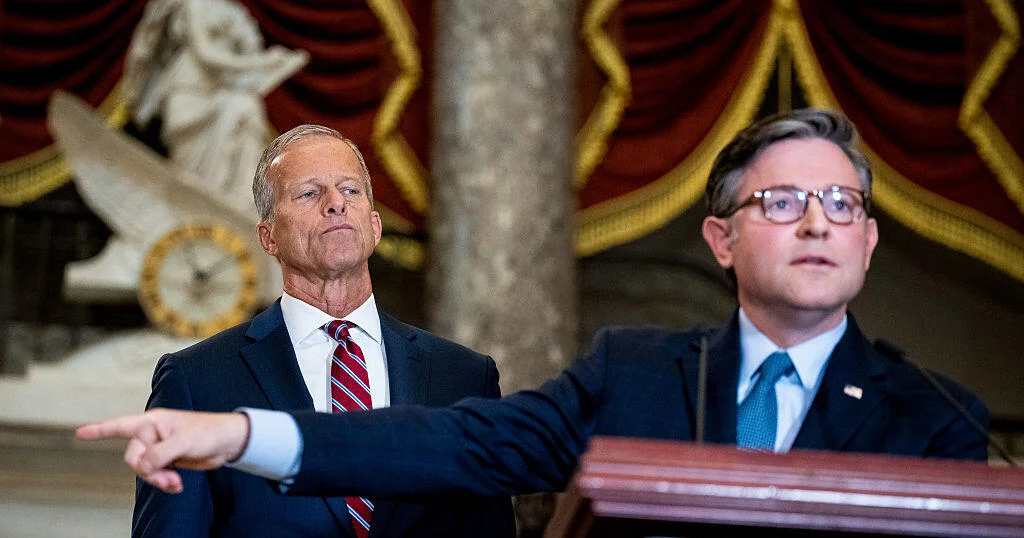
House Speaker Mike Johnson was meeting with Mr. Trump at the White House on Thursday afternoon about the path forward. Before leaving the U.S. Capitol, the Louisiana Republican said he expected a “productive” meeting about “how to get the agenda moving again.”
In a news conference Thursday morning, members of the conservative House Freedom Caucus railed against the Senate for recessing until July 13, instead of staying in Washington to find a path forward on one of Mr. Trump’s top legislative priorities. The Senate was previously scheduled to be off the next two weeks and left a day early for the break.
“The Senate sucks,” said GOP Rep. Byron Donalds of Florida.
GOP Rep. Scott Perry of Pennsylvania demanded that the Senate return to work, saying they would stay in town “and do whatever it takes” to get the legislation to Mr. Trump’s desk.
“We have done our job, but if there’s more to do, God bless it, we will stay and suffer through it,” he said.
Shortly after the remarks, House GOP leadership canceled Friday votes and announced just one vote Thursday afternoon. The House is currently scheduled to be in session for most of next week and then on break from July 3 until July 13.
EXCLUSIVE: Andrew Spends Riding Weekend at Home of Mysterious Arab Businessman
But conservatives, led by GOP Rep. Anna Paulina Luna of Florida, have effectively shut down legislative action on the House floor until the SAVE America Act passes the Senate. With their narrow majority, House GOP leaders need nearly all of their members to stick together in party-line procedural votes to advance their legislation.
“From my standpoint, I don’t want to vote on anything else until this is passed,” GOP Rep. Ralph Norman of South Carolina said Thursday. “I’m not voting for anything.”
“The fact that they’re trying to say that we can put the SAVE America Act in reconciliation — it cannot be done,” Luna said.
Republicans have used the budget reconciliation process twice in this Congress to approve party-line legislation. The process allows the party in the majority to approve legislation with direct budgetary consequences without support from across the aisle, lowering the Senate’s typical 60-vote threshold to a simple majority to advance. But the process has strict requirements, and a number of Republicans have cast doubt on the ability to use the maneuver to approve the elections legislation.
Luna has urged Johnson instead to attach the voting regulations bill to the National Defense Authorization Act or an extension of a key spy authority known as Section 702 of the Foreign Intelligence Surveillance Act, which Mr. Trump previously suggested.
Johnson said he believes the best path forward for the SAVE America Act is attaching it to a third budget reconciliation bill. On Wednesday, he pitched the creation of a “grant program” tied to reconciliation that states could draw from to implement elections provisions.
GOP Rep. Chip Roy of Texas said he’s not interested in “a watered-down version” and was doubtful that the elections measure would see a different outcome than its current fortune if attached to a party-line spending bill.
“We need the entirety of the SAVE America Act passed,” Roy said.
And the president also seemed to dismiss the idea. Asked Wednesday whether he would be open to provisions of the SAVE America Act in a reconciliation measure, Mr. Trump responded, “Not really, no.”
Ibrahim Aksoy
contributed to this report.