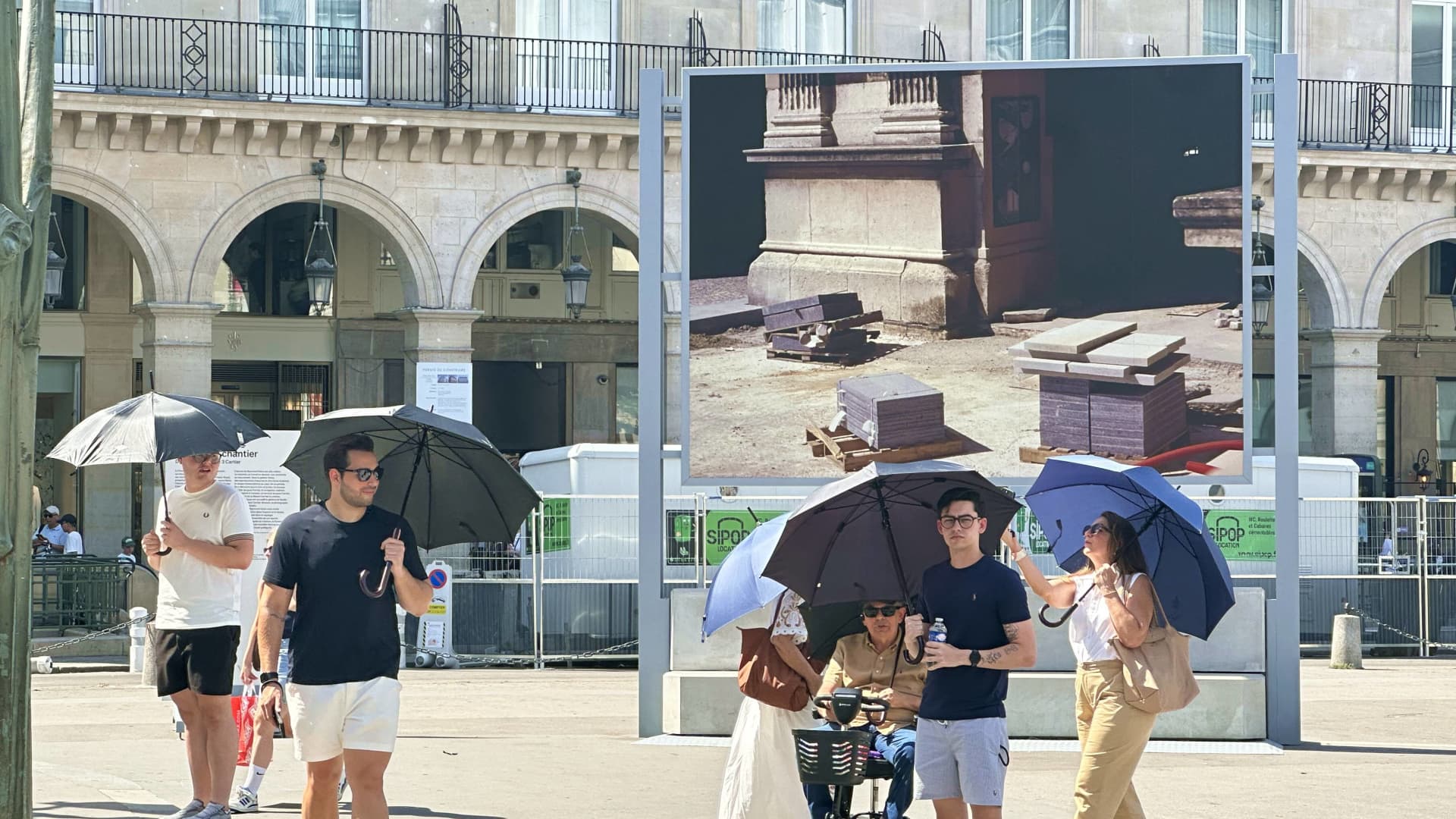

PARIS, FRANCE – JUNE 24: People walk through Paris using umbrellas for shade as exceptional, record-setting heat grips the French capital on June 24, 2026.
Li Yang | China News Service | Getty Images
The European Union is aiming to reduce its all-time-high trade deficit with China by October, yet an extraordinary heat wave across the continent is fueling a surge in demand for Chinese-made air conditioners — a vivid example of why Brussels may struggle to correct the imbalance.
On Monday, the EU and China issued an unusual joint statement pledging to work toward more balanced trade ties and to address concerns over access to each other’s markets.
European trade commissioner Maros Sefcovic said disputes involving trade gaps, export restrictions and intellectual property must produce “tangible results” by October, speaking to reporters after talks with Chinese Commerce Minister Wang Wentao. The two governments also agreed to create a bilateral working group to track trade flows, while Beijing offered “reassurance” that current export controls on rare earths and permanent magnets would not interfere with EU supply chains.
“Not everything will be solved, not everything will be fixed, but we think that between now and October, our teams have sufficient time to deliver the tangible results,” Sefcovic said. He added that Chinese shipments to Europe “keep rising, while our market share in China keeps shrinking,” describing the trajectory as “not sustainable.”
China, however, has signaled plainly that it is prepared to respond if Brussels introduces fresh trade restrictions aimed at confronting industrial overcapacity.
The talks come at a delicate moment. Sefcovic and Wang met in Brussels as Europe’s severe heat wave pushed consumers to snap up air conditioners, many of them manufactured in China. For decades, much of Europe has been wary of air conditioning, viewing units as noisy, visually disruptive to historic buildings and largely unnecessary because extreme summer heat was typically brief. Policymakers also worry that a broad shift toward power-intensive cooling could weaken efforts to combat climate change.
The bloc’s goods deficit with China grew 15% to €360 billion ($410 billion) last year, with all 27 member states experiencing a shortfall, and expanded to €98 billion in the first quarter, the highest since 2022. Electrical equipment and machines are among the most imported goods.
“The sense of urgency over [China’s] threat to European industry appears to have reached a tipping point,” said Gabriel Wildau, managing director at consultancy Teneo, while China’s leadership has shown “little appetite for placating Europe.”
“There is no sign of policy action forceful enough to materially reduce the trade surplus with Europe,” Wildau noted.
A big market to fill
Air conditioners are adding to that imbalance this summer.
Midea Group reportedly said orders for its PortaSplit unit — a portable split system engineered for Western Europe’s fragmented building rules — have topped 200,000 this year as of Monday, double 2025’s pace.
A website built by German software developer Adrian Kübel to track real-time inventory of Midea units across the country went viral on social media and showed the air conditioners were mostly out of stock.
Air-conditioning ownership in Europe stands at around 20% of households, far below the nearly 90% penetration rate in the U.S., according to the International Energy Agency, a gap Midea and Asian home appliance makers Samsung and Mitsubishi Electric are all racing to close.
None of Europe’s five best-selling air-conditioner brands is owned in the EU. Haier Group, Gree Electric Appliances Inc. of Zhuhai and Midea Group Co. — all Chinese — together hold about 32% of the European market by retail volume in 2025, according to Euromonitor International. Turkey’s Beko Corp. and Japan’s Daikin Industries Ltd. round out the top five.
Midea’s air-conditioning design illustrates the kind of engineering tailored to crack Europe’s fragmented and layered regulatory and market barriers.
PortaSplit’s outdoor unit clips onto a window bracket, needs no drilling, and is classified as furniture rather than a fixture — sidestepping facade-modification bans in cities like Paris. Its refrigerant charge is also capped at 1.99 kilograms, just under France’s 2-kilogram limit.
The absence of a homegrown European name among leading air-conditioning suppliers underscores the industrial gap that EU leaders are trying to address.
Half of the EU’s imports from China are technology products, from cars to sophisticated machinery, said Denis Depoux, global managing director at Roland Berger. “This is an inversion of the past decades and is scary for European industries, and can be a financial systemic problem for the Union,” Depoux said. He acknowledged the joint statement as positive progress, as “it is the first one in several years.”
Brussels’ balancing act
The soaring demand for Chinese-made cooling technology also reflects an economic reality underlying analysts’ skepticism that Beijing has conceded much in trade talks, as Brussels struggles to boost its own exports.
“China has made no real commitment in setting an actual [import] quota or actual implementation mechanism,” said Alicia García Herrero, chief economist at French investment bank Natixis, calling the progress simply “smoke” from China to deter Europe from launching more protectionist measures.

European leaders are balancing consumers’ desire for cheaper Chinese household goods, such as air conditioners, and maintaining their industrial inputs in strategic categories and employment.
The European Commission, which has long criticized the excessive subsidies Beijing uses to support its companies and has alleged it dumps cheap goods in the bloc, said after talks on Monday that “the status quo is not an option.” The bloc has recently turned up the heat on Chinese companies operating in Europe, including restricting funding to solar projects using Chinese-made components and ending a tax exemption for low-value parcels used by companies like Temu and Shein.
“Any measures would be targeted in areas where either Chinese competition risks causing serious harm to critical industrial sectors, or where there is a major dependency risk that China may weaponize,” said Andrew Small, director at the European Council on Foreign Relations, with a particular focus on rare earths, chemicals, autos and heavy machinery.
“There is no discussion about across-the-board tariffs,” he added.
For business in Europe, trade negotiations carry existential consequences.
“Europe, too, needs a common understanding to avoid escalation of tit-for-tat responses,” Depoux said.
“‘Delayed reciprocity’ is the concept that should be at play here” — one that could eventually see Chinese and European firms merge to compete globally rather than clash over market share, he added.