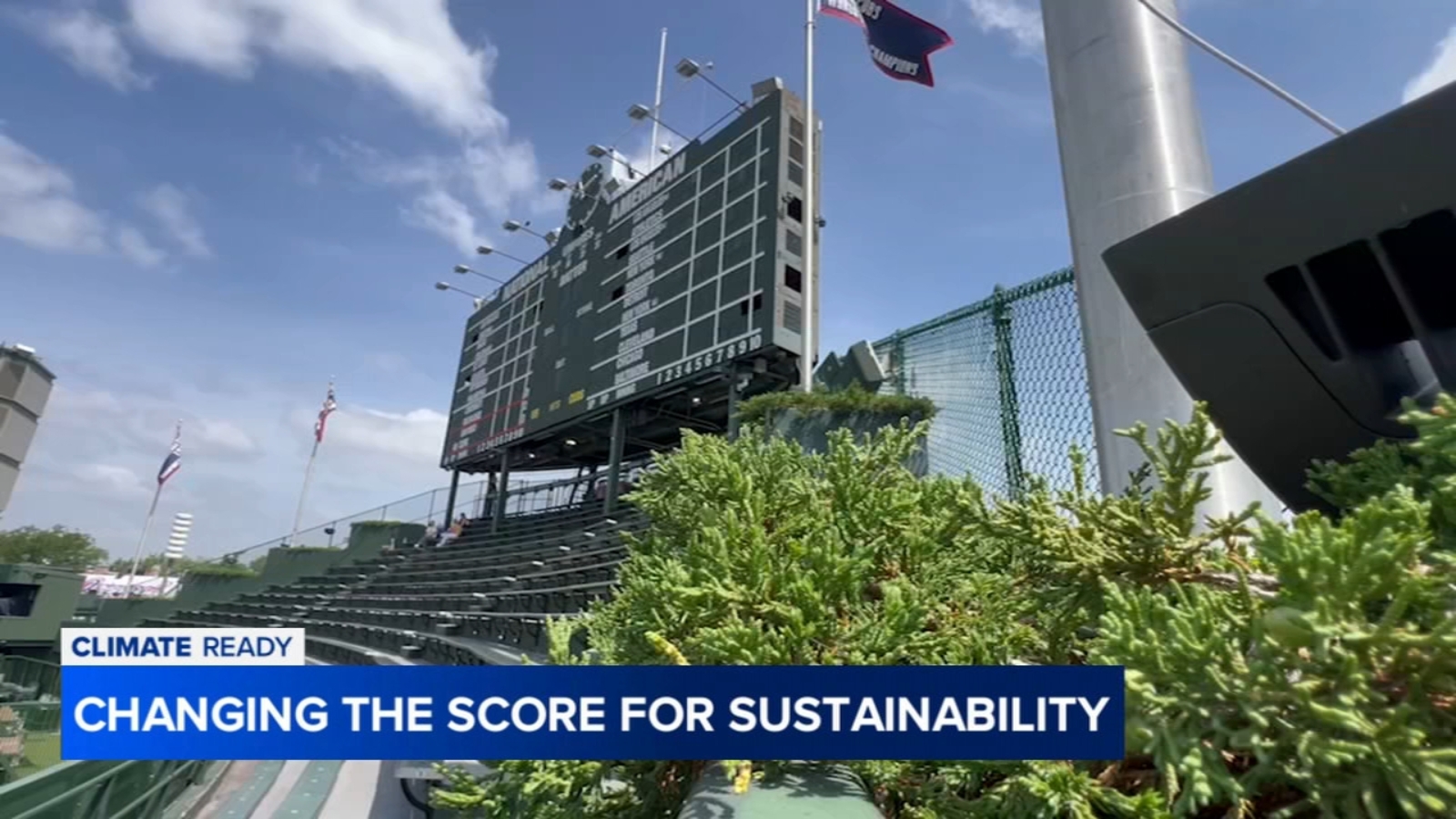

CHICAGO () — Keeping Wrigley Field lush and game-day ready takes more than sunlight, soil and the steady work of a skilled grounds crew.
It takes plenty of water, too — and one Chicago Cubs employee found an inventive way to make every drop count.
Water conservation has become an important piece of the Chicago Cubs’ sustainability work. But at Wrigley Field, a ballpark more than a century old, finding modern environmental solutions often requires a little imagination.
That kind of problem-solving led Assistant Groundskeeper Graham Flora to draw inspiration from a familiar place: his own backyard.
As Flora cared for the juniper plants that spill down along the ballpark’s bleacher sections, he spotted a chance to reuse water coming from high above the field. Rain falling on the roof of Wrigley Field’s iconic 60-foot scoreboard was draining away after storms.
His solution was simple but effective: install rain barrels and connect them to the scoreboard’s existing drainage system to collect stormwater before it disappeared.
“I was thinking about using rainwater, and the fact that we had the two drains on the roof of the scoreboard, and I just thought about getting rain barrels to ’em, and one thing led to another,” Flora said.
The rainwater collection system now helps the Cubs conserve about 1,500 gallons of water each year, turning runoff from one of baseball’s most recognizable landmarks into a practical tool for Wrigley Field sustainability.
The rain barrels are just one part of a larger sustainability strategy at Wrigley Field.
“It’s in the ballpark: waste less. In the community: give more. In the ballpark: energize responsibly, and in the community: power change,” said Maria Sapienza, the Cubs’ director of analysis and planning operations.
The Cubs also closely monitor water use throughout the ballpark.
“Water runoff is a big issue,” Sapienza said.
The team tracks water used for field maintenance and even the water used to clean the ballpark after games, helping identify opportunities to reduce consumption and improve efficiency.
“So when the ballpark is cleaned after every game to be nice and clean for our guests, we want to make sure we’re measuring what exactly water usage is that for versus what’s on the field so we can see what’s happening and get better at it if we need to,” Sapienza said.
The Cubs hope their efforts can encourage fans and neighbors to think about sustainability in their own communities.
“Sports have a really unique opportunity in the world to do good for people,” Sapienza said. “The more we can do the right thing, be good neighbors, waste less, give more, hopefully that just snowballs and inspires people.”
The team’s sustainability efforts extend beyond water conservation.
Inspired by another backyard idea, the Cubs installed beehives on a rooftop after receiving guidance from a neighbor. The team now produces its own honey and hopes to eventually use it in food served at Wrigley Field.