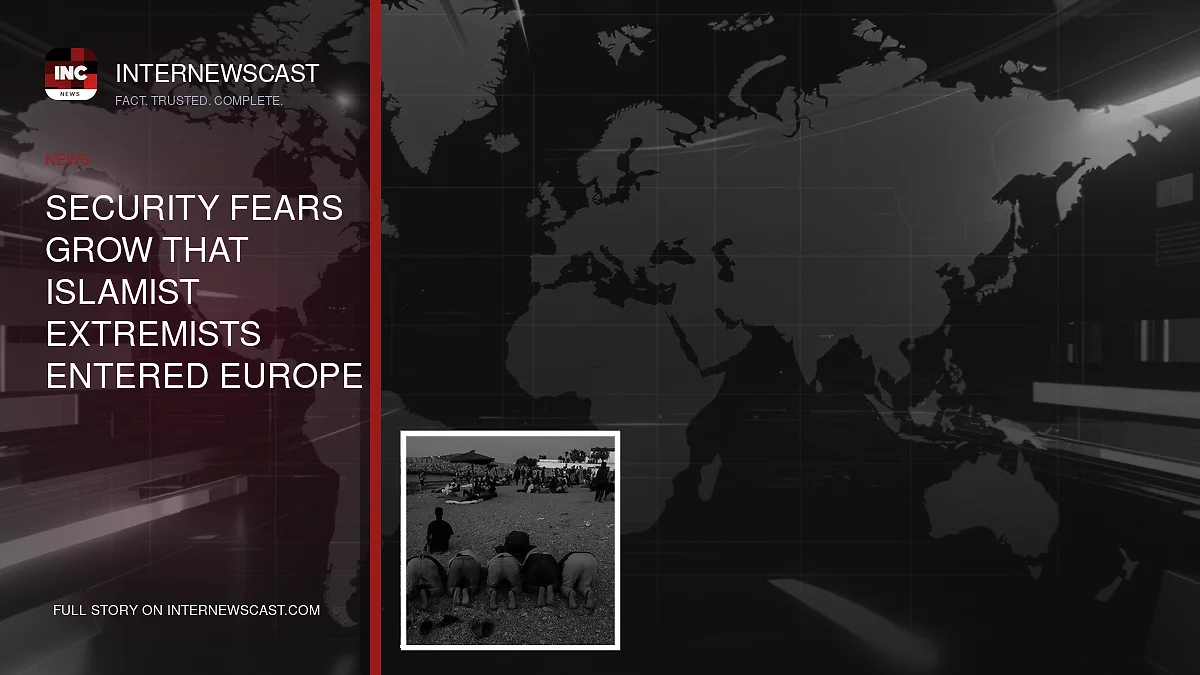

Islamic extremists may have slipped into Europe among violent offenders during last week’s mass crossing into Ceuta, when around 60,000 migrants swam or waded into the Spanish enclave from Morocco.
Police are reportedly examining video from the chaotic border breach and searching the streets of Spain’s North African territory as they try to identify suspected jihadists who officials fear may have exploited the crisis to reach European Union soil.
Some migrants who entered Ceuta have openly spoken in interviews about past violent offences. One man admitted attacking another person with a bottle during an earlier stay in Europe, an incident he said resulted in his deportation back to Morocco.
Spanish news outlet ElConfidencial, citing police sources, reported today: ‘The threat of international terrorism has often been used by the far right to attack the phenomenon of illegal immigration, but Interior Ministry sources admit that, on this occasion, there is a real danger that among the more than 60,000 people who have crossed into Ceuta there are jihadists.’
The report added that security services were aware that violent criminals had remained in Ceuta after crossing the border, stating: ‘The priority of the security forces is to locate the most dangerous men among those who have not returned.
‘Amid the chaos of the first few hours, some immigrants acknowledged before the television cameras deployed at the Ceuta beach El Tarajal that they had been expelled to Morocco by the authorities of Spain and other European Union countries after serving sentences for serious crimes, and that they had taken advantage of the confusion to re-enter the territory.
‘Other immigrants told the media that they had been in Moroccan prisons for violent crimes.
‘Intelligence officers from the Civil Guard and the National Police are now reviewing those videos to search for those individuals and others with similar criminal records who were more discreet and did not stop in front of the cameras to recount their criminal histories.

Migrants, many of them from Sudan, take part in evening prayers on Playa del Trampolan in Ceuta after arriving in the Spanish enclave during the recent mass migration surge from neighbouring Morocco

Migrants sleep while waiting on a beach following mass crossings of migrants on foot and by sea
‘In addition, they are examining recordings from the border perimeter and the city, and have turned to the security forces’ usual informants to locate those people.’
RELATED: Millions Urged to Close Windows as Toxic Air Spreads Across Five States
One migrant, speaking about time he had already spent in Europe, revealed he had been deported to his native Morocco from Holland after fleeing Spain following a bottle attack on another man.
He initially attributed his expulsion to a ‘family problem’ before revealing the true reason.
The 35-year-old told programme En Boca de Todos on Spain’s Cuatro channel, revealing he had a Spanish passport which was taken away from him and he needed medical attention for a broken arm and his hepatitis C: ‘I was living in Barcelona and I liked alcohol and got into a lot of problems.
‘One day I crossed paths with an Algerian b*****d and bottled him. I fled Spain and went to Holland afterwards.
‘I was stopped one day and asked for my ID and I explained to the police there I had just arrived from Morocco.
‘I ended up being taken to a migrant holding centre where I spent six months and was allowed out in a courtyard for an hour a day.
‘I was finally offered €2,000 to go back to Morocco and I agreed to that because I didn’t want to spend another six months in that centre.’
Claiming his bottle attack was the result of falling into a life of crime after a childhood spent on the streets of Rabat and saying if he hadn’t agreed to being deported he would have served five years in prison for his crime, he added: ‘I fell under bad influences but now I’ve chosen a different path and I’m a good guy.’
Another migrant told the same programme he had been linked to a death in Morocco and had crossed the Tarajal breakwater most of the migrants used to get into Ceuta to leave those problems behind.
The border town of Fnideq, also known under the Spanish name of Castillejos, is the closest Moroccan urban centre to Ceuta.
The town of 85,000 inhabitants has historically been one of the major breeding grounds for Islamist terrorism in North Africa.
In 2015 it was estimated around 400 of the 1,200 Moroccans who had travelled to Syria and Iraq to join ISIS came from the town.
One of them, Mohamed Hamaduch, became notorious for posing with the severed heads of his victims.
The Moroccan ISIS fighter, also known as Kokito Castillejos, gained notoriety in Spain for marrying a woman from Ceuta and giving her an explosive belt as a wedding gift. He reportedly died in combat in Syria in late 2015