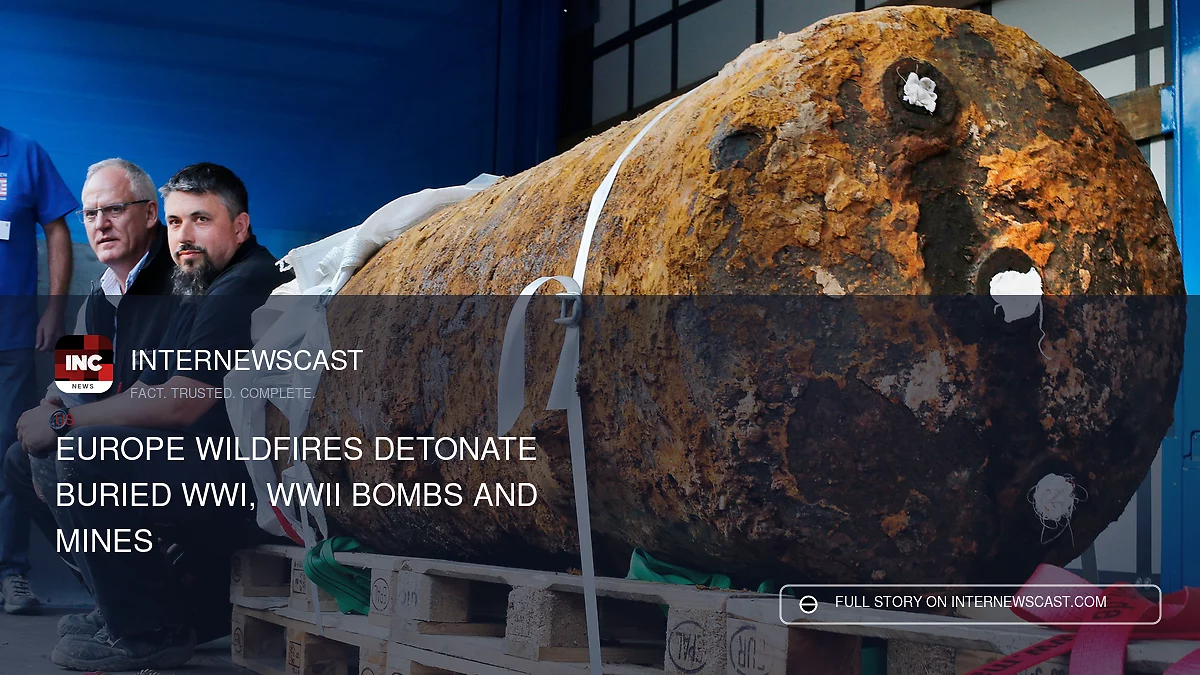

ELSENBORN, Belgium — As wildfires tear through parts of Europe this summer, firefighters are confronting a danger far older than the flames themselves: corroded bombs, shells and mines left behind from World War I and World War II, now hidden beneath scorched ground and capable of killing those sent in to stop the fires.
In several countries, the heat has already triggered explosions. Authorities have reported blasts in France, Belgium, Germany and the Netherlands, where bomb-disposal specialists were called to inspect a wooded area threatened by fire near the site of intense 1944 fighting in Limburg province.
The combination of climate-driven wildfires and unstable wartime remnants suggests Europe’s long-standing “climatic luck” may be fading, said Sarah Njeri, a peace and conflict scholar at London’s School of Oriental and African Studies. For decades, relatively steady temperatures and reliable rainfall helped keep many buried munitions undisturbed underground.
“Climate change is now doing the work of unburying and reactivating what was previously stable,” Njeri said. Wildfires can set off old explosives directly, but they can also strip away the brush, leaves and scrub that have concealed them for generations.
This year’s wildfire season was primed by heavy January rainfall that encouraged thick vegetation growth. When summer brought extreme heat, that new growth turned into fuel. A study released last month by the World Weather Attribution group found that high temperatures, drought, low humidity and strong winds combined to create ideal conditions for fast-moving fires.
Flames chewed up old battlefields and set off buried explosives
As the fires spread, they crossed landscapes already known for unexploded ordnance — a dangerous legacy still embedded in European soil long after the wars that produced it ended.
In drought-stricken France, a major wildfire near the southwestern city of Bordeaux exposed a cache believed to contain ammunition dating back to World War II.
In Belgium’s eastern province of Liege, Gov. Hervé Jamar said officials recently heard “a few sporadic detonations” and that emergency services were adjusting their response plans to account for buried munitions inside a fire zone. He said firefighters were not in danger, though local media later published images showing a firefighter handling a rusted bomb.
During World War II, booby traps, bombs and mines were sprinkled throughout the province’s dense peat-bog forest known as the High Fens. In the first four years after Germany’s surrender in 1945, the munitions killed six civilians, said Bernard Collard, a local historian who runs the Truschbaum Museum near Belgium’s border with Germany that houses a collection of found objects from the war.
“When you go into a forest like this, you are not sure where the explosives are,” he said. He remembers his father detonating a found bomb in a quarry.
The fire in the High Fens, which stretches across the border with Germany, is smoldering atop a much-bloodied battlefield where Nazis fought Allied troops. The Battle of the Bulge was fought in and around the High Fens.
The fire is even closer to the sites of two lesser-known skirmishes along Elsenborn Ridge and in the Hurtgen Forest, which lasted 88 days and killed about 33,000 American and 28,000 German troops.
Every year, Belgium responds to thousands of calls about explosives
Collard is authorized to scan with a metal detector the former battlefields, now forests, pastures and farmland. He has found mortar shells, machine guns, helmets, cigarette cases, and once, a human skeleton.
“You never know what you might come across, and you shouldn’t take it lightly,” Collard said while standing in a field that was once a blood-soaked site. Nearby, blueberry bushes cover old foxholes, trenches and deep craters from artillery fire.
He frequently works with the Belgian demining squad. “It’s part of our history. We live with it,” Collard said.
Unexploded ordnance is even more dangerous around wildfires because heat can trigger the explosives, said Jonas Tepe, a spokesperson for North Rhine-Westphalia, just across the border in Germany.
The Belgian Ministry of Defense said it receives requests from the region about every week to assist in disarming explosives, yet it does not consider the area a “hot spot” compared to elsewhere in Belgium. Such requests are even more common in the west, where farmers in towns such as Ypres – infamous for harrowing trench warfare in World War I – call the annual tilling of the soil ” the iron harvest ” because it turns up so many war remnants.
Every year across the nation, Belgium’s Explosive Ordnance Disposal and Destruction Service responds to more than 3,000 calls and disposes of 200 to 250 tons of munitions left over from both world wars.
Flames are not the only threat
Drought has also helped to lay the past bare by shrinking rivers and lakes to reveal old weapons.
In Slovakia, the Danube River fell and exposed two naval mines that police pulled out of the water and buried in a trench for a controlled demolition. Authorities in Hungary closed Budapest’s Margaret Bridge after a bomb dating from World War II emerged at its base in receding water.
As the Rhine dried up, German authorities also found a WWII-era bomb.
Christina Greene, a researcher at the University of Arizona who, with Njeri, wrote an article on Europe’s wildfires and unexploded ordnance risk, said “the legacy of war keeps creeping up” because of climate change.
“It’s reliving the legacies of war and conflict in a way that we haven’t had to deal with in a while in certain places.”
___ Associated Press writers Mike Corder in The Hague, Netherlands; Sylvain Plazy in Brussels; Angela Charlton in Paris; Kirsten Grieshaber in Berlin; and Stanislav Hodina in Prague contributed to this report.
Copyright © 2026 by The Associated Press. All Rights Reserved.


