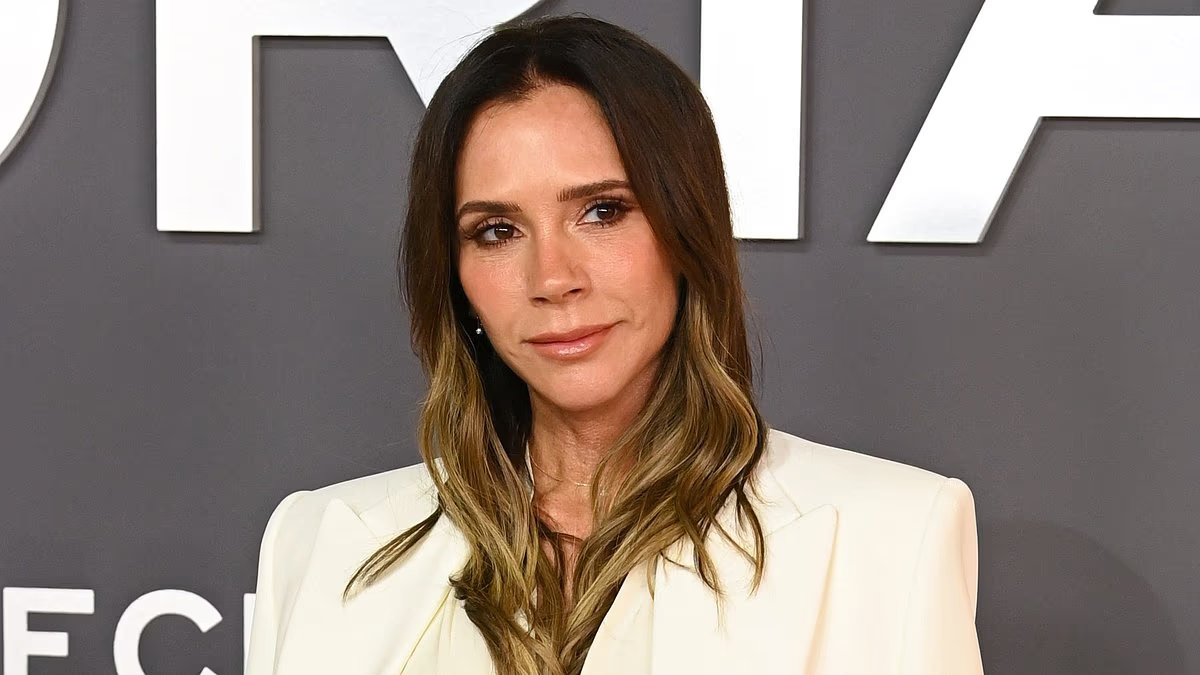

Victoria Beckham admitted in her Netflix documentary that she once feared her fashion empire could collapse after the business racked up losses of £66 million.
Now, however, the designer and former pop star has fresh reason to celebrate, with Victoria Beckham Holdings recording a £7.3 million operating profit, helped by runaway demand for her £104 foundation, which sold out within days and attracted a 25,000-strong waiting list.
The complexion product, launched in 2025, has become a major driver for Victoria Beckham Beauty, more than doubling the scale of her skincare operation, while her much-loved Satin Kajal eyeliners continued to deliver strong sales.
Newly filed accounts for Victoria Beckham Holdings, covering the period to December 2025 and published this morning, show group revenue climbed 15 per cent to £129.8 million, up from £112.7 million in 2024, marking the brand’s fifth year in a row of double-digit revenue growth across its fashion and beauty divisions.
A source close to the business said Victoria had poured years of relentless effort into turning the company around and had fought hard to secure its success.
They added that, after coming close to losing the business in the past, she was delighted to see it return such a strong profit.

Victoria Beckham is celebrating after her company posted a £7.3 million operating profit, boosted by huge demand for her £104 foundation
The turnaround follows a £1.6 million revenue loss reported by the company last year.
In her documentary released last October, Victoria, 52, held back tears as she recalled her embarrassment at her losses.
After launching it in 2008, she was repeatedly bailed out by husband David, 51, which made her a laughing stock.
‘This business is everything to me, it’s absolutely who I am but it has been a hell of a journey. I almost lost everything and that was a dark, dark time,’ she said.
‘I used to cry before I went to work every day because I felt like a fire fighter. We were tens of millions in the red. Yes, I’m going home to my husband but I’m going home to my business partner as well and so I would talk to him about it, I had to. He was invested, and I hated it. I absolutely hated it.’
David added: ‘We both sat there and looked at what I had invested and I think part of that conversation broke my heart because Victoria is a proud woman.
‘When we met, she was a lot richer than me, she actually bought our first house in Hertfordshire known as Beckingham Palace so for her to have to come to me and say “can I have some, we need some more money, the business needs more money,” that was hard for both of us. Because I didn’t have the money to keep doing this and eventually I was like “this cannot continue.”’
Victoria added: ‘The entire house was crashing down, I was losing my business. I needed outside investment. I needed someone to help me.

In her documentary released last October, Victoria, 52, held back tears as she recalled her embarrassment at her losses
‘I was so desperate to save this business. I was breaking down myself. I felt embarrassed but it’s fact. It wasn’t an opinion, it was at anyone being unkind. I was in a whole, I felt like I was in quicksand. I was desperate. Really, really desperate.’
Victoria later found David Belhassen, whose company Neo Investments invested £30 million in Victoria Beckham in 2017.
She opened her first fashion shop in the US, an exclusive pop-up at Bal Harbour Shops running from May to October, and will soon be opening a New York store on in September, the first Victoria Beckham space in the city to house fashion, beauty and fragrance together.
In April, the brand launched a sell-out multi-season partnership with Gap, reimagining its classic staples through Victoria’s design lens.