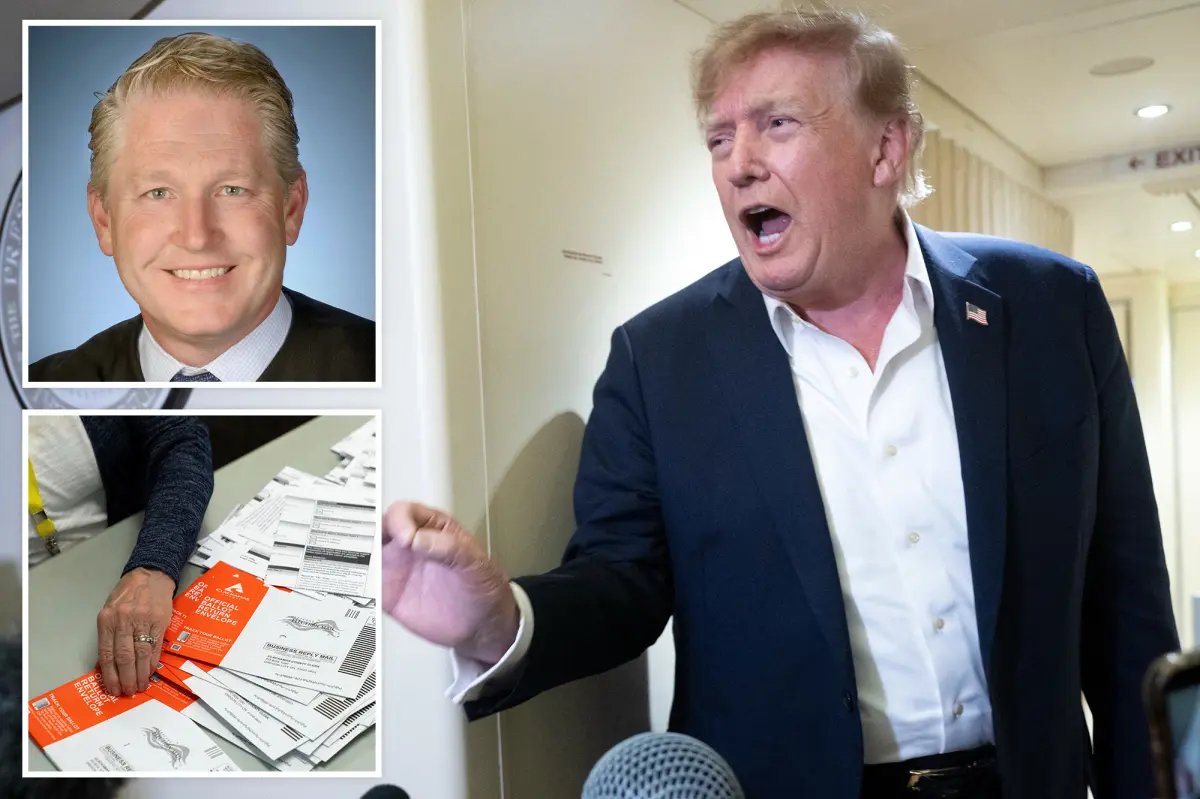

A federal judge late Sunday blocked the US Postal Service from enforcing President Donald Trump’s executive order restricting mail voting, creating another setback for the administration as the Supreme Court considers the broader dispute over election rules.
The Supreme Court is already reviewing the administration’s appeal of an order from US District Court Judge Indira Talwani in Boston. That ruling barred the Postal Service from applying its new mail-voting regulations before this year’s midterm elections.
US District Judge Carl J. Nichols of Washington, DC, issued a similar injunction late Sunday against the regulations, which were released Aug. 21.
“Plaintiffs have demonstrated that, absent an injunction, there is an increased risk that a significant number of otherwise appropriate absentee or mail-in ballots will ultimately not be counted in the upcoming elections,” Nichols wrote in his decision. “The public has a strong interest in ensuring that doesn’t happen.”
Nichols had declined in May to issue an injunction, ruling that the lawsuit had been filed prematurely. That reasoning echoed the Supreme Court’s decision late last month to lift an earlier freeze imposed by Talwani. After the administration formally issued the regulations to advance Trump’s plan, however, plaintiffs in Boston and Washington, DC, filed new lawsuits.
Talwani was nominated to the federal bench by former President Barack Obama, while Trump nominated Nichols.
The Postal Service regulations followed an executive order Trump issued earlier this year. Election officials have said the changes cannot realistically be implemented so close to a general election.
Under the regulations, the Postal Service would have to approve every ballot-envelope design in advance. States would also be required to upload the identities of ballot recipients to an online portal that is not yet operational.
Mail ballots are already being sent in at least three states — Alabama, North Carolina and Wisconsin — while additional states are preparing to begin distribution this week.
A whistleblower report submitted to Congress warned that allowing the regulations to take effect for the midterms could disenfranchise millions of people.
The union representing Postal Service employees has also opposed the executive order, arguing that postal workers should not be responsible for verifying voters’ eligibility.
Trump has repeatedly targeted mail voting, falsely attributing his 2020 loss to Democrat Joe Biden to the practice and claiming it enables fraud, even though he has used mail ballots himself.