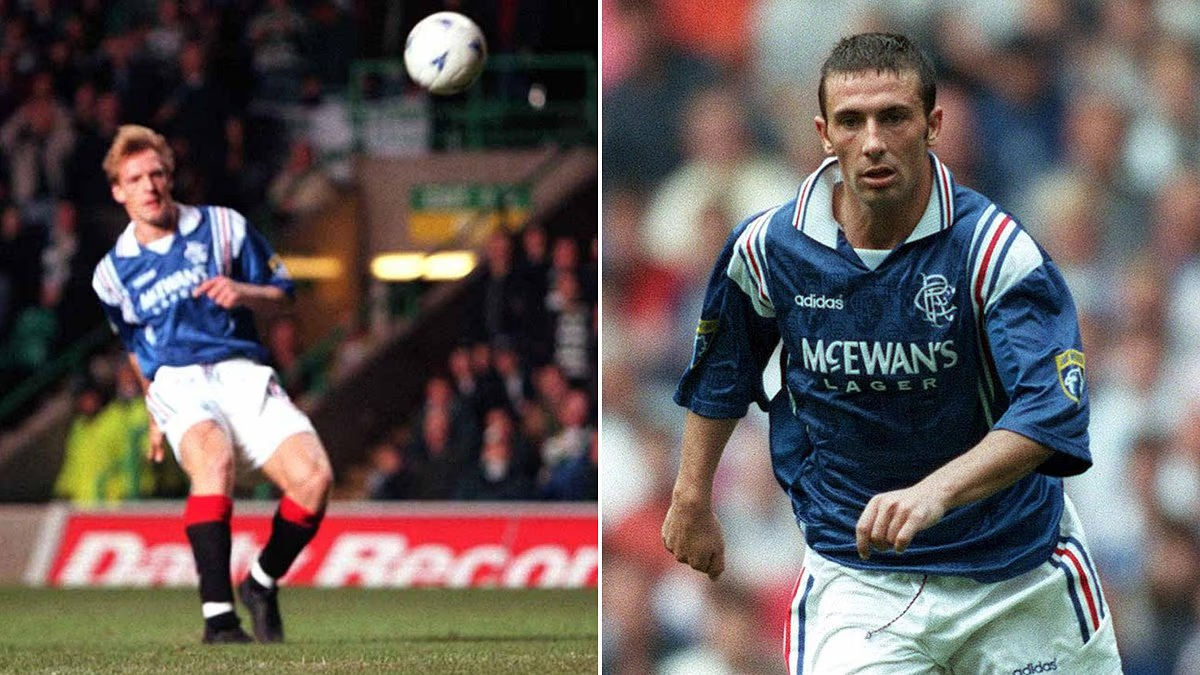
Derek McInnes will need to produce an extraordinary Old Firm debut as a manager if it is to match the astonishing drama of his first experience of the fixture as a player.
That November 1996 meeting at Celtic Park took place as Walter Smith’s Rangers moved closer to a historic ninth consecutive league title, adding even more intensity to an already fiercely charged occasion.
Brian Laudrup struck early to give Rangers the lead in a tense encounter, yet the Danish winger’s goal was quickly overshadowed by everything that unfolded afterwards.
Paul Gascoigne and Pierre van Hooijdonk both saw penalties saved, while a fox somehow invaded the pitch on a freezing midweek evening and completed its own lap of honour. Even those bizarre moments paled beside an incident that remains almost impossible to believe three decades later.
‘That was the Peter van Vossen night,’ McInnes said ruefully this week. It was an accurate summary of an unforgettable Old Firm contest.
Time has done nothing to make the Dutch striker’s extraordinary miss seem less shocking. If anything, watching it again confirms that the moment was every bit as inexplicable then as it is now.
With Celtic pushing forward in search of an equaliser, Van Vossen escaped the offside trap near halfway by flicking the ball towards Jorg Albertz. He then raced alongside the German, completely unchallenged, towards Stewart Kerr’s goal.

Rangers forward Peter van Vossen sends his shot over the crossbar despite having an open Celtic goal in front of him
Albertz’s clever square ball, delivered with the outside of his boot, removed Kerr from the equation and left Van Vossen with a simple seven-yard finish into an unguarded net. It was the kind of chance that appeared impossible to miss.
Yet the former Ajax Champions League winner somehow lifted his right-footed effort over the bar. That miss came to define Van Vossen’s Rangers spell and ensured his name would forever be linked with Old Firm football for one unforgettable reason.
‘I remember the manager, Walter Smith, barely celebrating,’ McInnes recalled.
‘He was furious with Peter because that chance could have changed everything and left us vulnerable late in the match.
‘In the end, I think the feeling was more relief than celebration because we had won. Peter was a brilliant guy, but even after seeing the replay, I still cannot understand how he missed it.
‘Had we failed to get the result, he would have taken an awful lot of criticism. That is just how these things go.
‘Fortunately, the miss did not ultimately decide the match.’
On an evening when both teams repeatedly made life harder for themselves, McInnes could look back knowing he had done his part.
Celtic began with purpose, but McInnes won an aerial duel with Morten Wieghorst to deal with a long ball. A costly slip from Brian O’Neil then opened the door for Laudrup, who took advantage with a superbly measured shot from the edge of the penalty area that flew beyond Kerr.
‘I only remember wanting to make sure I did not disappoint anyone,’ the current manager said. ‘I was sharing a dressing room with players who had become serial winners and were collecting trophies year after year.
‘When I joined Rangers, I wanted to feel that I had contributed to winning something. My priority was to give a performance, help my teammates and ensure I did not let either them or the club down.’
‘I think we were strong. I think the gaffer went with a different system that night. Sometimes he went with a five against Celtic.
‘We filled the middle of the pitch. I think it was me and Craig Moore as two sixes in the middle of the park.
‘We were there to try and break up the play, keep the ball simple and give it to the guys that could make the difference. Thankfully, Laudrup did that.’

Derek McInnes enjoyed a victory on his playing Old Firm debut back in 1996
Never has a season illustrated the importance of edging derby matches. In what proved to be his final year in charge, Tommy Burns lost all four in the league and left the post knowing that just a single victory would have seen Celtic win the title by one point. For Smith, his friend and adversary, history beckoned.
‘I could see the pressure the gaffer was under as well,’ McInnes recalled of that storied campaign.
‘I think there have been three different managers not being able to deliver 10 in a row – Jock Stein, Neil Lennon and Walter.
‘The pressure to deliver nine was clearly on everybody in that dressing room, particularly the gaffer and we all felt it.
‘Wherever you came from in the world, whether you were a local boy or you weren’t, there was a sense of opportunity there and having won eight, we had to win nine.
‘We all felt that collective responsibility, but the players all wanted to do it for the manager as much as anybody.’
A generation on, the late Smith’s approach to those games will shape McInnes’ thinking as he prepares to manage in one for the first time.
As was the case 30 years ago, there will be no attempt to blind anyone with science.
‘I think as a player it’s different,’ he explained.
‘You just don’t want to let anybody down when you play in these games.
‘You think about your teammates, you think about your friends, your family who are all going on about the game and things like that. You just want to make sure you win it.
‘I think that any team the gaffer would have picked, you wouldn’t need to motivate that dressing room because he knew that all week the motivation was there.
‘Because there were so many of a certain type playing in the dressing room, I think he took it as a given that the competitive part of the team was always going to be there.
‘I think really he just would speak about the basics.
‘He’s the best manager this club’s ever had, but his fundamentals were about doing the basics really well and in this game in particular.
‘Any time I played it was a case giving it to the guys that could make the difference in the game and do your job well.
‘It’s hard to win these types of games without everybody bringing a performance of some sort.’
McInnes is a novice in terms of managing in this fixture but is well-versed in the demands of derbies from his year spent at Hearts.
‘We won three derbies last season and they were all quite late wins for us,’ he recalled.
‘You could clearly see what it meant to the supporters to win them.
‘The impact it can have on the opposition as well, I think you’ve got to recognise that as well.’
While the victor today would still have two ties to encounter to get their hands on the trophy, the psychological boost of edging the first local skirmish of a season would feel significant.
Rangers haven’t tasted victory in the first derby of a campaign for five years. With their second meeting coming in the league at Parkhead in a week’s time, this would be an opportune moment to put down a marker.
‘It’s a chance to strike a blow to your direct opponents as well. It’s a big game,’ said the Rangers manager.
‘I understand that if you can win it, you get a lot of feel-good factor benefits from it.
‘We’re playing against a team who have been the most successful team in recent seasons.
‘It’s up to us to try and take advantage and use the opportunity to say, ‘it’s our trophy this year and we’re going to work towards it.’
‘We have to deliver a performance that overcomes them.’
Click here to visit the Scotland home page for the latest news and sport