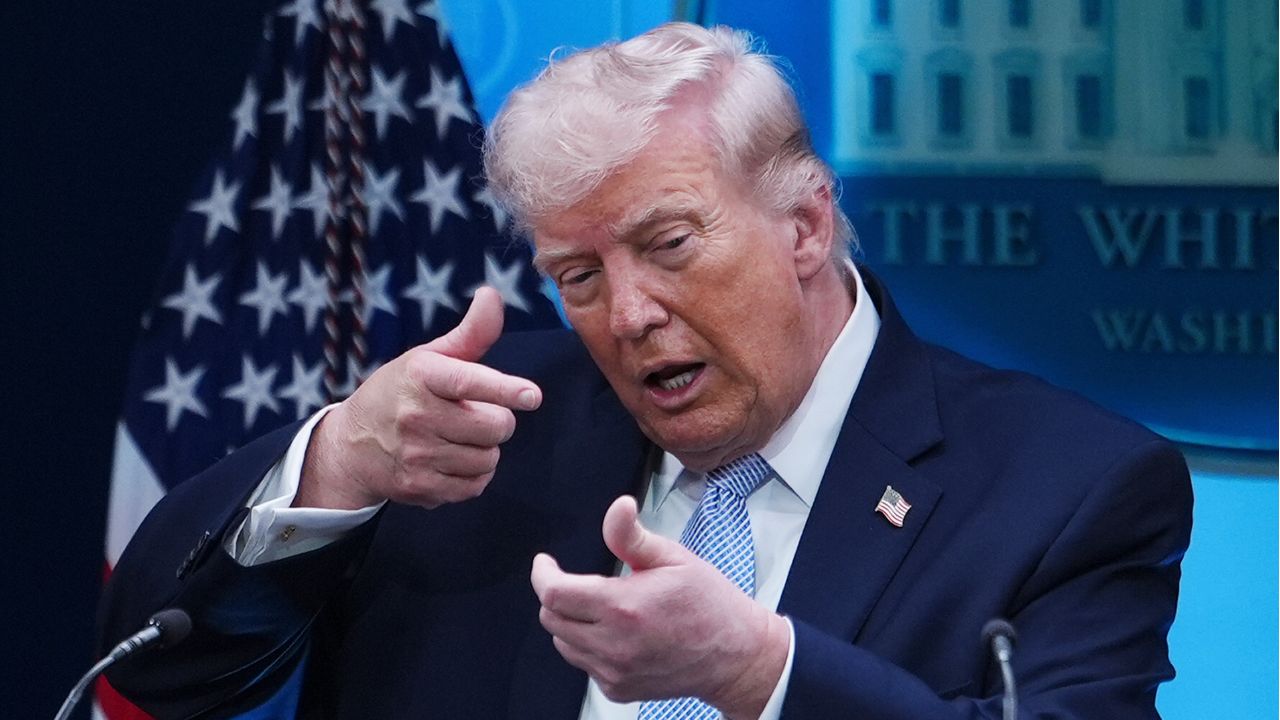

FILE – President Donald Trump gestures as though aiming a sniper rifle while speaking to reporters in the James Brady Press Briefing Room at the White House on Monday, April 6, 2026, in Washington. (AP Photo/Julia Demaree Nikhinson, File)
The Trump administration issued an advisory opinion Friday declaring that two federal firearms laws restricting licensed dealers from selling handguns to adults under 21 violate the Constitution.
The 49-page opinion was written by T. Elliot Gaiser of the Justice Department’s Office of Legal Counsel and addressed to Attorney General Todd Blanche.
The document concludes that federal limits preventing 18- to 20-year-olds from obtaining firearms conflict with the Second Amendment’s text. Because those young adults fall within the amendment’s protection, the restrictions are “presumptively unconstitutional,” the OLC wrote.
The disputed provisions appear in two sections of 18 U.S.C. §922. They prohibit licensed dealers from selling “any firearm or ammunition”—with exceptions for rifles and shotguns—to anyone they know or reasonably believe is younger than 21. A related provision requires age-certification statements for some handgun transactions that do not take place over the counter.
By issuing the opinion, the Justice Department is signaling to federal prosecutors and courts that it views those age-based restrictions as no longer enforceable.
Gaiser pointed to what he described as an inconsistency in federal law. Eighteen-year-olds may be drafted, vote, serve on juries and, in some circumstances, face the death penalty, yet federal law could make it a felony for a licensed dealer to sell one of them a handgun.
The Justice Department’s position comes as courts continue to reshape the legal landscape surrounding the Second Amendment.
In late June, the Supreme Court ruled in Wolford v. Lopez that Hawaii could not bar licensed concealed-carry permit holders from carrying handguns on private property open to the public unless property owners had expressly approved it. Justice Samuel Alito wrote the opinion.
The OLC compared the federal age limits to the Hawaii law, arguing that both impose special burdens on firearm-related conduct that do not apply to other commercial goods. In the department’s view, the legal gap identified in Wolford exists here as well, even though it operates in the opposite direction.
The opinion rejected arguments based on the common-law concept of “infancy,” which can limit the contractual capacity of minors. Gaiser argued that a rule generally applicable to commercial transactions cannot justify criminal penalties aimed specifically at handgun sales to 18- through 20-year-olds.
The advisory came one day after the administration indicated that it would not appeal a district court decision striking down certain federal regulations involving silencers, short-barreled rifles and short-barreled shotguns.
That district court ruling, written by U.S. District Judge James Wesley Hendrix, a Trump appointee, was not cited in the OLC’s analysis.
The opinion did, however, point to a 2024 decision by the 8th U.S. Circuit Court of Appeals. That court struck down a Minnesota law limiting gun-carry permits to applicants who were at least 21.
The OLC argued that it makes little sense to require 18- to 20-year-olds to register for selective service and potentially defend the country while denying them what it called the core Second Amendment right to armed self-defense. It also cited the Twenty-Sixth Amendment, saying that amendment places adults ages 18 to 20 clearly within the nation’s political community.
Despite its clear conclusions, the OLC document is advisory rather than binding. It does not control federal courts or prosecutors and does not establish legal precedent.
The post Trump DOJ issues advisory opinion saying SCOTUS precedent entitles young adults to own handguns first appeared on Law & Crime.