
President Trump’s Board of Peace unveiled a phased recovery blueprint for Gaza on Wednesday, beginning with a six-month effort projected to require $2.45 billion.
Presented on the sidelines of the United Nations General Assembly in midtown Manhattan, the proposal outlines 66 initiatives covering infrastructure repairs, economic development and the deployment of an international security force.
The full reconstruction program is expected to carry a price tag of approximately $71 billion.
“Recovery must be Palestinian-led and built through genuine partnership,” Ali Shaath, chief commissioner of the National Committee for the Administration of Gaza, wrote in a one-page overview. “Central and local authorities, businesses, civil society groups and affected communities will participate throughout the process.”
“This is not a wish list,” Shaath added. “Every initiative has been evaluated, assigned a cost and placed in sequence. We are asking partners to provide political backing, remove barriers and direct their resources into one unified plan.”
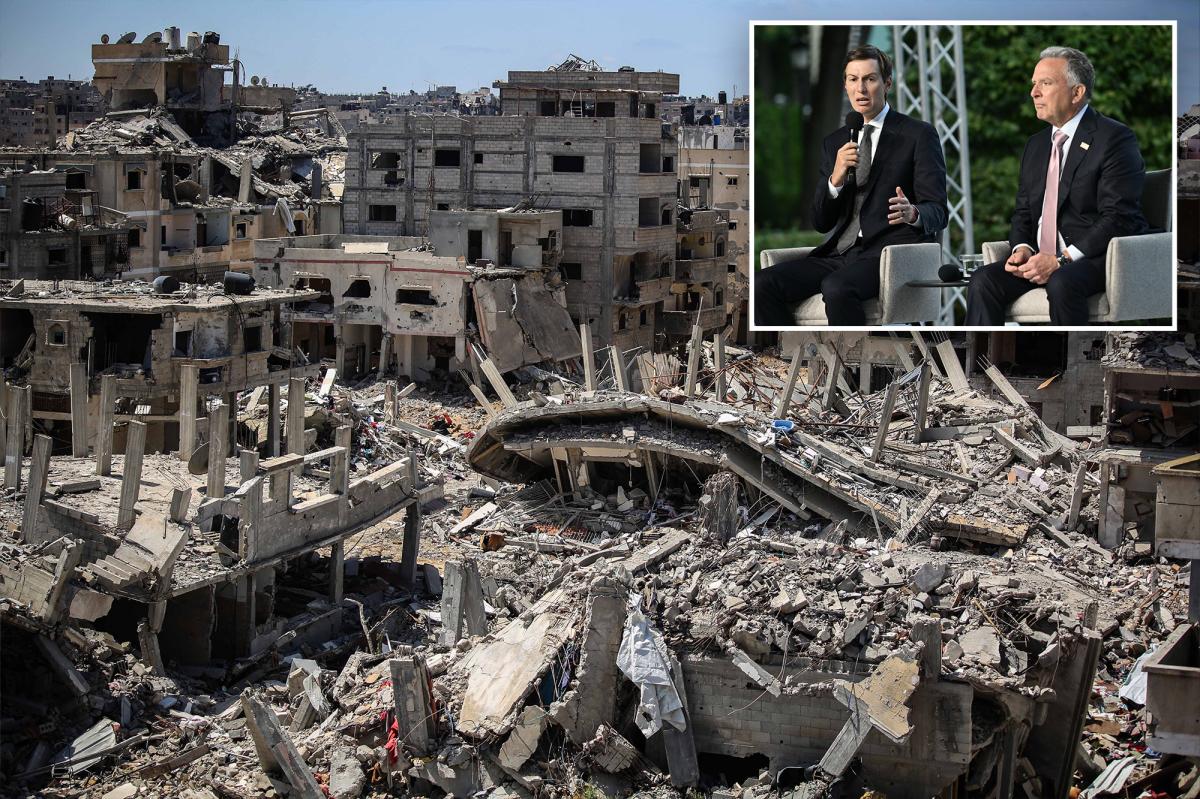
The initial work would include replacing tents with more durable shelters, clearing war debris, restoring hospitals and building desalination facilities to expand access to clean water.
US special envoy Jared Kushner, who is also the president’s son-in-law, said the framework had emerged rapidly. “A year ago, none of this existed,” he said. “The conflict had not been resolved, the Board of Peace did not exist, the International Stabilization Force was not in place, and there was no national committee for Gaza.”
Kushner compared the effort to launching an unusually complex startup, saying those involved were driven by a desire to achieve peace and meaningful progress. “They could have created a huge company with all the sophistication and work that has gone into this,” he said, “but I believe we are building something far more important than a company.”
He described the initiative as a foundation that would allow Palestinians in Gaza to concentrate on strengthening their livelihoods and improving daily life.
The war between Israel and Hamas, now approaching its third year, has inflicted an estimated $35.2 billion in damage on the Hamas-run territory along the Mediterranean, according to former British Prime Minister Tony Blair, who serves on the Board of Peace.
Blair said the UN Security Council resolution authorizing the reconstruction reflected broad agreement on a future framework for Gaza—one intended to break the pattern of recurring conflict rather than extend it.
The first element, Blair said, would be removing Gaza from Hamas control and establishing a Palestinian-led interim administration with international backing. The second would involve complete demilitarization, supported by a new security structure that includes the International Stability Force and a civilian police service agreed upon with Israel.
The third component is a detailed renewal and rebuilding effort. The fourth leaves the broader question of Palestinian self-government unresolved for now, while preserving the possibility of a future agreement that addresses Israel’s security concerns and Palestinians’ desire for self-rule.
More than 25 nations and 75 organizations are expected to contribute to Gaza’s recovery through financial support and other forms of assistance.
Organizers say as much as $18 billion has already been pledged through donations and private-equity commitments.
The security phase must come first. As many as 250,000 members of the International Stability Force are expected to move through Gaza one sector at a time, overseeing the planned demilitarization and the removal of Hamas weapons.
“Hamas has agreed to surrender the weapons, but that agreement still has to be carried out,” Kushner said.
US Army Gen. Jasper Jeffers, commander of the International Stability Force, said 19,000 candidates for a future Gazan police service have completed vetting and begun initial training. They are part of a pool of more than 250,000 applicants, he said, while warning that “the scope of the problem is immense.”
Jeffers said military planners are developing an operation that can be implemented district by district. Weapons, tunnels and other military-related sites will need to be either decommissioned or neutralized, he explained.
After that process, the national committee and its vetted security personnel would take over local responsibility, Jeffers said. The committee would eventually assume full control, clearing the way for an Israeli Defense Forces withdrawal while verification efforts continue on an ongoing basis.
“Dismantling the military infrastructure inside Gaza is unprecedented in its complexity,” Blair noted. “Underneath the cities, the towns, the villages of Gaza are literally hundreds of miles of tunnels with weapon depots and weapon manufacturing capability.
“This new government cannot govern unless that infrastructure is systematically destroyed. Hamas have agreed in principle that it should be,” he said. “And that was a landmark agreement. But our most urgent challenge now is to turn this agreement into a credible stage by stage plan, as we are doing.”