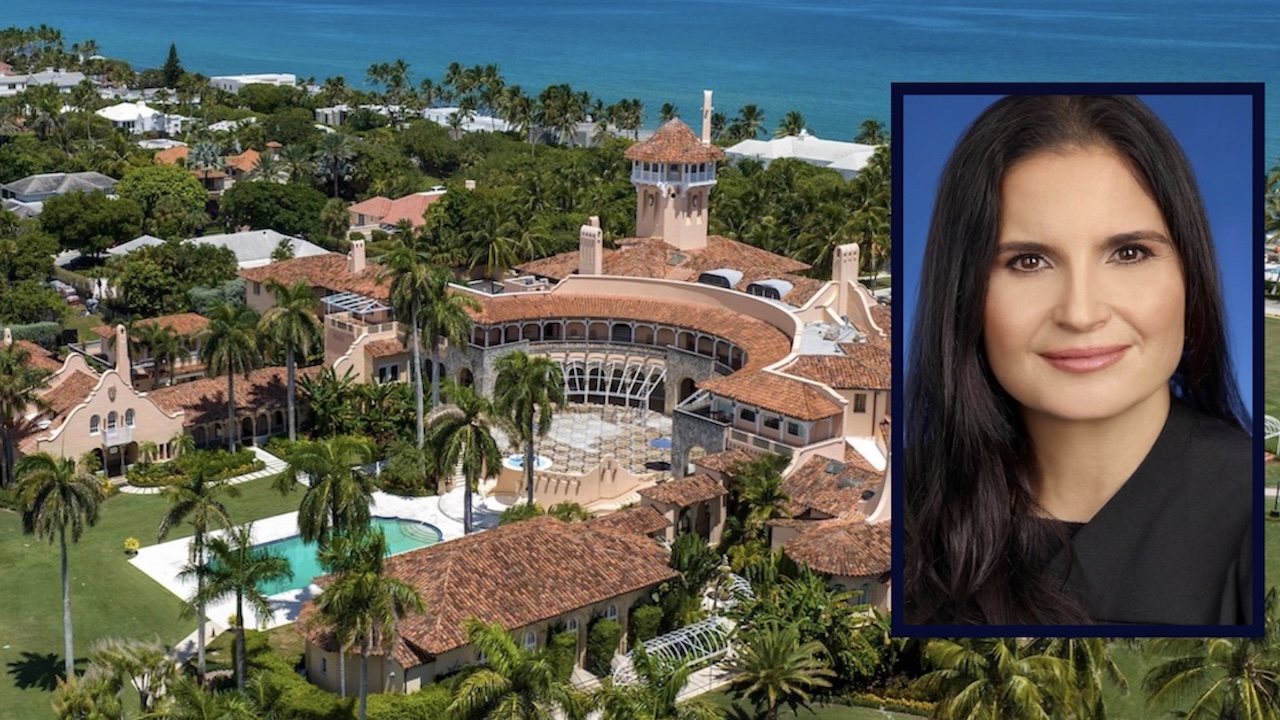
Main: An aerial view of former President Donald Trump’s Mar-a-Lago club in Palm Beach, Fla., on Aug. 31, 2022 (AP Photo/Steve Helber/File). Right inset: U.S. District Judge Aileen Cannon (U.S. District Court for the Southern District of Florida).
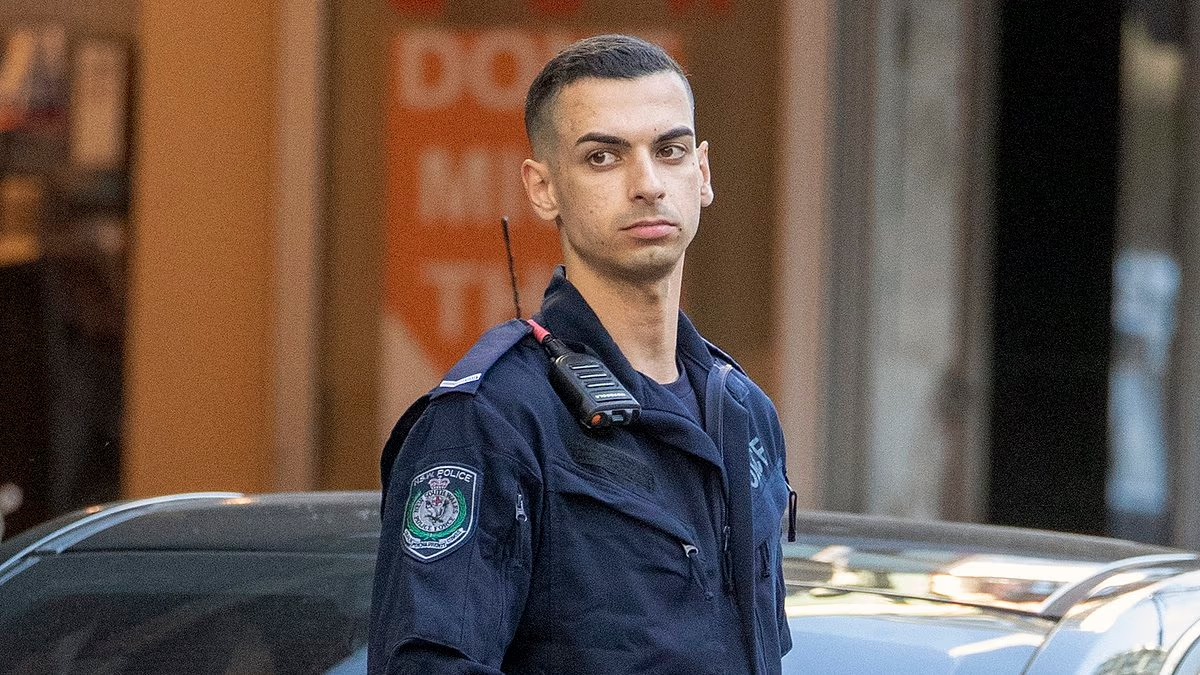
Current and former FBI agents are seeking guidance from the judge who barred former special counsel Jack Smith from discussing his Mar-a-Lago report. They want to know whether they can testify safely before a Florida grand jury investigating what the Justice Department has described as a “grand conspiracy.”
The motion to intervene, first reported by Politico, said that federal agents and analysts “participated in the investigation and prosecution of” Trump and the 2022 search of Mar-a-Lago, which led to his indictment in the classified documents and conspiracy case.
U.S. District Judge Aileen Cannon dismissed the indictment after ruling that Smith had been unlawfully appointed as special counsel, characterizing him as little more than a “private citizen.”
The Trump-appointed judge subsequently placed Volume II of Smith’s report under seal following the case’s dismissal. Cannon also condemned Smith’s “brazen” decision to prepare the document in the first place.
Cannon permanently prohibited the Justice Department and then-Attorney General Pam Bondi, “or her successor(s),” from “releasing, sharing, or transmitting Volume II of the Final Report or any drafts of Volume II outside the Department of Justice.” Her order also barred anyone from “otherwise releasing, distributing, conveying, or sharing with anyone outside the Department of Justice any information or conclusions in Volume II or in drafts thereof.” As a result, Smith faced significant limits on what he could publicly say about the classified-documents case.
The prospective intervenors now want the order clarified, saying they do not want to risk being reprimanded by Cannon for violating her injunction while responding to a grand jury subpoena.
“Absent clarification, Clients cannot testify before the grand jury without risking violating terms of the Order,” their filing states. According to the motion, the DOJ has reportedly taken the position that disclosing any nonpublic information potentially contained in Volume II would breach the order—even if the disclosure occurred in response to congressional questions, a Freedom of Information Act request, or confidential discussions with attorneys.
The motion says attorneys asked the government to explain how its investigation fits with Cannon’s order. DOJ officials reportedly replied that their “work does not disturb [the] Order,” but offered no further explanation or factual or legal support for that conclusion.
The FBI agents—“most” of whom “were unlawfully fired and are no longer federal employees”—say they are generally prepared to testify voluntarily before the grand jury. Their concern, however, is that doing so could expose them to “possible punitive consequences.”
The former agents expect to face questions about material in Volume II, and they cannot determine whether those questions would fall within the scope of Cannon’s order. That uncertainty, they argued, leaves them choosing among three difficult options: risking possible contempt, limiting their testimony to comply with the order, or invoking their Fifth Amendment protection against self-incrimination. “The first two options bear possible punitive consequences,” the motion says, while the third could create “unnecessary negative optics” for former federal employees who are described as witnesses but might appear to be withholding information simply to avoid contempt.
“Although most were unlawfully fired and are no longer federal employees, Clients are deeply respectful of all court orders and do not wish to violate them,” the motion adds.
The post ‘Unlawfully fired’ Mar-a-Lago FBI agents fear ‘possible punitive consequences’ unless Judge Cannon clears up her order first appeared on Law & Crime.