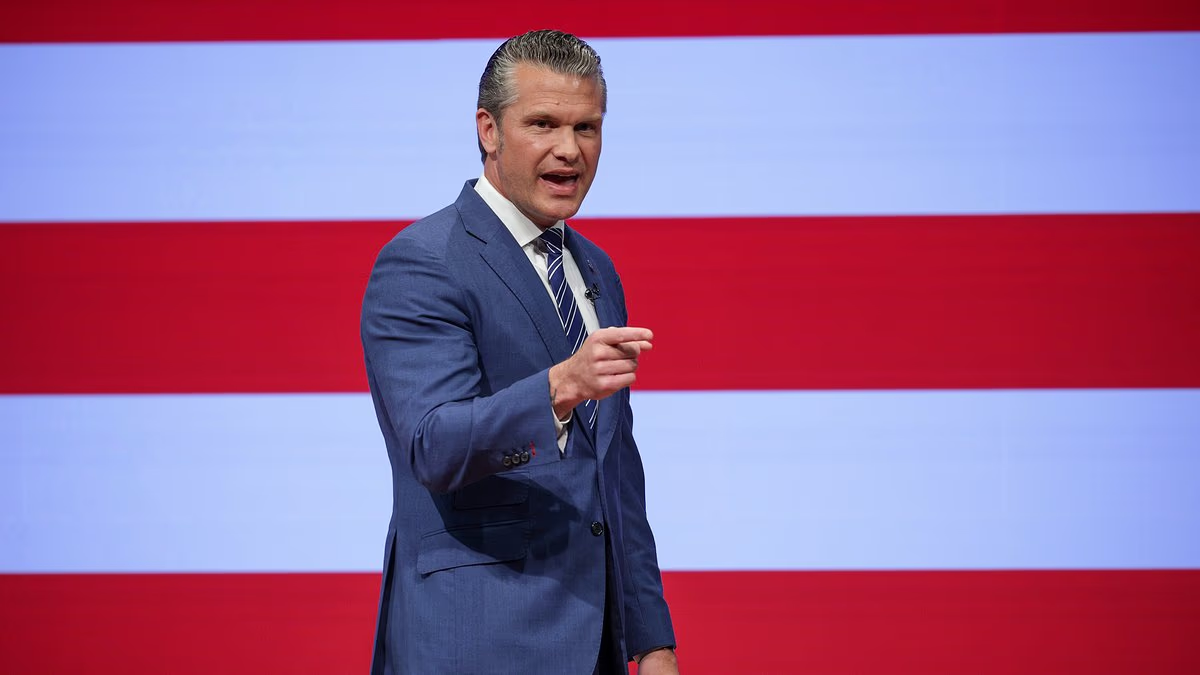

Secretary of War Pete Hegseth praised Iran’s state-run media as “reasonable” while attacking the US press during an announcement introducing a new “autonomous” Pentagon command.
“Our so-called press makes Iranian state media look reasonable,” Hegseth said at the start of a fierce criticism of American journalism during his State of the Force address to senior military leaders in Quantico, Virginia, on Wednesday.
The former Fox News host, who now leads the War Department, used the speech to intensify his long-running dispute with US journalists. Earlier this summer, as the Iran war continued, he barred reporters from the Pentagon’s press office.
Hegseth accused major news organizations of attacking President Trump in what he called “political retribution.” He also claimed that journalists suffered from “Trump derangement syndrome” and had committed a “national betrayal” through their coverage of the unpopular conflict.
“Partisan activism that intentionally smears the troops and the historic mission they’re undertaking is fundamentally anti-American. It’s sick. It’s a national betrayal.”
Alongside his criticism of the media and praise for Iranian state broadcasters, Hegseth announced the creation of a new “autonomous” military command.
The Autonomous Warfare Command, also known as “AutoWarCom,” will oversee the procurement, testing and deployment of next-generation drones and robotic systems for US troops.
Hegseth said the new command is expected to become operational by October 2027.

“Our so-called press makes Iranian state media look reasonable,” Hegseth said as he launched a blistering attack on US media during his State of the Force address to senior military leaders in Quantico, Virginia, on Wednesday

Hegseth also announced a new “autonomous” military command, known as AutoWarCom, focused on drone warfare and robotic systems

The US is working to develop low-cost autonomous systems that can be produced quickly and deployed worldwide. Ukraine’s successful drone industry has reportedly encouraged Pentagon planners to prioritize AI-enabled combat tactics
Owen West, a War Department official and former Marine, and Max Strasiser, a Navy SEAL test pilot, will initially oversee the initiative. A four-star military officer will later be chosen to lead the command.
Placing a four-star officer at the top would give AutoWarCom a status comparable to major commands such as Central Command, which oversees the Middle East, and AFRICOM, which is responsible for Africa.
The command’s central mission will be to rapidly build a supply chain for affordable autonomous military systems, giving US forces a potential advantage on battlefields around the world.
DON’T MISS: Liberal Stronghold Eyes Major Minimum Wage Hike Amid Business Exodus
Hegseth also said SpaceX CEO Elon Musk, Anduril founder Palmer Luckey and former House Speaker Newt Gingrich would join “Project Meridian,” an effort examining the future of warfare and the technologies expected to shape it.
The group is expected to deliver its report on the future of war within 120 days.
Drones and autonomous weapons have become defining features of conflicts fought during the current decade.
Ukrainian drones have played a significant role in resisting Russia’s years-long invasion, providing the smaller nation with greater flexibility because the systems are relatively inexpensive and simple to produce.
Iran has launched thousands of homemade drones at US and Israeli targets during the ongoing war, with some attacks producing devastating consequences.

Low-cost Unmanned Combat Attack System (LUCAS) drones sit on the tarmac at a base within the US Central Command (CENTCOM) operating area. CENTCOM recently deployed the LUCAS platforms as a one-way attack drone squadron to the Middle East to bolster regional security and deterrence

SpaceX founder Elon Musk will help the Department of War study the future of warfare. He is expected to co-author a report within the next 120 days informing the Pentagon of his findings

Hegseth addressed a room full of senior-level officers from across the military branches
Taking note, the Pentagon’s latest budget request includes three times the funding it previously sought for drone and counterdrone capabilities.
In its latest approximately $1.5 trillion budget request, the Pentagon asked $74 billion for drones alone, meaning roughly five percent of the total budget is earmarked for the AI-enabled weaponry.
Trump has warmed to AI and hosted many industry executives at the White House this week to sign a ‘constitution’ regarding the future of the technology.
Renaming AI to ‘SI,’ or super intelligence, the president signed an executive order to rename the booming tech across the government on Tuesday.
‘Drone warfare supercharged by SI-enabled targeting is the biggest battlefield revolution in generations,’ Hegseth said Wednesday.