

OXFORD, Miss. – Two Ole Miss students were found dead near tablets whose packaging lists a compound the federal government recently banned, while the product is no longer listed on the manufacturer’s website.
Court documents say Ole Miss students Aidan Hamilton, 18, and Robert Strang, 20, were found dead Sept. 21, each near similar packages of kratom or synthetic kratom. Officials said Hamilton “could have died due to a Pulmonary Edema,” a finding that can be associated with a drug overdose. When emergency responders arrived at Strang’s home near campus, he was reportedly “cold to the touch.”
The packaging recovered near both students carries the Modus name, according to court records. An affidavit identifies the tablets as Smax Pseudo-DHM and says the package found near Hamilton listed pseudoindoxyl and MGM-15(DHM) as ingredients.
On Aug. 26, the Drug Enforcement Administration temporarily classified mitragynine pseudoindoxyl as a Schedule I substance, a designation that prohibits its sale. A Mississippi law enforcement officer investigating the deaths said he believes the “pseudoindoxyl” listed on the package refers to that compound. Laboratory testing to verify the tablets’ contents remains pending, court documents say.

Robert Strang and Aidan Hamilton in a split image provided by their families. (Strang family | Kathleen Hamilton/Facebook)
Pending toxicology reports may help investigators determine what caused Hamilton’s and Strang’s deaths, according to the affidavit.
Modus Brand, which maintains offices in Florida and California, does not currently list Smax Pseudo Tablets on its website. The company describes the product as a “next-generation approach to botanical supplements, offering a carefully formulated, high-quality product in a convenient chewable format.”
It is unknown whether Smax Pseudo Tablets were previously sold through the Modus website, but the product is not listed there now.
Hamilton made several purchases in September at Puffs Vape, Tobacco and Beer Store in Oxford. Store employees Yahya Mohamed Mosleh, 51, and Islam Mohamed, 18, were arrested and charged with possession of a controlled substance with intent to distribute, court documents say. Each received a $100,000 bond. Officials have said they do not believe the arrests are connected to Hamilton’s death.
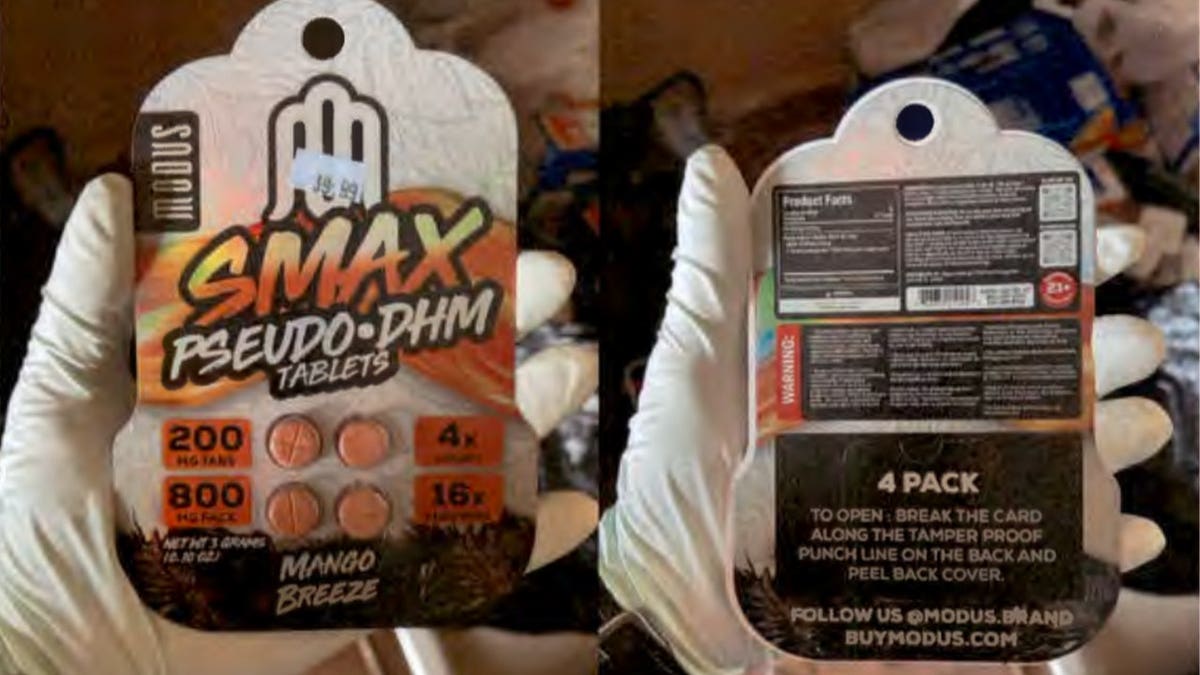
A package of Smax Pseudo-DHM tablets, a synthetic kratom-derived product, that authorities say was found near Aidan Hamilton when paramedics arrived. (Court records)
The court documents do not show that the kratom found near Hamilton came from Puffs Vape, Tobacco and Beer Store. At least one of Hamilton’s purchases was made the day before he was found dead.
Officials said Strang bought the synthetic kratom-derived product at a gas station roughly 30 minutes from Oxford, Mississippi.
MORE STORY: Brits Play ‘Travel Tetris’ to Cut Holiday Costs
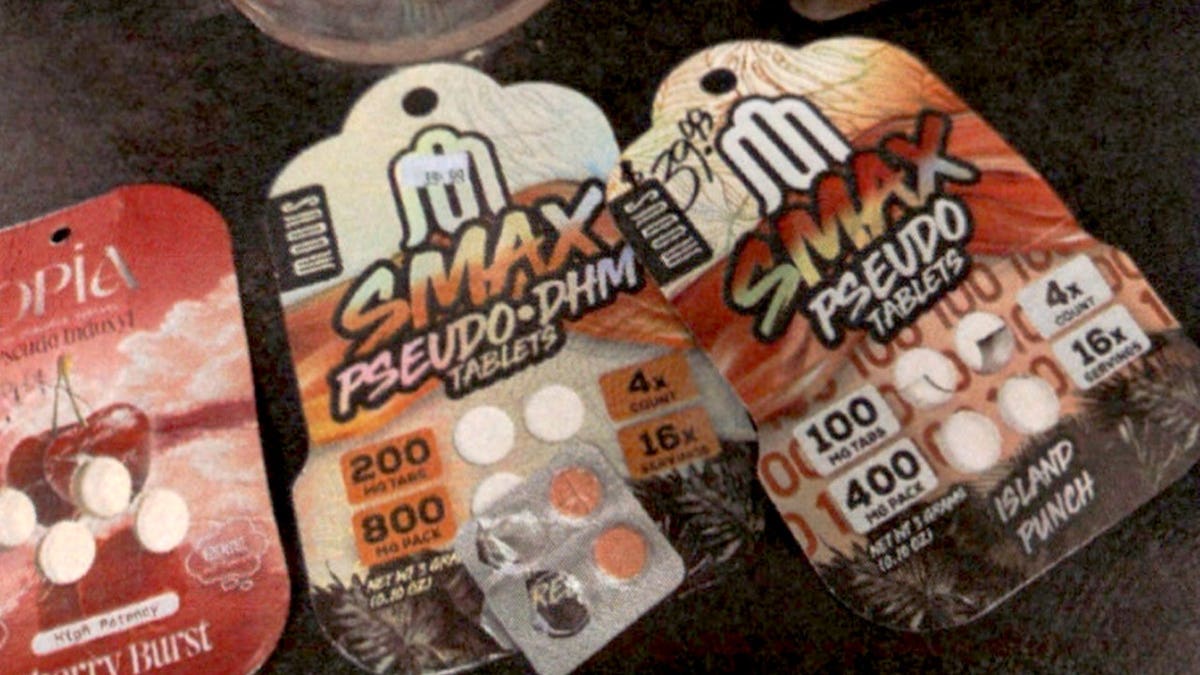
Packages of synthetic kratom products, including Smax Pseudo-DHM and Smax Pseudo tablets, that authorities say were found at the scene where Robert Strang was discovered dead. (Court records)
The gas station owner told News Outlet that the Smax tablets found near Strang were not purchased at his business. He said his store does not place price stickers on its packages, unlike the package found beside Strang’s nightstand. However, he did not deny that the station sold Smax Pseudo Tablets.
The owner said federal agents seized his entire kratom inventory Friday.
Neama Rahmani, a former federal prosecutor, told News Outlet that selling products containing MGM-15 became illegal after the DEA reclassified the substance, though bringing a criminal case could be more complicated.
“It would be unlawful for anyone, whether it’s a drug dealer or a gas station convenience store owner, to sell MGM-15 after it was categorized as Schedule I,” Rahmani said. “Now, to be prosecuted, the Department of Justice would have to prove intent.”
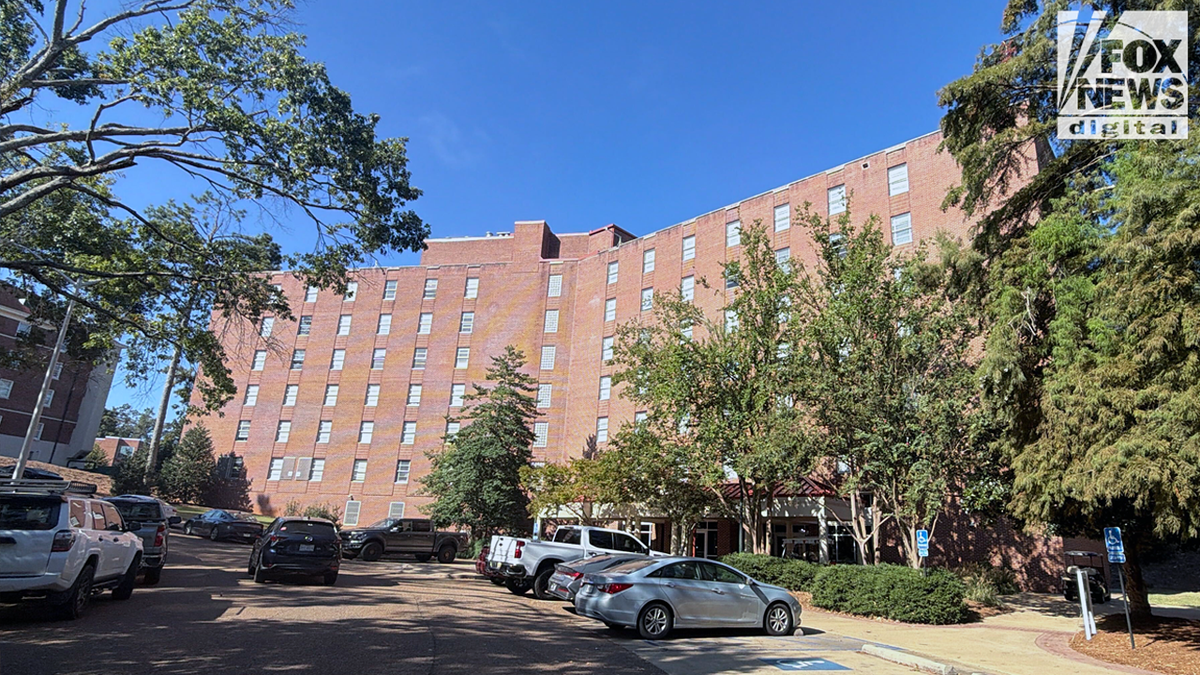
Stewart Hall, a dorm building on the University of Mississippi campus where an 18-year-old student is believed to have died on Monday. Dispatch records show first responders arrived within a minute of being sent to the address. (Adam Sabes/News Outlet)
Kratom itself is a plant, while MGM-15 and similar compounds are synthetic derivatives. The two, Rahmani said, are “certainly not an apples-to-apples comparison.”
Rahmani said Modus, the company named on the packaging, could face civil or criminal liability if testing determines that its product contains a Schedule I substance.
“There’s no doubt that Modus and any company that distributed this drug can face civil, even criminal, liability. If you put out a dangerous product, doesn’t matter if it’s a pharmaceutical, street drug, or really, frankly, anything else. It could be a vehicle, it could be social media. Products liability law does hold the company responsible,” Rahmani said.
“Now, in the case of something that’s outright illegal in Schedule I, there’s no question that criminal liability for the distributors can attach as well, and it can be the manufacturer, it can be the street level dealer, the wholesaler, anyone in the supply chain that distributes a Schedule I drug can absolutely be held responsible.”
Multiple calls and emails to Modus by News Outlet went unanswered.
News Outlet reached out to the FBI, DEA, Mississippi Bureau of Narcotics, Lafayette County Metro Narcotics, Yahya Mohamed Mosleh and Islam Mohamed for comment.