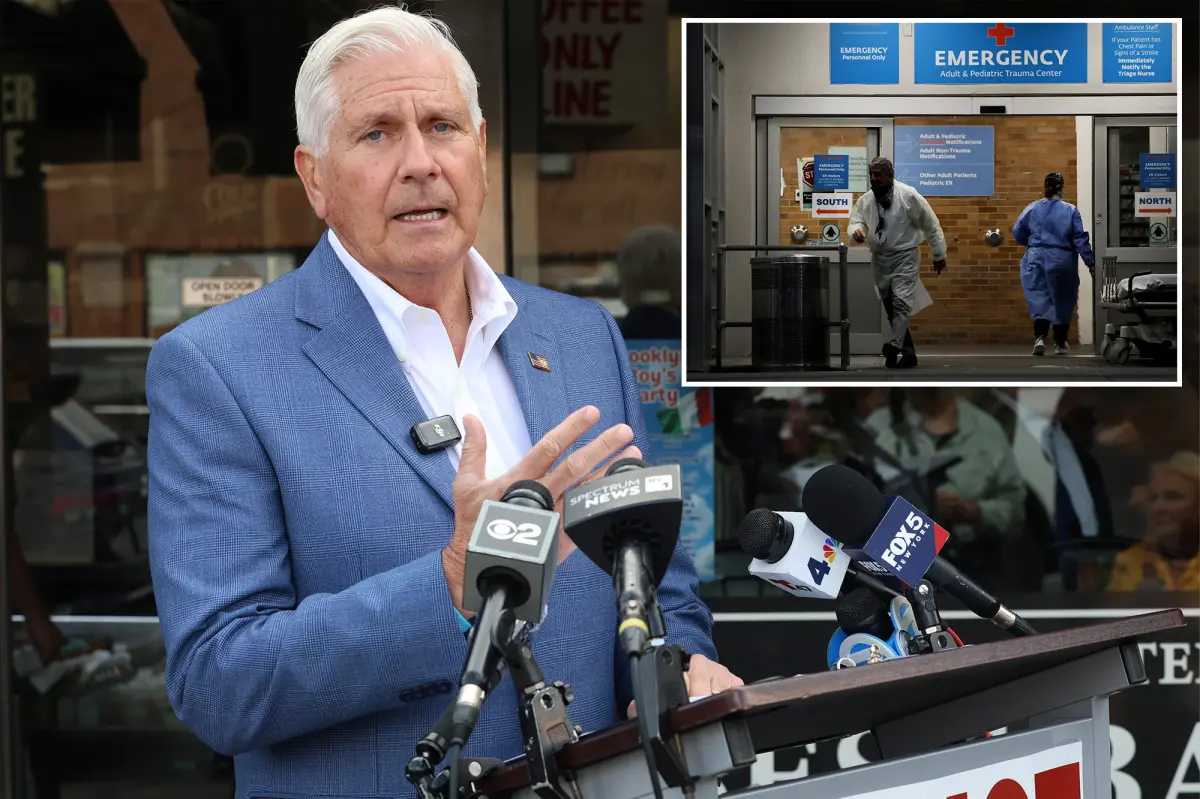

Republican gubernatorial candidate Bruce Blakeman is opposing the state-backed plan to bring Brooklyn’s financially troubled Maimonides Health into New York City’s public hospital network, a move supported by Gov. Kathy Hochul.
The New York State Public Health and Health Planning Council recently approved the proposal, which would make Maimonides part of NYC Health + Hospitals, the city’s public hospital system.
Hochul announced last fall that Maimonides could receive access to a $2.2 billion grant as part of the transition. The funding is intended to help cover payroll and keep the hospital operating as the deal moves forward.
Blakeman argues that the Borough Park hospital, named for the renowned Jewish philosopher and physician Maimonides, should remain privately operated rather than be transferred to a government-run system.
“Kathy Hochul — against the wishes of the local Boro Park community — is leading a state takeover of Maimonides Medical Center, a world-class private teaching hospital with over a century of service,” Blakeman, who serves as Nassau County executive, said.
Blakeman said the hospital also holds personal significance for his family because his wife was born there. He warned that the governor’s unwillingness to heed local concerns could result in poorer healthcare for the residents who have depended on Maimonides for decades.
He pledged that, if elected governor, he would block the takeover and work to restore Maimonides as a leading medical facility.
The dispute over Maimonides’ future has drawn attention beyond New York, reaching the White House and President Trump.
During a recent White House visit, rabbis from Borough Park told the president’s domestic policy advisers that they opposed the proposed city takeover, according to a source.
Maimonides has long served the Orthodox Jewish community in southern Brooklyn, especially Borough Park, where many residents were born at the hospital. The facility also operates a kosher kitchen.
At the same time, Maimonides is regarded as a financially distressed institution that treats a significant number of Medicaid patients and other people with limited incomes.
The hospital is also relied upon by residents of Brooklyn’s growing Asian and Hispanic communities.
EXPLORE MORE: Australian Woman of the Year Award Winner Caught Stealing
Questions about Maimonides’ leadership and long-term future have intensified for years as the hospital’s financial challenges have mounted.
Those difficulties have persisted over an extended period, fueling the current debate over whether public ownership is the best path forward.
Maimonides reported a $145 million loss in 2021.
Local opponents fear that a government takeover could lead to reduced or lower-quality services. Mitchell Katz, president and CEO of NYC Health + Hospitals, rejected those concerns during a recent public hearing.
Katz said NYC Health + Hospitals intends to preserve Maimonides’ cultural traditions and historic identity, emphasizing that the goal is for the hospital to retain what makes it distinct.
Opponents of the plan have also turned to the courts in an effort to prevent the takeover.
Two lawsuits challenging the proposed transaction remain pending.
The planned merger was first announced by former Mayor Eric Adams during the final days of his administration.
The state attorney general or the courts have to give final approval to transfer Maimonides’ assets to Health+Hospitals, sources said.
Hochul defended her support of the Maimonides-Health+Hospitals merger.
“Governor Hochul is committed to saving Maimonides, which is why she directed billions of dollars in support for them while their Board found a partner who could provide a sustainable path forward,” a Hochul spokesperson said.
“Following the standard regulatory review process and direct engagement with the community, New York City Health and Hospitals has agreed to become the operator of Maimonides Medical Center and Maimonides Midwood Community Hospital. This transaction, which was the best and only way to stabilize Maimonides, will help protect access to essential health care in Brooklyn by strengthening the hospital’s long-term financial stability, supporting critical investments in its facilities and technology, and providing additional resources to sustain and improve patient care.”
Hochul’s office also insisted that the merger with the city public health system is not a “takeover.”