

Building wealth, it turns out, may partly come down to having enough time to let assets grow, according to new Federal Reserve data.
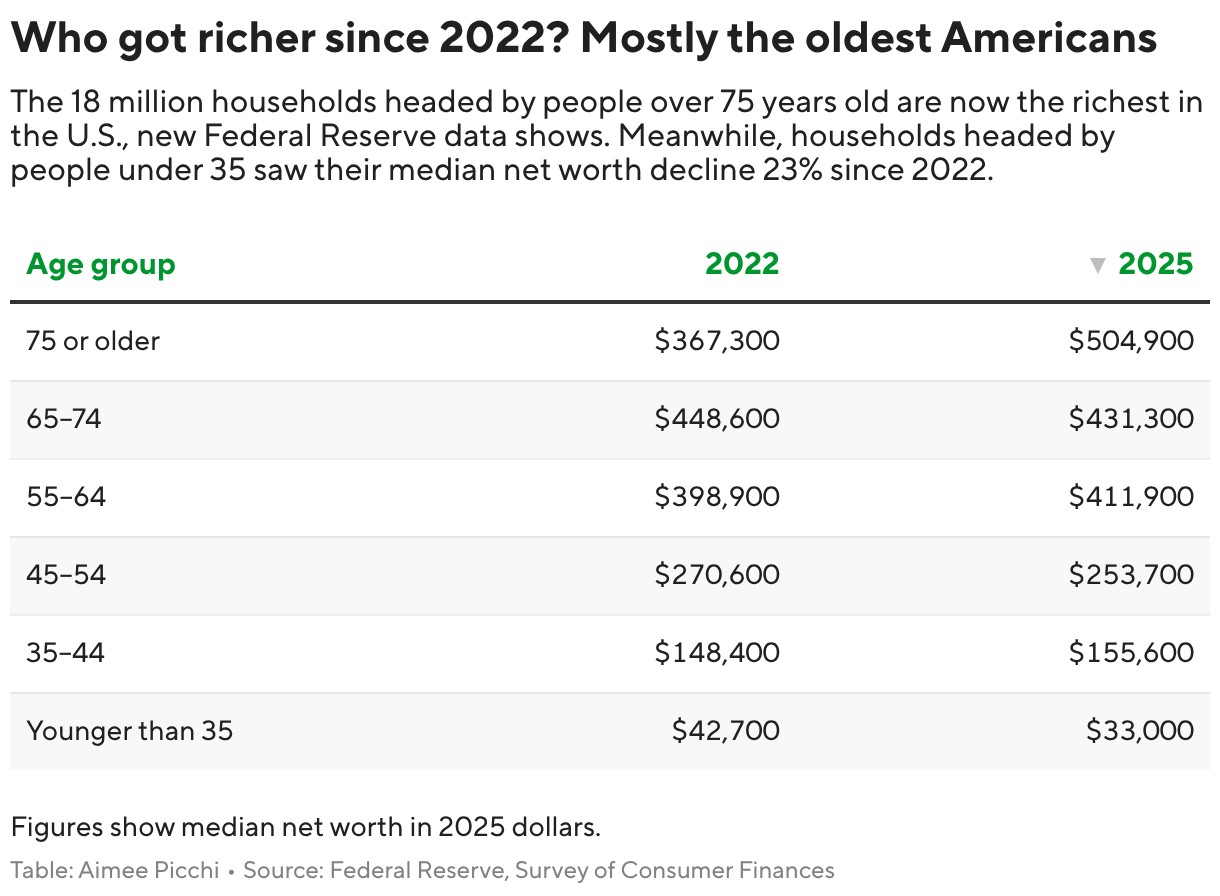
U.S. households led by someone age 75 or older have the highest median net worth of any age group. The Federal Reserve’s triennial Survey of Consumer Finances found that these roughly 18 million households held median wealth of $504,000 in 2025.
The survey offers a broad look at the financial condition of American families, including their wealth, income and liabilities such as credit card balances and student loans. The figures are adjusted to account for inflation.
Older households posted the sharpest growth in both wealth and income among all age groups. Their median annual income climbed 24% from 2022 to $67,000 in 2025, while the Federal Reserve said rising retirement account balances likely helped drive their gains.
Households headed by adults ages 65 to 74 also saw substantial progress, with their wealth rising 37% between 2022 and 2025.
The results highlight how the stock market’s powerful run helped lift household wealth during the period covered by the survey. The S&P 500 advanced approximately 78% from the end of 2022 through 2025.
Fidelity Investments reported that the number of its 401(k) accounts containing at least $1 million rose to a record 769,000 in the second quarter. Strong market performance and historically high average employee contribution rates contributed to the increase.
The wealthiest 10% of American families also saw their median net worth jump 31%, reaching $3.6 million in 2025 compared with 2022, according to the Fed survey.
Although households led by people 75 and older hold the greatest median wealth, they represent only about 13.4% of U.S. families, making them the smallest age category. Families headed by someone under 35 make up the largest group, accounting for approximately one in five households.
The survey also revealed a more difficult financial picture for millions of Americans. In 2025, around one-fifth of households were late on at least one debt payment, including mortgages, credit cards, payday loans and other forms of borrowing. That was a 7-percentage-point increase from 2022.
The rise in missed payments may be linked to the lingering effects of unusually high inflation since the pandemic. However, the survey does not include this year’s renewed acceleration in prices associated with surging energy costs.
“Families were more likely to be behind on their financial obligations than at any point since the 2010 survey,” the Federal Reserve said in its assessment of the 2025 results.
The report found that about one in 12 families devoted approximately 40% or more of their income to debt payments, the largest proportion recorded in at least 12 years.
Census Bureau data showed that nearly 10% of Americans age 65 and older lived below the poverty line in 2025. That compares with about 9% a decade earlier.
Younger households faced a markedly different outcome. The median net worth of families headed by someone under 35 fell 23% between 2022 and 2025, dropping to $33,000. The Federal Reserve attributed much of the decline to weaker gains in business equity during those years.