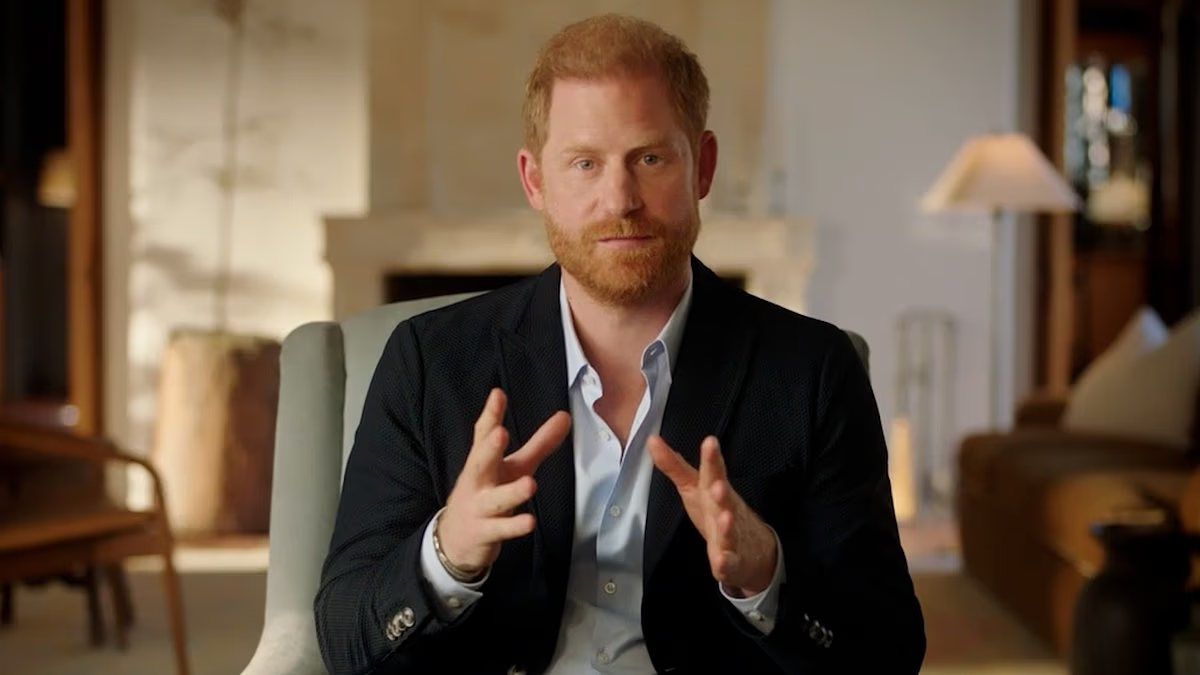

Prince Harry has taken on a new role: Master of Grief.
It is a strikingly bleak title.
As part of his latest commercial project, Harry has partnered with MasterClass on a course called Redefining Grief: Building Resilience Through Loss.
But resilience is a curious theme for a prince who, critics argue, has spent the past six years presenting himself as a victim.
The financial terms also draw attention. Instructors for the online education platform can reportedly receive at least $100,000 upfront, along with a 30 percent share of subscription revenue generated by their episode.
Harry appears alongside Dr Mary-Frances O’Connor, a specialist in grief, who serves as his co-host and expert guide.
‘I’d encourage everyone to watch it before casting any judgement,’ a source close to the prince told the Mail.
Naturally, the appeal is obvious: the more people who watch, the more commercially valuable Harry’s latest project becomes.

Harry’s latest commercial venture is a MasterClass tutorial titled Redefining Grief: Building Resilience Through Loss.

Critics may question whether Harry is the right messenger on resilience after years of publicly discussing his grievances. Meghan was pictured in London this week.
Still, after years of interviews, documentaries and memoir revelations, many viewers may feel they already understand the central message.
Harry remains both aggrieved and grieving. Yet the source insists that, in this new course, the prince is ‘speaking from the heart’.
There is also a practical backdrop. The lucrative Netflix and Spotify deals have ended, Harry has never held a conventional job, and Meghan’s efforts to establish herself as a content creator have largely failed to gain traction.
So the couple appear to be returning once again to their most familiar subject: sorrow, disappointment and personal despair.
‘You would think I had the best help in the world. I’m a prince, for God’s sake,’ Harry says in the course. ‘But I was still grieving and didn’t have any place to put those feelings.’
That raises an uncomfortable question: why would people seek guidance on grief from a 42-year-old man who, despite having extraordinary privilege and access to support, continues to speak about the death of his mother 29 years after it occurred?
He is also a husband and father of two who wrote in his memoir Spare about using drugs and alcohol to dull his emotional pain.
The memoir even described Harry treating a frostbitten ‘todger’ with his late mother’s favorite face cream.
YOU MAY ALSO READ: NY House Candidate Cait Conley Calls Trump America’s Greatest Threat
‘My penis,’ Harry wrote, ‘was oscillating between extremely sensitive and borderline traumatized.’
It is difficult to imagine a more fitting description of the audience’s experience after years of this relentless emotional oversharing.
It beggars belief that the execs at MasterClass think this is a viable offering. It feels more like an epic troll: Are you struggling with complicated grief? Have you been unable to metabolize the loss of a loved one after a sustained period of time?
Listen to Harry, who also admits here that he ‘slipped into depression’ after Megxit.
‘Being in Canada… within two or three days, I experienced an adrenaline crash, something that I’d never experienced before,’ he says.
‘It was as though I needed stress for my brain to function because I became useless around the house.’
It’s not hard to conjure. After all, what does a prince of the blood, who has never had to forge his own purpose — having been born with one — do once he’s thrown it all away?
Meghan seems to thrive in chaos, unperturbed as she burns down family bridges, moves cities and countries and commercial ventures.
Harry, it seems, just wants stability. The safety he felt in childhood, before Diana died.
If only he had a sense of the sacred versus the profane. If only he understood that the more he speaks about his mother’s death, for money, the more — in my opinion — he cheapens her legacy and his own grief.
It really does seem that this is all Harry has going on for himself: perseverating publicly about his mother’s death, reminding us that he is special because he is her son.
That William also lost his mother doesn’t seem to figure here.
But it makes sense, if we consider Harry’s abject failure in the marketplace of ideas. Recall his reported pitch to Spotify, a podcast in which he would interview such figures as Donald Trump, Vladimir Putin and Mark Zuckerberg about their childhood traumas.
Spotify passed.
And Harry’s inaugural appearance as a paid speaker at a corporate event, his first after Megxit, was at JP Morgan’s Alternative Investment Summit in Miami, for which he was estimated to have fetched up to $1 million.
That speech? It was about his late mother and his grief.
One million dollars for that. Imagine.
People with a lot less money and resources have suffered as much, if not more. It’s well past time for Harry to grow up.


