
Australian house prices could fall by as much as 40 per cent in some suburbs, raising the prospect of the nation’s largest property downturn on record, a prominent economist has warned.
The prediction comes as borrowers grapple with four Reserve Bank interest rate increases this year, while another hike remains possible in November.
Chris Joye, founder and chief investment officer of Coolabah Capital Investments, said Sydney property prices were already declining at an annualised rate of 18 per cent.
Speaking on Mark Bouris’ Straight Talk podcast on Monday, Mr Joye forecast a 17 per cent peak-to-trough fall in Sydney house prices.
“On our numbers, individual suburbs (in Sydney) will fall as much as 20 to 40 per cent,” Mr Joye said.
He said national house prices were currently falling at an annual rate of about 16 per cent and predicted an overall peak-to-trough decline of approximately 13 per cent.
“We’ll break the record for the biggest fall ever in house prices on our numbers before Christmas,” he said. “Sydney’s falling at 18 per cent per annum, Melbourne a bit less than that, but double-digit all around the country.”
Mr Joye also warned the housing downturn could coincide with a recession, rising business failures and a sharp increase in unemployment.

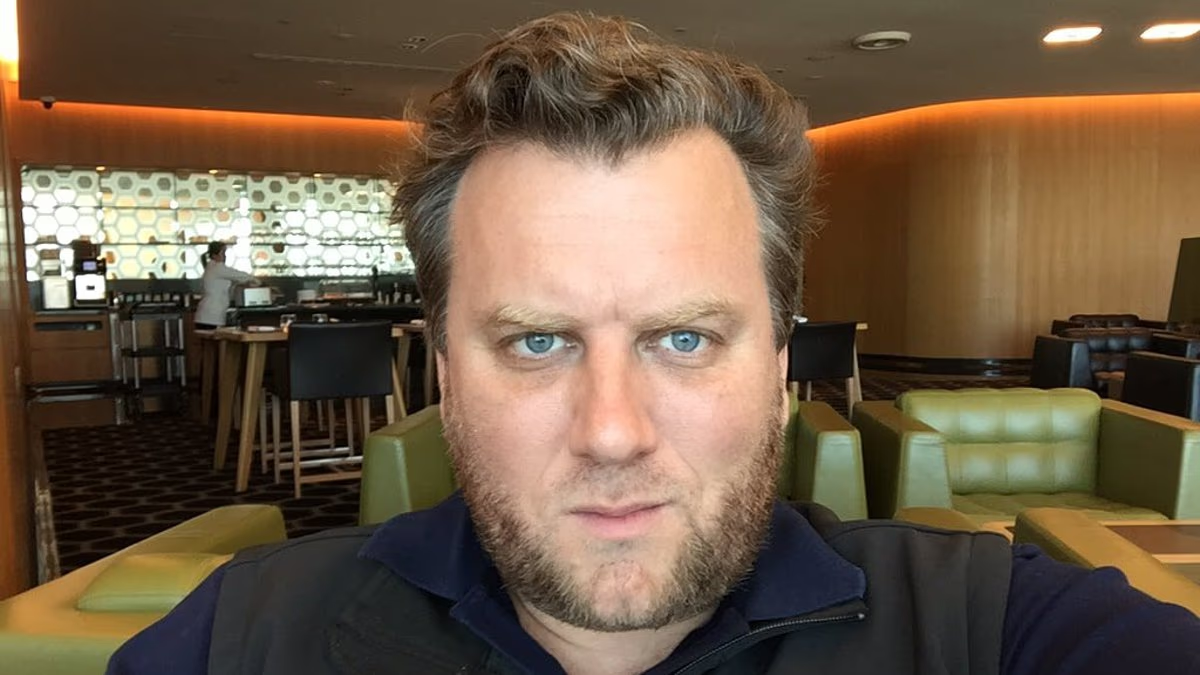
Economist Chris Joye warned that the property slump could be accompanied by a recession, business failures and rising unemployment

RBA governor Michele Bullock has indicated the board is willing to tolerate a weaker labour market and falling property prices in its efforts to bring inflation under control
He said Australia faced a genuine recession risk, with the potential for “a big increase in unemployment”, numerous business failures and widespread job losses.
“I think it’s going to be tough,” Mr Joye said.
“There’ll be adversity and your house is not going to be worth as much as it was, and your super’s probably not going to be worth as much as you thought it was going to be worth, and you’re going to have to work a little longer.
“Maybe you won’t retire when you thought you were going to retire.”
Other property experts are also expecting the downturn to last for an extended period, although their forecasts are considerably less severe.
A survey of 384 real estate experts found property prices were expected to drop between 8 and 11 per cent from their March peak, with a recovery not forecast to begin until September 2027.
The findings suggest the Australian housing market may be only halfway through its decline. Dwelling values have already fallen 5.2 per cent since March, according to property data firm Cotality.
In Sydney and Melbourne, an 11 per cent decline would push property values back to levels last recorded as early as February 2021.

Chris Joye made the comments during Mark Bouris’ Straight Talk podcast on Monday

Australian Property Institute research head Sherman Chan said uncertainty surrounding interest rates and government policy was keeping buyers on the sidelines
Australian Property Institute research head Sherman Chan said uncertainty over interest rates and government policy was keeping buyers on the sidelines.
READ MORE: Wyoming Graduate Student Arrested While Allegedly Fleeing to China After Tea-Poisoning Accusation
‘People are worried about more interest rate hikes on the horizon, and they are after greater clarity,’ Dr Chan told AAP.
Higher interest rates were the experts’ biggest concern, followed by inflation and changes to tax concessions for property investors.
The cash rate was raised to a 15-year high of 4.6 per cent at the Reserve Bank’s September 29 meeting, with governor Michele Bullock warning further increases could follow before the end of the year.
The RBA has made clear it is prepared to tolerate a weaker labour market and falling property prices to bring inflation under control.
An International Monetary Fund outlook on Tuesday forecast inflation would remain above the RBA’s two-to-three per cent target until the end of 2027.
But Dr Chan said interest-rate fears alone could not explain the property slump, arguing uncertainty surrounding Labor’s tax changes was also weighing heavily on buyers.
‘There’s a lot of “wait and see”. High inflation and cost-of-living concerns… (don’t) really justify the slump that we are seeing,’ she said.

Chris Joye said Sydney prices were already falling at an annualised rate of 18 per cent
‘It is really about the lack of clarity about the policy changes that’s holding people back.’
Under the government’s proposed changes, negative gearing would be limited to new builds, while real capital gains would be taxed at a minimum rate of 30 per cent from July 2027, the same month the API expects the housing market could begin recovering.
Dr Chan said a recovery could come earlier if buyers gained greater certainty about the changes before they took effect.
‘I won’t rule that out,’ she said.
‘Some are even optimistic enough to think that it will rebound in the start of 2027, and some are more pessimistic, thinking that it will drag into 2028. What we present is that medium perspective.’
AMP is forecasting a 15 per cent fall in Australian house prices that could become the worst downturn on record.
Such a fall would wipe about $139,971 from national home values and $241,057 from Sydney prices, potentially leaving recent buyers who purchased near the peak facing mortgage stress and negative equity, where they owe the bank more than their home is worth.
Mr Joye blamed the inflation problem largely on government spending, population growth and weak productivity, dismissing claims that the war between the US and Iran and resulting surge in fuel prices was the main culprit.
He said state and federal governments had racked up $660 billion in spending on cheap credit since 2022.
‘It’s all public spending. It’s all population growth and migration,’ he said.
‘And it’s all productivity. I mean, the oil price stuff is at the margins.
‘It’s not… the reason the RBA hasn’t hit its inflation target since 2021. That’s a recent event. So, he’s just bulls***ing.’


