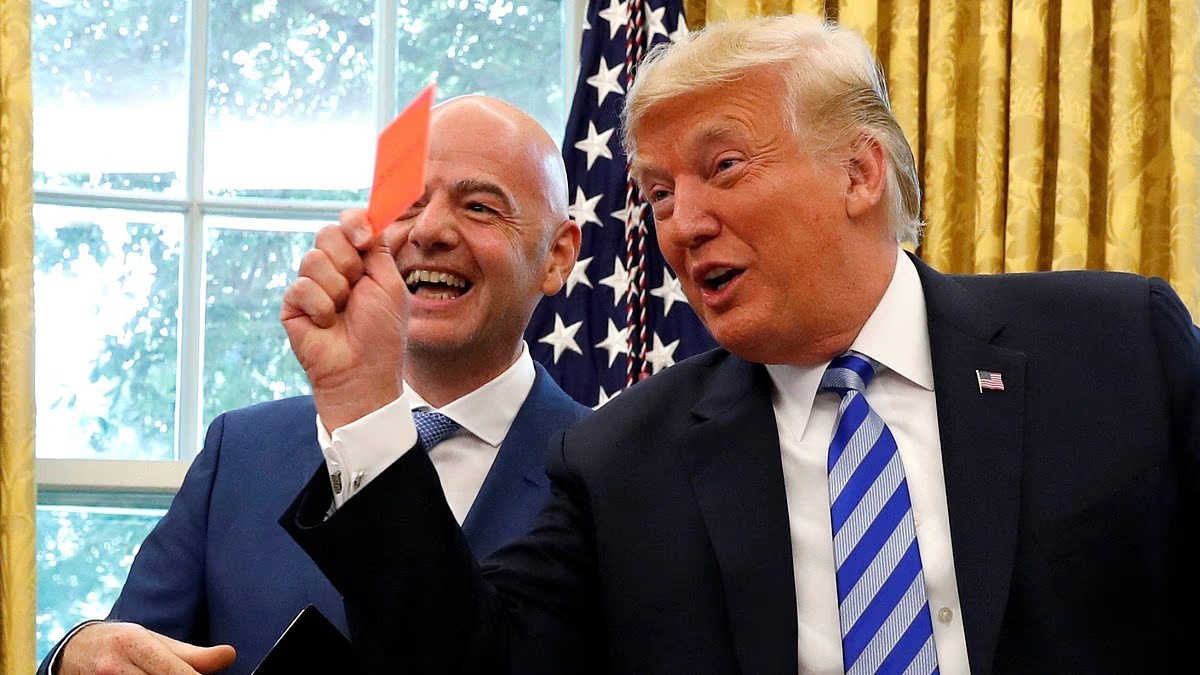

FIFA president Gianni Infantino allegedly stepped in to suspend Folarin Balogun’s World Cup red-card ban after speaking with President Donald Trump, according to a newly published report.
The controversy began when Balogun was initially ruled out of the United States’ last-16 clash with Belgium. His suspension was later put on hold by the FIFA Disciplinary Committee after an intervention from the White House. The New York Post now reports that Infantino told Trump during a July 1 phone call that he would “take care of it,” adding: “One call and it was done.”
FIFA has not addressed the latest allegation directly. Instead, the organization referred to a statement Infantino released in July, in which he maintained that the ruling had been made by independent bodies operating without outside influence.
The report is expected to increase scrutiny of Infantino as he attends a FIFA Council meeting in Switzerland this week, an event some observers believe could be “explosive.” The FIFA chief has faced mounting criticism over the past year. In December, he presented Trump with the first-ever FIFA Peace Prize, a decision that was widely mocked.
The Balogun dispute also fueled accusations that Infantino had shown favoritism and yielded to pressure from the White House. During the tournament, the FIFA president and Trump were further ridiculed after jointly presenting the trophy to Spain.
Infantino later encountered internal resistance over confidential plans to sell a stake in the World Cup to private equity firms. Those proposals, which included investors such as Joshua Kushner, the brother of Trump’s son-in-law Jared Kushner, were eventually abandoned.

Gianni Infantino is alleged to have intervened in the suspension of Folarin Balogun’s World Cup red card

The striker was dismissed after a tackle during the United States’ 2-0 victory over Bosnia and Herzegovina
Balogun received his marching orders during the United States’ July win over Bosnia and Herzegovina. Under FIFA rules, a red-card decision can generally be challenged only in cases of mistaken identity or when the player is facing a suspension spanning multiple matches.
Trump later acknowledged that he had asked Infantino to review the decision that removed Balogun from the game.
“All I did was ask for a review. I didn’t say, you have to do this,” the president said. “This man is a smart, tough man, Gianni Infantino.”
Trump added: “His stock has gone through the roof because the job he has done has been great. I feel like we have to have all the best players on the field.”
Although Balogun was cleared to return, the United States’ World Cup run ended with a heavy 4-1 defeat by Belgium.
Jesse Marsch, the US-born coach of Canada, criticized the decision after the controversy erupted. “What I feel when the Balogun ruling happens is that would never happen in any other country in the world, and this is why everyone around the world hates America,” he said.
As criticism spread, Infantino issued a statement defending FIFA’s disciplinary process. “I have seen the public comments regarding the decision of the independent FIFA Disciplinary Committee related to the suspension of Folarin Balogun, and I would like to reiterate a fundamental principle of FIFA’s governance,” he wrote.
“FIFA’s judicial bodies are independent. They operate autonomously, apply the FIFA Disciplinary Code, and decide cases based on the applicable regulations and the specific facts before them.”
He continued: “Their independence is essential to the credibility and integrity of football, and this must always be respected.”

Trump later acknowledged asking FIFA president Gianni Infantino to review Balogun’s dismissal

The United States were eliminated after losing 4-1 to Belgium in Seattle
Infantino also confirmed that he had spoken with Trump, while emphasizing that such conversations were part of his wider contacts with international leaders and football officials. “Yes, I regularly discuss matters related to the FIFA World Cup with the President of the United States, and on this matter, I did receive a call from President Donald Trump, just as I receive calls from heads of state, government officials, football stakeholders and business executives from around the world on many different issues,” he said.
‘During our conversation, I explained that there was an ongoing legal process involving FIFA’s independent judicial bodies and that the case would be decided in due course by the competent bodies.
‘That is how FIFA’s system works, and it is a principle that I will always uphold. I read the decisions of the FIFA Disciplinary Committee when they are issued. Sometimes I am surprised by them. Sometimes I agree with them, and sometimes I disagree.
‘What I always do, however, is respect those decisions and the autonomy of the bodies that make them. Whether we personally like a decision or not is irrelevant. Respect for independent institutions and the rule of law is what protects the integrity of our competitions and the credibility of FIFA at all times.’
The Post also reports that, on the eve of a FIFA council meeting this week, soccer chiefs proposed a disciplinary code change that ‘forbids FIFA legal panels from suspending automatic one-game bans for red cards.’
A source insisted the move would only put the change up for discussion at the upcoming FIFA meeting and was neither an emergency attempt to rewrite the rules or an admission of guilt over the Balogun affair.
Earlier this month, meanwhile, former Tottenham defender Ramon Vega announced his intention to challenge Infantino at next year’s FIFA presidential election.
Despite mounting pressure over recent months, Infantino intends to stand for a fourth consecutive term next March at the FIFA Congress. But there is uncertainty around his future after three confederations rejected Infantino’s plan, which was then abandoned.
Among them was UEFA, which said it has lost confidence in Infantino and threatened to boycott future World Cups.
Vega, meanwhile, played for Tottenham between 1997 and 2001 and is the first person to publicly challenge the 56-year-old.