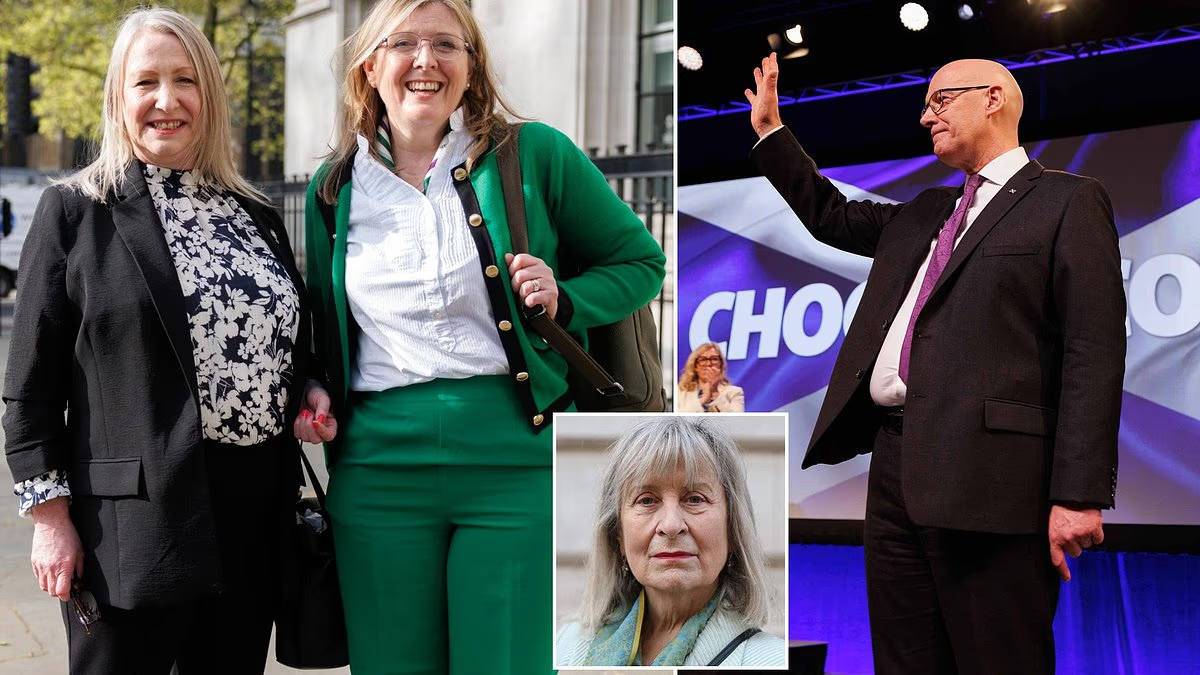

John Swinney has come under fire for reviving plans for a misogyny law that was previously abandoned by his justice secretary.
Speaking at the SNP conference, the First Minister pledged to introduce legislation before next summer that would make “harassment and abuse based on misogyny a specific criminal offence”.
The Scottish Government scrapped similar legislation in May 2025, saying there was insufficient time to rewrite the proposals after a Supreme Court ruling on the definition of a “woman” under the Equality Act. The abandoned bill had included protections covering transgender women.
A working group chaired by lawyer Baroness Helena Kennedy had recommended a standalone bill, citing the seriousness and complexity of misogyny-related offences, including sexual violence, hate, gender-based threats made online and “incel” culture.
Critics have questioned whether the SNP can be trusted to protect women and girls after its earlier attempt to introduce the legislation was dropped.
Meghan Gallacher, the Scottish Conservative equalities spokeswoman, said: “The SNP have been so duplicitous over protecting women and girls, for so long, even they don’t really believe what they say.

Baroness Helena Kennedy recommended a standalone misogyny bill in 2022

For Women Scotland’s Susan Smith (L) and Marion Calder (R)
“A misogyny law was promised in the last Scottish Parliament and wasn’t delivered. Nicola Sturgeon waged war on protected spaces for women and girls and was backed to the hilt by John Swinney.
“When the SNP don’t even know what a woman is, how can they claim to be serious about defending us from misogyny?”
In a 30-minute address to delegates in Aberdeen, the First Minister focused heavily on the constitution before unveiling his plans to tackle gender-based violence.
He said: “My government will bring forward a Bill to make harassment and abuse based on misogyny a specific criminal offence and we will do so before the summer recess.
“It will recognise misogyny as a distinct form of prejudice and abuse. We will not accept misogyny. It is completely deplorable and it has no place in the Scotland we choose.”
Mr Swinney also announced a £1 million “Respect fund” for schools, intended to give every school the resources required to address misogyny.
The Scottish Government later said it would invest “up to an additional £1 million” so secondary pupils could access third-sector programmes designed to help young people reject misogyny. Primary pupils would receive age-appropriate lessons focused on respect.
Police Scotland’s 2021 campaign against misogyny, “Don’t be That Guy”, will also return. The initiative will feature sporting figures as positive role models for young men, including Scotland rugby players Jamie Dobie and Grant Gilchrist, alongside tennis player Connor Thomson.
In 2022, then-First Minister Nicola Sturgeon accepted recommendations from a panel led by lawyer and human rights expert Baroness Helena Kennedy. The group called for dedicated legislation to address misogynistic abuse.
The proposed law was intended to cover street harassment, organised online hate and repeated threats of rape and disfigurement, which Lady Kennedy said “absolutely degrade women’s lives”.
Lady Kennedy argued that a separate bill was necessary because of the scale and complexity of the problem, which includes sexual violence, hatred, gender-based online threats and “incel” culture.

John Swinney announced plans to revive the previously abandoned misogyny bill
For Women Scotland’s Marion Calder said: ‘There is no detail yet about this new bill but it won’t be surprising that we do have concerns.
‘The Scottish government’s lawyers were arguing against us in court very recently for biological men to remain in female jails, failed to support a bill criminalising the purchase of sex and remain silent on men being placed in women’s wards in hospitals.
‘Perhaps instead of soundbites announcing new legislation that will not address the root causes, they should do the hard work around it.’
Rape Crisis Scotland said it welcomed the decision.
External affairs manager Nicola Love said: ‘Misogyny legislation was initially recommended because it recognised the extent of abuse that women and girls were being subjected to as part of their everyday lives, which was often going unreported and being perpetrated without consequence.
‘We were incredibly frustrated to see the misogyny bill dropped at the end of the last session and we made our feelings about that known at the time.
‘It is encouraging to see it brought back with a clear timescale, and we look forward to engaging with the draft legislation to make sure it has the intended impact, which is ultimately to make women and girls across Scotland safer.’
Alongside the gender-based violence announcements, Mr Swinney focused on Scotland’s constitutional future in his speech, mentioning ‘independence’ two dozen times in half an hour.
Scottish Conservative leader Russell Findlay said the First Minister had ‘inevitably and recklessly indulged’ in his ‘obsession’ with independence and added: ‘His divisive rhetoric serves as distraction from the SNP’s miserable 20-year record of failure.’


