
How, exactly, does the Royal Family handle Harry and Meghan? One can imagine the question surfacing over the King’s morning coffee. After weeks of unmistakable positioning, the Sussexes have stepped back into the spotlight, turning heads in Nottingham during their first official-but-not-royal appearance together.
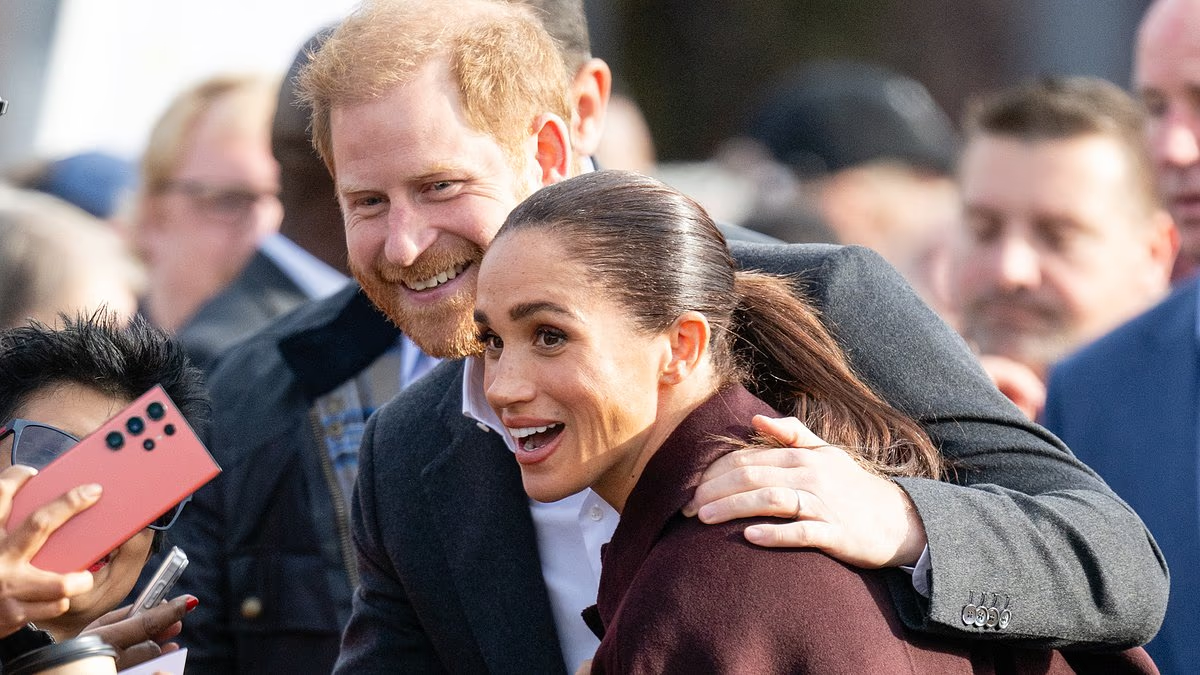
Meghan embraced a carefully calibrated palette of plum and burgundy, pairing a £26 Marks & Spencer belt with £650 Jennifer Chamandi stilettos, a £345 Joseph cashmere sweater and a £1,495 Joseph cashmere coat. The message was clear: polished, expensive and accessible—or at least accessible by royal standards.
She added a deliberately informal touch by revealing a bare calf and ankle, reinforcing the image of a duchess determined to appear relaxed, relatable and close to ordinary people.
Around 200 supporters gathered, although many in the crowd were photographers and journalists. Meghan held her flowers, hugged well-wishers, posed for selfies and greeted children with enthusiastic smiles and waves. Harry watched on with the unmistakable expression of a devoted husband.
The couple decorated cakes, exchanged greetings with strangers and performed the familiar choreography of a royal walkabout. In almost every respect, it recalled the appearances they made before their so-called “freedom flight”—albeit after six years of bitter disputes, millions spent on legal fees and a conspicuous amount of commercial branding.
Nottingham was also the setting for their first official royal engagement in 2017, making the choice seem unlikely to have been accidental. Yet it raises an obvious question: if these exhausting public appearances helped drive the Sussexes away from royal life, why return to precisely the same stage now?

Harry and Meghan drew crowds in Nottingham during their first official non-royal appearance together, writes Sarah Vine
At the same time in Cardiff, King Charles and Queen Camilla were carrying out the formal opening of the new session of the Welsh Parliament. They met community groups and navigated anti-monarchy demonstrators, yet their engagement received only a fraction of the attention generated by the Sussexes in Nottingham.
For the King—and, inevitably, for Prince William—this must feel like the scenario they feared most when Harry and Meghan announced their return to Britain. The Sussexes have re-entered the public arena on their own terms, outside the restrictions of official royal duty.
Freed from formal protocol and the expectations attached to senior royal life, Harry and Meghan appear determined to establish themselves as a more modern, informal alternative to the institution. In a culture driven by novelty and attention, that strategy could prove remarkably effective.
Their critics argue that the couple have shown little understanding of the constitutional role of the Crown or the tradition of service associated with Queen Elizabeth II. To those observers, the Sussexes’ public criticism of the Royal Family reflects a focus on personal ambition rather than duty.
That criticism also points to the source of their influence. In an era when public standing is measured in clicks, likes and online engagement, a narrative built around grievance can travel further than one based on patience, discipline and quiet endurance. Harry and Meghan’s emphasis on personal hurt fits comfortably within a broader culture of victimhood.
IN CASE YOU MISSED IT: Dad Who Murdered 9-Year-Old Daughter on Vacation Learns Fate
Their approach can therefore attract an audience that finds the restraint and solemnity of the King and other senior royals distant or difficult to engage with. The Sussexes offer emotion, conflict and immediacy—qualities that tend to perform well in the modern attention economy.

In the age of social media, the Duke and Duchess have tapped into a culture that rewards grievance and personal storytelling
The King’s decision to continue working despite ill health might once have been viewed as evidence of resilience and character. Today, however, such stoicism can be dismissed as an outdated “stiff upper lip”—the very attitude Harry criticised in his memoir, Spare, when discussing emotional repression and the psychological impact of losing his mother, Princess Diana.
The result is a striking double standard. Meghan is often praised as courageous for speaking openly about mental health, while Charles, now in his seventies and continuing his public duties during cancer treatment, can be portrayed by critics as emotionally detached. It is a dispiriting reflection of the times.
The difficulty for the Palace is that Harry and Meghan show no sign of adopting a quieter or more restrained approach. They appear committed to building a parallel public role and will naturally compete for attention with the working royals. Yet they have broken no law, leaving the King with few obvious means of stopping them.
That may ultimately force the Royal Family to consider bringing them closer to the institution once again. Restoring titles, privileges and official status—including security, staff, accommodation, ceremonial appearances and financial support—could, in theory, be the most effective way to contain their influence.
The precedent is Princess Diana, who was often considered more disruptive to the Royal Family after leaving it than while she remained within the institution. The uncomfortable possibility is that the same calculation may now apply to her younger son and his ambitious wife.
Zeta’s glam… like my gran

Catherine Zeta-Jones in Kill Jackie on Amazon Prime
Having spent a few days on the sofa last week recovering from a small operation, I stumbled across Kill Jackie on Amazon Prime. Think Guy Ritchie meets Quentin Tarantino meets Gavin And Stacey, with Catherine Zeta-Jones as the eponymous Jackie, a reformed cocaine queenpin from Swansea on the run from a gang of assassins. It’s both bonkers and brilliant – not least because even though Zeta-Jones looks every inch the star, each time she opens her mouth she sounds exactly like my Welsh granny.
Hail Sufragettes of Smugdom
They are the ME+EM Martyrs, the Artisanal Agitators, the Suffragettes of Smugdom. Well-heeled, well-connected, secure in their lib-Left outlook, ensconced in their own VIP corner of the moral high ground. I’m talking, of course, about the Palestine Action (proscribed terror group) fangirls: Tilda Swinton, Charlotte Church, Miriam Margolyes, Sally Rooney – and now author Sarah Helm, wife of the Government’s national security adviser, Jonathan Powell. Far be it from me to criticise the wife of a high-profile official for expressing a political opinion. But I seem to recall that when I dared to make a modest suggestion at the time of Brexit, I was vilified by the so-called sisterhood and branded ‘Lady Macbeth’. Whereas Ms Helm remains unchastened and has even been characterised as ‘standing up for free speech’. Where did I go wrong?
Last week, a coroner ruled that Adriana Retyte, a 14-year-old from Norfolk who took her own life in May was ‘aided by having viewed online content’ – the content being videos on suicide. Hers is not the first family to have its heart ripped out by social media, nor will it be the last. Meanwhile, we learn that Nick Clegg is set to trouser £30million from the Wall Street flotation of Nscale, a UK-based AI company. Seriously, how do these tech ghouls sleep at night?