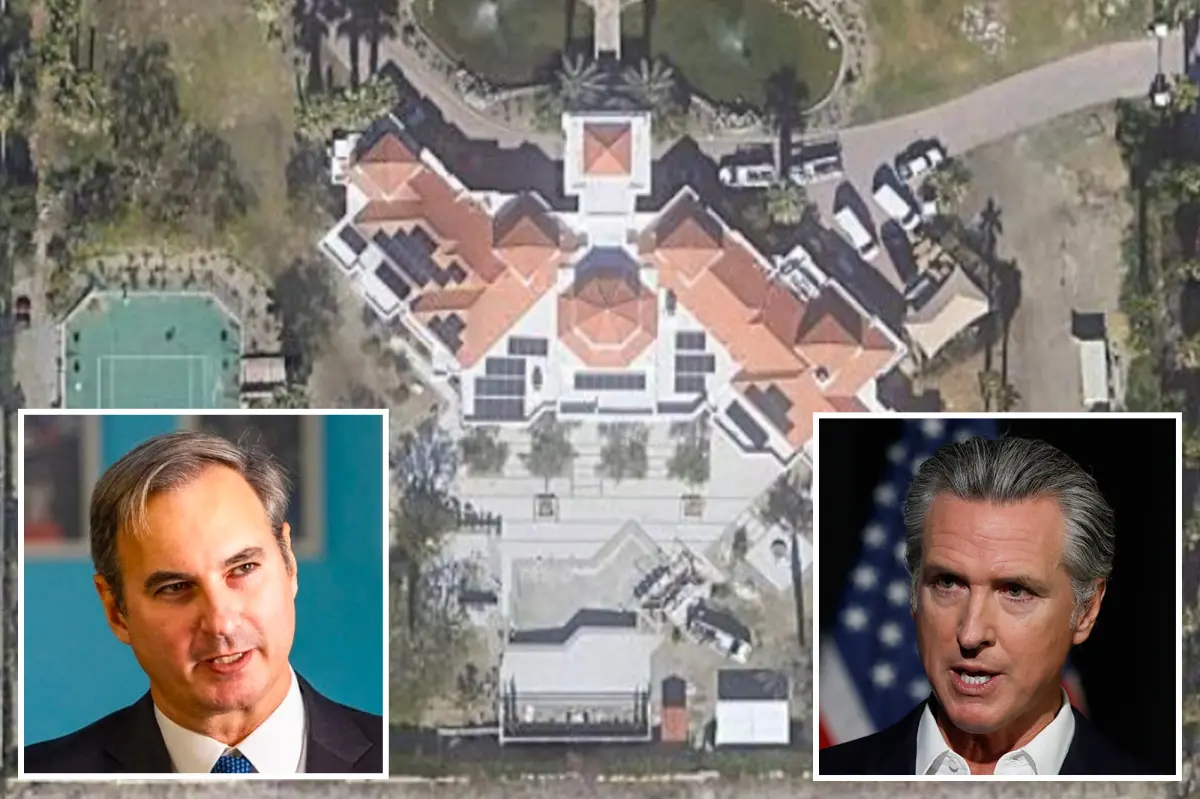

A convicted Wall Street fraudster once branded New York’s top tax delinquent has built a lavish new life in California, where he runs a charity praised by Gov. Gavin Newsom and promotes erectile dysfunction medication — even as his unpaid tax liability has climbed to $59.1 million, The Post has learned.
Daniel Gordon, a former Merrill Lynch trader who admitted in 2003 to stealing $43 million from the firm through an elaborate wire-fraud scheme, now lives with his wife, Kate, in a 10,495-square-foot home outside Palm Springs. California tax records value the property at more than $5 million.
The Rancho Mirage estate sits in an affluent desert community once home to figures including Frank Sinatra, Bill Gates and former President Gerald Ford. A real estate listing describes amenities such as a recessed tennis court, a three-hole putting course and a resort-style swimming pool equipped with waterfalls and a swim-up bar.
At 50, Gordon has recast himself as a California philanthropist. Through Gordon Philanthropies, a charity focused on prison reform, he has appeared in television interviews and posed with representatives of the LAPD and California’s corrections department. His website also features images of him attending ribbon-cuttings and other charitable events.
In November 2024, Gov. Newsom sent Gordon a strongly worded letter of appreciation. Addressed simply to “Daniel,” the message included a prominent handwritten “Thank you!” above the governor’s signature and was later showcased on the charity’s Facebook page.
“Thank you again for your generous contributions,” Newsom wrote. “I look forward to your continued partnership.”
Neither Gordon nor Newsom’s office responded to requests for comment. California prison officials also declined to address questions about Gordon’s criminal history or massive tax debt, instead referring to regulations that permit the department to accept private donations.
Gordon’s California makeover follows New York’s decision in 2016 to identify him as the state’s largest tax delinquent. At the time, he appeared on the Department of Taxation and Finance’s “Top 100” list with $25.1 million in outstanding warrants, while officials promised The Post they would track him down and pursue payment.
Nearly 10 years later, two active tax warrants filed in Albany County total $59,141,763.16.
The debt stems from Gordon’s attempted $43 million theft from Merrill Lynch. At age 24, the Yale graduate deceived his superiors into authorizing a transfer to an offshore shell company, then diverted the money through a fabricated insurance transaction.
Although Gordon was ordered in 2003 to return the stolen fortune, federal and Albany County tax authorities also sought taxes on the proceeds. Under tax law, illegally obtained money can still be treated as income. Interest and penalties have since driven the balance sharply higher.
At a 2013 bankruptcy hearing, Gordon acknowledged under oath that he had avoided more than $34 million in back taxes. He said the IRS had made clear that returning the $43 million did not eliminate his tax obligation: “Under our laws you owe us taxes … regardless of the fact that it was repaid.”
His criminal convictions did not erase the tax claims. When tax authorities continued seeking payment, Gordon turned to bankruptcy court in an effort to escape his debts.
In a sharply critical 2015 ruling, US Bankruptcy Judge Robert E. Gerber rejected Gordon’s Chapter 7 effort to discharge his personal liabilities. The judge found that Gordon had concealed $3.1 million in assets and lied under oath, dismissing his explanations as claims that “insulted the intelligence of the court.”
Evidence presented at the trial showed that Gordon had transferred $2 million to a fictitious Nevada shell company with no employees, office or financial records. Judge Gerber was also taken aback when Gordon’s attorney confirmed that the former trader had charged ex-New York Knicks center Eddy Curry an 89.79% interest rate on a $570,000 loan. The balance reached $2 million after only 18 months.
Gordon testified that he possessed just $3,147. Yet he also acknowledged renting a Manhattan apartment for $19,000 a month and spending $140,000 on a summer home in the Hamptons, with the Upper East Side lease concealed through a corporate entity.
Despite the intense publicity surrounding Gordon’s financial and criminal cases, New York officials have still not filed the routine documents needed to pursue the enormous tax balance. That inaction continued even after a whistleblower alerted authorities more than two years ago, The Post has learned.
Emails obtained by The Post show that state investigators took no apparent action after receiving a detailed guide to assets allegedly worth more than $26 million.
In March 2024, an unidentified whistleblower sent multiple reports to the internal affairs division of the Department of Taxation and Finance. The source, a Texas entrepreneur, asked to remain anonymous, citing death threats and an ongoing legal battle with Gordon.
One message identified “$4.1mm dollars in non-exempt California Real Estate in addition to the 22mm worth of shares of stock in public companies,” according to the emails.
“I would really like the state of New York, at least, to get their money back,” the tipster wrote.
The tipster even pointed state investigators to an address right in their own backyard: a stock transfer agent at 1 State St. in Lower Manhattan holding shares tied to a Gordon-linked corporate vehicle.
ALSO READ: Mother Fights Off Intruder After He Grabs Her by the Neck
A New York tax investigator, identified in the messages only as Inv. Politylo, replied promising to “forward this to the appropriate department.”
More than two years later, however, county records show New York has yet to record a single lien against the Rancho Mirage mansion. Empire State tax warrants expire after 20 years, meaning Albany has already blown half the clock to collect.
Darren Dopp, a spokesman for the New York Department of Taxation and Finance, declined to comment on what efforts the agency under Gov. Kathy Hochul has made to collect the $59.1 million, citing state tax secrecy laws.
Thanks to a bureaucratic rule, New York drops deadbeats from its “Top 100” list if officials fail to file a fresh warrant in 12 months, Dopp said. Debtors can also drop off the list by challenging an assessment, cutting a deal, dying, or declaring bankruptcy.
Edward Zelinsky, a tax professor at Yeshiva University’s Cardozo School of Law, said tracking down Gordon’s California assets should be straightforward for New York’s top lawyers.
“This is certainly something that should be within the routine competence of the New York attorney general, particularly for large judgments where it would be financially feasible to acquire help from counsel in the other state,” he said.
A spokesperson for New York Attorney General Letitia James insisted the state’s top prosecutor can’t lift a finger unless tax officials formally hand over the file.
“The Department of Taxation and Finance is the primary enforcement agency in matters involving outstanding public tax debts unless a referral is made to the Office of the Attorney General,” James spokeswoman Alexis Richards said.
“Per the Post’s own reporting, the Department issued warrants for Mr. Gordon’s state tax debts. That is the end of the story here, but unfortunately The Post seems determined to disparage the critical work the Office of the Attorney General does every day to protect New Yorkers and their wallets,” she added.
The Tax Department, for its part, claimed it never sends collection cases to James’ office.
“The AG’s office is not involved in the case,” Dopp said. “The AG’s office does not handle our collections matters.”
“It’s very unusual,” added Timothy Noonan, a partner at Hodgson Russ LLP. “I would think a taxpayer like that would be high on the radar screen.”
When tax deadbeats flee the state, tax authorities “can authorize the Attorney General to pursue collection anywhere else,” Noonan said. Specifically, by “domesticating the warrant” in California, Albany could turn its New York tax tab into a local court judgment overnight, freeze Gordon’s bank accounts and seize his desert mansion, Noonan said.
Generally, there is no law that prevents the AG and the tax department from picking up the phone to coordinate, said Steven Goldburd, a managing partner at Manhattan tax firm Goldburd McCone LLP.
“Governments are all about going after low-hanging fruit,” he said. “It is infinitely easier to attack a $2,000 tax bill of a taxpayer that will likely never fight back than the multimillion-dollar tax bill of a legally well-armed taxpayer that will.”
Still, while a wealthy tax dodger can employ high-priced consultants to shield themselves from collection and delay enforcement, “an LLC is a legal barrier, not a magic cloak,” former Manhattan DA asset forfeiture chief Duncan Levin told The Post.
“New York cannot simply grab company assets to pay an owner’s personal tax bill,” Levin said. “But if the company is really his personal piggy bank, that barrier may come down.”
Levin added that Gordon’s California palace could be a much easier target because it sits in his own name, though seizing real estate requires a court order.
“A $5 million house is not a $5 million check,” Levin said. “The state’s job is to turn a tax warrant into a recovery. You don’t collect a debt by admiring the size of it.”
Meanwhile, Gordon stays busy in California. Corporate filings show his charity, his penny stock outfit Polomar Health Services, and his GLD Partners investment arm all operate out of the same Los Angeles office suite.
SEC records show he holds 49% voting control at Polomar, which recently spent more than $193,000 buying “Wafesil” — a dissolving sildenafil erection drug — directly from another firm Gordon controls.
Disclosures reveal Polomar has also been pushing an “inhalable sildenafil” program: essentially an asthma-style rescue inhaler loaded with generic Viagra.
CONTINUE READING: Sydney mum Sammi reunites with cruise lover after fiancée reveal