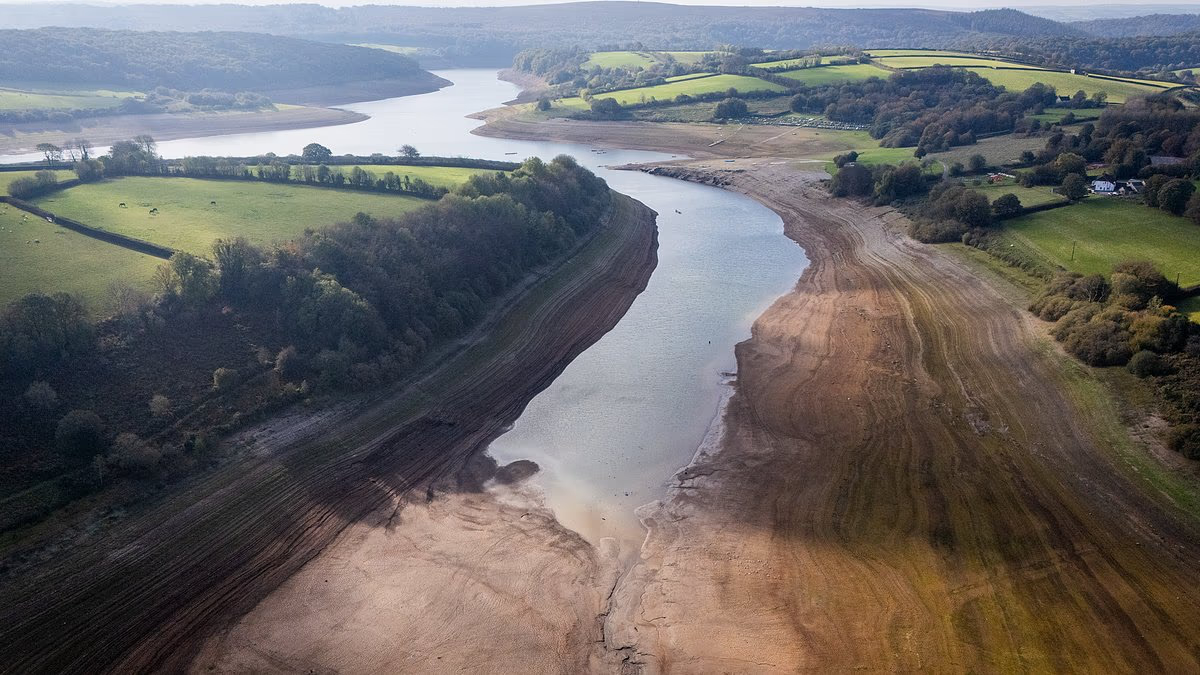

Ministers have been privately warned that some reservoirs could run dry within weeks, potentially creating severe disruption for households in the run-up to Christmas.
The Government’s emergency committee, Cobra, is holding twice-weekly crisis meetings over water supplies in south-west England and Sussex.
A secret “reasonable worst-case scenario” prepared by officials warned that water reserves could fall to zero per cent within weeks.
If no action is taken, household taps could run dry, while construction work on a nuclear power plant could also be affected.
Wimbleball Reservoir, which supplies more than 400,000 people in Somerset, is currently at 13 per cent capacity. Ardingly Reservoir, serving 280,000 customers in West Sussex, is at just 17 per cent.
Record-breaking summer heatwaves triggered widespread drought, leaving some parts of England under hosepipe bans even after two autumn storms swept across the country.
Sussex and the south-west were among the worst-hit areas, recording their driest April-to-September period in more than a century. Both regions continue to face critically low water supplies.
Emergency plans have been prepared for a frightening “Day Zero” scenario in which reservoirs in each area become completely empty.

Pictured: Wimbleball Reservoir, which is at 14 per cent capacity

Ardingly Reservoir in West Sussex supplies about 95,000 properties served by South East Water in Haywards Heath, Uckfield and nearby areas. It is at 19 per cent capacity.
The threat of winter drought has prompted water companies to ask the Government to introduce bans on non-essential water use. Such restrictions could prevent businesses from operating car washes and water sports facilities, as well as refilling private swimming pools.
Southern Water, South East Water and South West Water have all urged Environment Secretary Dame Angela Eagle to consider imposing the measures.
South West Water has privately told the Government that it does not expect Wimbleball Reservoir to run dry because of preventative measures already introduced. South East Water, meanwhile, does not anticipate its supplies running out until next year, provided conditions do not deteriorate.
However, concerns remain over supplies at Devon’s Venford Reservoir, while monitoring for “Day Zero” risks has begun at Stithians and Drift reservoirs in Cornwall.
Even if individual reservoirs were to run completely dry, water companies would probably be able to transfer supplies from other areas.
Experts have warned, however, that the return of wet weather will not by itself reverse the impact of the drought. Normal rainfall levels would not be sufficient.
Officials estimate that rainfall would need to be 120 per cent above average over the next six months to achieve a nationwide recovery.
Water companies have been instructed to monitor reservoir and river levels every day and strengthen water-quality checks. The Environment Agency will also increase compliance inspections of businesses that abstract water to ensure they are taking no more than their permitted amounts.
Last week, Dame Angela instructed the Environment Agency to prioritise public water supplies and reduce the amount of reservoir water released into rivers. The move is intended to help maintain supplies while limiting the risk of “supply interruption”.
YOU MAY ALSO READ: Local Resident Fights Looters with Hot Water in Paris – VIDEO
The decision has nevertheless raised concerns about the potential impact on salmon and other fish, which could die if a lack of clean water causes river conditions to worsen.
The government told The Times: ‘Customer water supplies remain uninterrupted. We have instructed water companies to transfer water to support the lowest reservoirs, speed up leak detection and deliver daily monitoring of reservoir and river levels to help ease the pressure on public supplies.’
South West Water said it was not expecting any water restrictions in early November. It said: ‘We are taking urgent action to protect drinking water supplies, repairing around 440 leaks a week and transferring three million litres of water a day to areas where it is needed most.
‘We are also exploring additional water sources and working directly with households and high-using businesses to reduce consumption.’
South East Water said ‘day zero’ was not being considered for 2027 given the actions it had taken. Southern Water and EDF Energy, the company behind Hinkley Point C, declined to comment.
John Halsall, chief executive of South East Water, previously told The Mail, supplies in the region are now under ‘severe pressure’ and standpipes may appear on British streets for the first time in 50 years.
Mr Halsall also ended exemptions to a months-long hosepipe ban in Sussex – with the rules expected to be in place until next year.
However, he admitted his company’s efforts to persuade customers to use less water had not been as successful as hoped – with water demand falling by about 5 per cent rather than around 10 per cent as expected.
Mr Halsall also recognised that outages in Tunbridge Wells and other towns and villages had undermined customer confidence.

Drone footage revealed ‘record’ low reservoir levels at Wimbleball

The Environment Agency issued this drought update on October 15, 2026
Environment Agency chief executive Philip Duffy previously said: ‘Record-breaking summer heat and severe drought have put our water resources under immense pressure.
‘Recovery depends on both rainfall and how much water we use.
‘We cannot change the weather, but water companies can act now. We expect them to follow their drought plans and take the steps needed to secure public water supplies.
‘We are also asking everyone to use less water. That will leave more in our rivers and the environment, helping farmers and protecting wildlife and nature.’
The Environment Agency has granted South East Water’s drought permit application to reduce the amount of water Ardingly reservoir releases each day to the River Ouse by three million litres.
Separately, it has granted a drought permit application by South West Water to reduce the amount of water sent to the River Exe each day by nine million litres.
Last week a drought declaration was made for Yorkshire, with all of England now in drought except for the North West and North East which remain in prolonged dry weather status.


