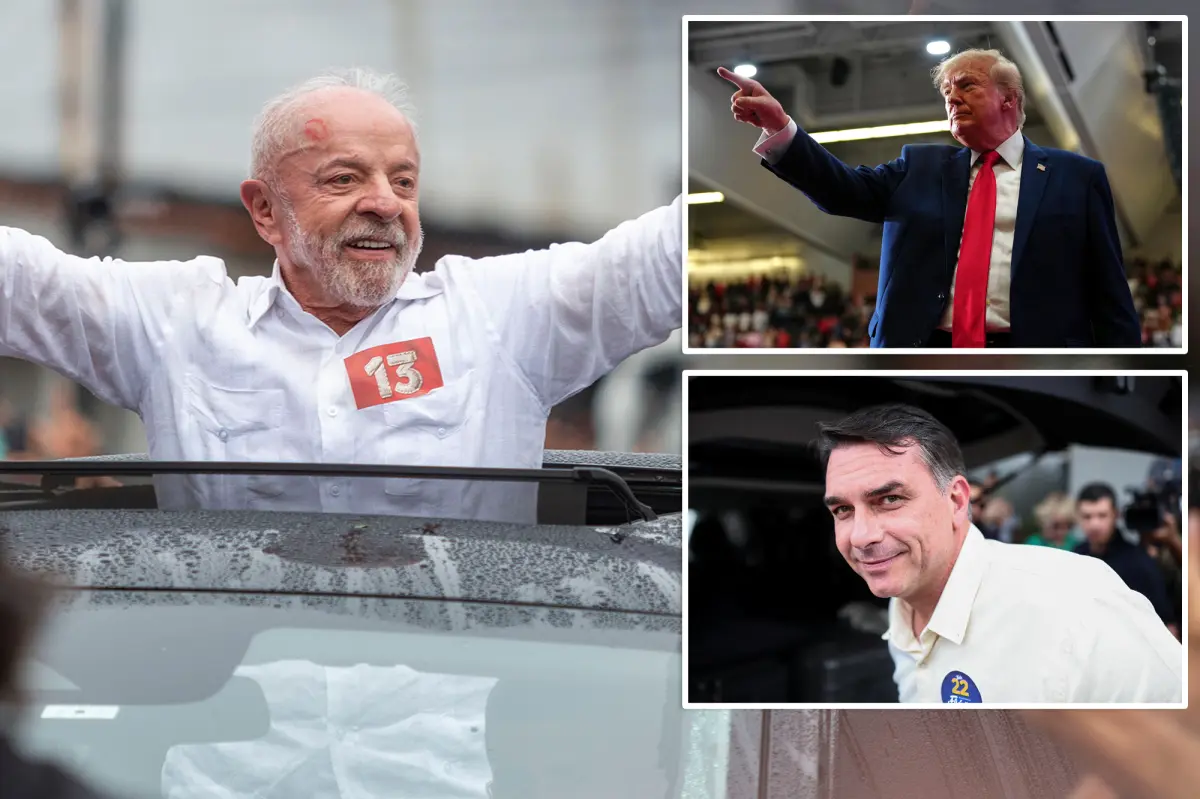

RIO DE JANEIRO — Brazil’s President Luiz Inácio Lula da Silva, a prominent critic of US President Donald Trump, won reelection Sunday in a result that offers relief to Trump’s opponents while preserving some distance between Latin America’s largest economy and Washington.
After all ballots were counted, Brazil’s electoral court declared that the soon-to-be 81-year-old Lula had secured an insurmountable advantage. The announcement followed a tumultuous night at polling stations nationwide, where voting was extended by two hours under a last-minute decision by a Supreme Court justice. Lula’s opponent, Flávio Bolsonaro, may challenge the move in court.
Lula’s victory breaks with a broader Latin American shift toward right-of-center presidential candidates aligned with Trump, a trend that has expanded US influence across the region. His win means Mexico and Brazil, the two most populous countries in Latin America, will continue to be led by left-of-center governments. It also signals that Brazil’s $2.6 trillion economy intends to maintain its independence from the United States despite the pressure created by Trump’s higher tariffs.
The result sparked celebrations among Lula supporters inside and outside the São Paulo hotel where he watched the vote count alongside First Lady Rosângela da Silva, political allies and friends.
If formally confirmed by electoral authorities, Lula’s win will give him a fourth, nonconsecutive term in office. His new term is scheduled to begin on Jan. 5, 2027.
The outcome marks the first time since Brazil’s military dictatorship ended in 1985 that the candidate who finished second in the first round went on to win the presidency. Bolsonaro received 47% of the first-round vote, compared with 45% for Lula, a gap of roughly 2.2 million ballots.
Neither Lula nor Sen. Bolsonaro had addressed supporters as of the announcement.
KEEP READING: Michigan Senate candidate Mike Rogers dodges MAGA Republican label
Sunday’s result is expected to be the final electoral triumph of Lula’s long political career. He entered public life in the 1970s as a union leader and later helped establish the Workers’ Party. After running unsuccessfully for president three times, he won the office in 2002 and was reelected four years later. His successor, former Cabinet minister Dilma Rousseff, won the presidency in 2010 and again in 2014.
Rousseff was impeached in 2016 over accounting practices amid a sweeping corruption investigation that also implicated Lula. He sought another presidential bid in 2018 but was imprisoned in March of that year after being convicted.
Lula spent 580 days behind bars before being released. Brazil’s Supreme Court later annulled his conviction after messages emerged suggesting that the judge who oversaw the case had acted with bias. Lula soon became one of former President Jair Bolsonaro’s fiercest critics and narrowly defeated him in the 2022 election.
In 2024, two years into his administration, Lula acknowledged that his government had done little so far to win over the voters who supported him.
After falling behind in the first round, Lula reshaped his campaign and made a stronger appeal to younger voters. He helped mobilize millions of Brazilians to defend democratic values and his political legacy, while warning against another Bolsonaro administration and highlighting several government programs.
Lula also made national sovereignty a central theme, arguing that a Bolsonaro presidency would give the United States greater leverage over Brazil’s affairs.
At 80, Lula joins Trump and Nicaraguan President Daniel Ortega among the oldest sitting presidents in the Americas.


