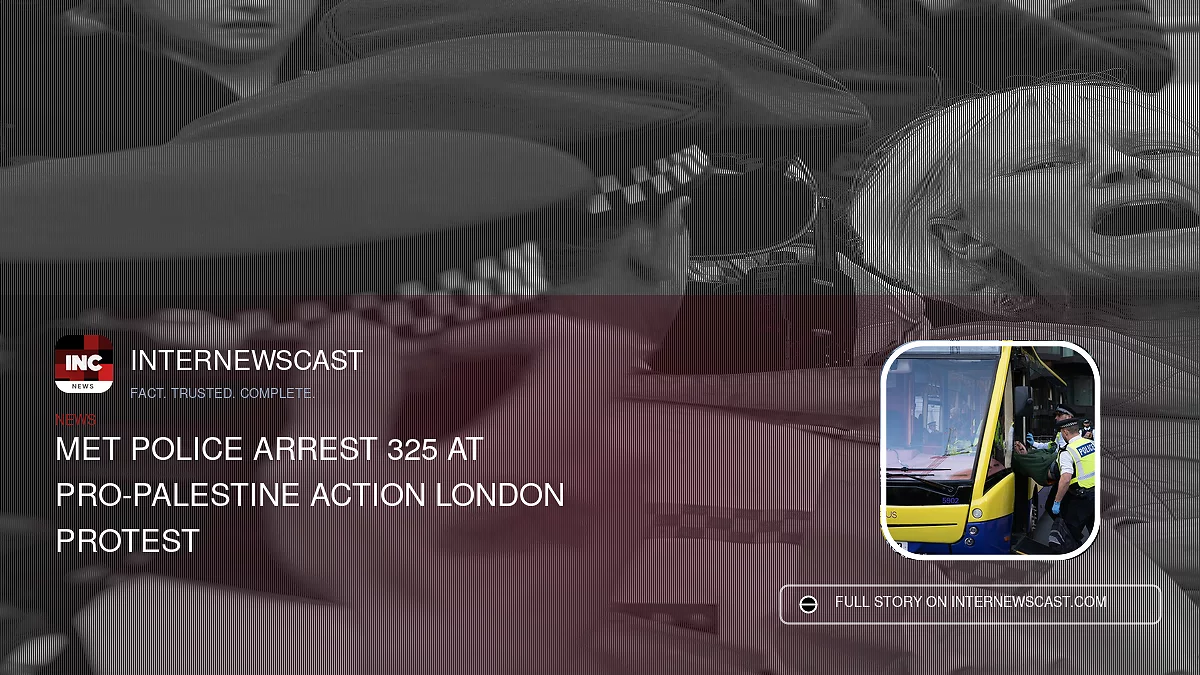

More than 300 supporters of Palestine Action were arrested outside the US Embassy in London yesterday.
Most of those detained were arrested on suspicion of expressing support for a proscribed organisation, the Metropolitan Police said.
Defend Our Juries, which organised the demonstration, had expected 400 people to attend and hold placards reading ‘I oppose genocide, I support Palestine Action’. However, images from the protest suggested the actual turnout was slightly above 100.
Since Palestine Action was proscribed in June 2025, expressing support for the group has been an offence under the UK Terrorism Act.
Officers moved in shortly after protesters assembled outside the embassy and raised their signs. By Saturday evening, the Met said it had made 325 arrests, with further detentions expected as the demonstration continued into the night.
Defend Our Juries said the protest was held ahead of a Supreme Court hearing concerning the ban on Palestine Action.
Explaining its decision to protest outside the US Embassy, the group said the United States had ‘not shied away’ from involvement in the conflict involving Palestine.
The US government announced sanctions against Palestine Action in August, designating it as a terror group.
Scotland Yard said protests linked to Palestine Action ‘take significant police resources away from the neighbourhoods and communities where they are most needed’.

Police carry a person onto a bus after the individual took part in a Defend Our Juries protest outside the US Embassy in south London

A woman holds a placard reading ‘I oppose genocide, I support Palestine Action’ outside the US Embassy on Saturday

Met officers arrest protesters outside the US Embassy

Protesters outside the US Embassy hold signs supporting Palestine Action, which the Government has proscribed as a terror group

A man is carried away by Met officers on Saturday afternoon

The Met said protests linked to Palestine Action ‘take significant police resources away from the neighbourhoods and communities where they are most needed’
David Polden, 86, attended the protest carrying a satirical sign that read: ‘I support genocide, I oppose Palestine Action (satire)’.
Asked why he had joined the demonstration, the retired Campaign for Nuclear Disarmament activist said: ‘I’m against genocide, and I’m against the British government supporting genocide.’
He continued: ‘In spite of my sign, which says, “I don’t support Palestine Action”, I do support Palestine Action because they are attempting to stop genocide.’
Mr Polden said officers had tried to arrest him earlier in the day but released him after realising what his sign actually said.
He said he had previously been arrested for displaying signs in support of the proscribed group and had since been charged with one terrorism offence.
‘I keep getting notices postponing my [court] hearing until after the Supreme Court decides whether supporting Palestine Action was illegal or not,’ he added.
Retired lecturer Christopher Williams, 65, said: ‘This will be my first arrest. I have everything prepared. My family know.’
‘I take this stuff seriously. It won’t be a consequence to me. If we don’t do anything, I think we are all culpable then.’
The Met spent £1.3 million policing six ‘Palestine-Israel public order events’ in June and July, according to its response to a freedom of information request.
Before yesterday’s demonstration, the force warned that anyone displaying a sign expressing support for Palestine Action could be arrested. It also said people suspected of playing a key organisational role, including giving instructions or providing logistical assistance, could face detention.
Met Commander Adam Slonecki, who led the policing operation, said those providing logistical support to people holding placards should also expect to be arrested.
He said: ‘Everyone intending to attend this event knows that supporting a proscribed organisation is unlawful – they are essentially meeting with the purpose of committing a crime.
‘The public would rightly expect us to act proactively rather than stand by and wait for offences to take place. I want to be clear – it is not only people holding placards who should expect to be arrested.
‘Anyone officers believe is playing a key role in organising the event, giving instructions to others and/or providing logistical support will very likely be committing an offence and face enforcement action.
‘This is not about stopping people from expressing their opinions. It is about responding robustly when that expression involves criminality.’

Defend Our Juries, which organised the demonstration, accused the Met of a ‘significant escalation’ and ‘double standards’ in enforcing the ban on Palestine Action

Defend Our Juries had previously said it expected 400 people to attend the protest in support of Palestine Action

Police detain a protester during the Defend Our Juries demonstration outside the US Embassy

Four police officers carry away a woman during the protest outside the US Embassy on Saturday
A Defend Our Juries spokesman said: ‘How can the Met possibly justify arresting people who are not themselves defying the ban, but are simply providing logistical support to peaceful protesters, many of whom are elderly or disabled and need assistance?
‘This significant escalation by the Met highlights even more starkly the unprecedented attacks on freedom of expression unleashed by the ban on Palestine Action, which is at the heart of next week’s Supreme Court hearing. It also exposes the police’s double standards in enforcing the ban, a position that becomes less sustainable by the day.’
In June, five Court of Appeal judges ruled that proscribing Palestine Action as a terror group was a ‘justified and proportionate’ interference with freedom of expression rights.
Their ruling overturned a decision by three High Court judges, who found in February that then-home secretary Yvette Cooper’s decision to ban Palestine Action was unlawful. The High Court case followed a legal challenge brought by the group’s co-founder, Huda Ammori.


