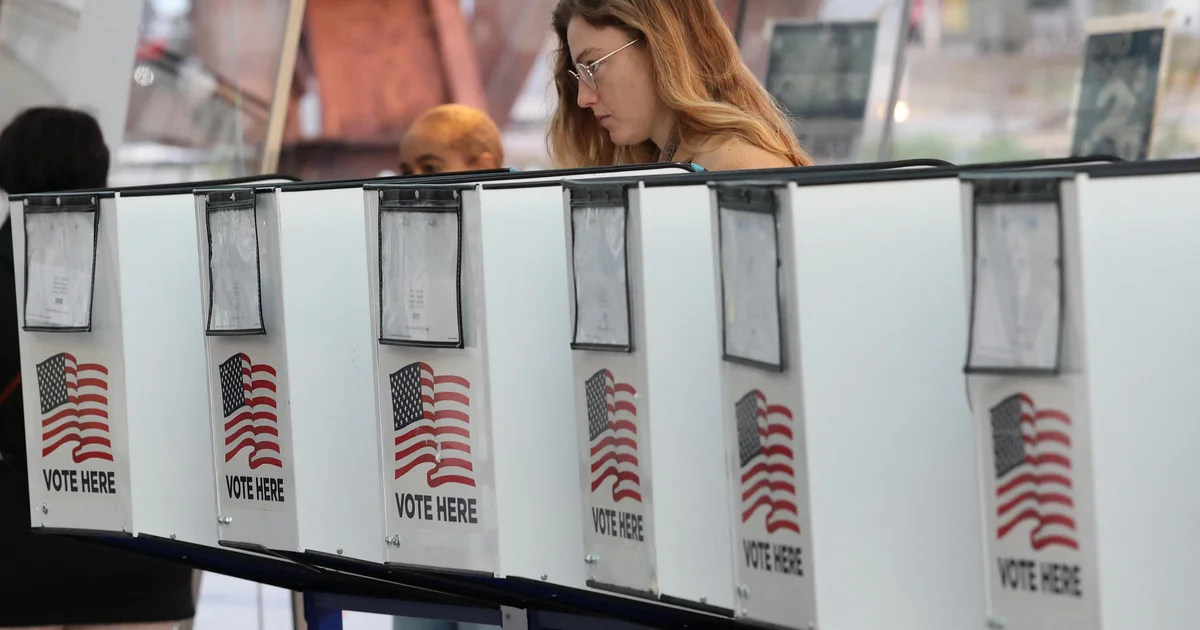

The midterm elections could alter the balance of power in Congress as lawmakers confront persistent inflation, elevated energy costs and rising fiscal debt. For investors, however, the political shift could create a favorable backdrop for stocks.
Data compiled by financial firm Edward Jones shows that the S&P 500 gained an average of 1.7% during the month after the previous 14 midterm elections, dating to 1970. Over the six months that followed, the index delivered an average return of 15.5%.
“Markets may experience turbulence around the vote, but history shows they have generally performed well in the year afterward, as political uncertainty fades and investors refocus on the economic outlook,” Magdalena Ocampo, a market strategist at global investment firm Principal Asset Management, said in an email Tuesday as Americans headed to the polls.
With control of Congress at stake, Wall Street analysts are weighing how a divided government might affect stocks if Democrats capture the House, the Senate or both chambers. Historically, political gridlock has often supported markets by limiting Congress’ ability to enact sweeping tax and spending measures, thereby reducing the threat of abrupt policy changes, analysts said.
“A slower pace of change creates a more predictable environment, allowing companies to pursue longer-term investments,” Chris Low, chief economist at capital markets firm FHN Financial, said in an email Tuesday. “That generally supports earnings.”
Still, reduced stock-market volatility would not necessarily mean an easy path for investors. A congressional stalemate in Washington, D.C., could trigger another partisan confrontation over the nation’s debt, which recently surpassed $40 trillion, or encourage the government to borrow more to finance its priorities, economists warned.
That prospect could unsettle bond investors who already fear Washington is following an unsustainable fiscal path, Ed Yardeni, president of Yardeni Research, said in a note to clients.
“Extended government shutdowns and fiscal standoffs could drive Treasury yields higher, putting pressure on equity valuations,” he said.
The Bipartisan Policy Center, a Washington, D.C.-based think tank, estimates that the United States will face the debt limit again sometime between late winter and midsummer 2027. Lawmakers would then need to raise the ceiling, suspend it temporarily or risk another government shutdown.
Market uncertainty could also linger if President Trump continues using executive authority to advance his agenda, Yardeni said. Democrats would have limited ability to curb his actions even if they won control of Congress, he added.
“As a result, a blue wave could deliver a cold shower to stocks,” Yardeni said. “Even so, we would view a sharp selloff as a buying opportunity given the economy’s remarkable strength and solid corporate earnings.”
A Democratic sweep could affect the broader economy in ways that extend beyond financial markets. One possibility is that Democrats could block Trump’s regulatory nominees, according to Jaret Seiberg, a financial policy analyst and managing director at investment bank TD Cowen.
“They could use that leverage to pressure the president to fill Democratic seats on independent agencies such as the FDIC, SEC and CFTC,” he said.
A Democratic Senate majority could also elevate Massachusetts Sen. Elizabeth Warren to chair the Senate Banking Committee, giving her greater influence over efforts to advance populist legislation, Seiberg said. Warren would succeed South Carolina Republican Sen. Tim Scott, who currently leads the powerful panel.
Even so, lawmakers would remain constrained at the federal level by the president’s power to veto legislation, UBS analysts said in a research note.