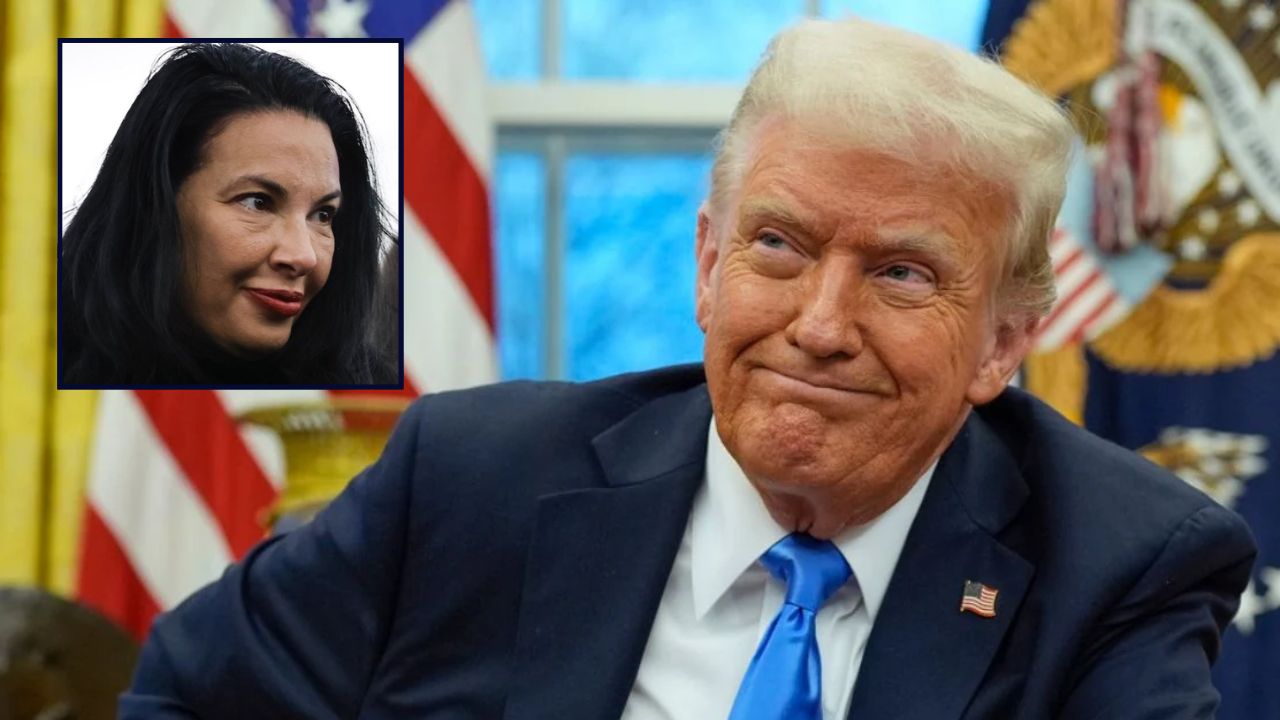

Inset: Sigal Chattah appears in court in Las Vegas on Monday, March 4, 2024. (Wade Vandervort/Las Vegas Sun via AP). Background: President Donald Trump speaks to reporters in the Oval Office at the White House on Tuesday, Feb. 11, 2025, in Washington, D.C. (Photo/Alex Brandon).
Three men indicted by Sigal Chattah, the prosecutor President Donald Trump selected to lead the U.S. Attorney’s Office in Nevada, are asking the U.S. Supreme Court to leave her disqualified from the position.
Chattah took over as Nevada’s top federal prosecutor in an interim capacity in March 2025 under a federal law that limits such appointments to 120 days. Two days before that period was set to expire under the Federal Vacancies Reform Act (FVRA), she resigned from the temporary post and was designated the first assistant U.S. attorney.
In September 2025, federal public defenders challenged Chattah’s authority on behalf of Devonte Jackson, Shamar Garcia, and Giann Salazar Del Real. They asked a federal court to dismiss indictments issued while Chattah was in charge and/or bar Chattah “and any attorneys acting under her direction” from prosecuting the cases.
A district court ultimately disqualified Chattah, although the judge declined to throw out the indictments. The U.S. Court of Appeals for the 9th Circuit later upheld that ruling.
“The FVRA’s text and structure are unambiguous: The statute does not permit the executive to fill an existing vacancy by designating a new first assistant,” the appellate opinion states.
In a 33-page petition for a writ of certiorari, Solicitor General D. John Sauer contended that Chattah’s appointment represents “a commonly selected option” and “a critical tool” that the executive branch has used “without meaningful objection for 25 years.”
In a 47-page brief in opposition, the three defendants are now urging the Supreme Court to let the 9th Circuit’s decision stand.
“This case involves the appointment of U.S. Attorneys, who wield federal prosecutorial power within a given district,” the brief states. “In keeping with the office’s weighty responsibilities, Congress has maintained the Senate’s prerogative to advise and consent to the appointment of U.S. Attorneys since their inception in the Judiciary Act of 1789.”
The challengers portray the dispute as another example of the Trump administration attempting to bypass the Senate confirmation process.
YOU MAY ALSO READ: Is Law Roach Bald, Is His Hair Real? Illness And Health
The filing points to previous court-ordered disqualifications involving federal prosecutors in New Jersey and New York. It also emphasizes that, procedurally, no split currently exists among the federal appeals courts over what the FVRA permits.
“Every other court of appeals that has confronted similar maneuvers by the Executive Branch has reached the same conclusion,” the brief says. “The Third Circuit affirmed the disqualification of a post-vacancy First Assistant in the District of New Jersey. The Second Circuit affirmed a similar disqualification in a case arising from grand jury subpoenas issued by a putative acting U.S. Attorney in the Northern District of New York.”
The defendants also criticize the Justice Department’s argument that disqualifying Chattah could “threaten chaos during the next presidential transition.”
“With no genuine split to rest on, the government resorts to exaggeration and fearmongering,” the opposition brief states.
The men argue that the government’s concerns have “no basis in fact or law,” saying the lower court ruling “leaves intact the multiple methods Congress prescribed for temporarily filling vacant offices.”
The brief says the FVRA, when properly applied, permits an individual to serve for up to “two-and-a-half years.” It also notes that “approximately 40 other statutes” provide additional ways to temporarily fill vacancies.
“The government’s warnings of ‘chaos’ thus do not stem from an inability to fill vacant offices,” the filing continues. “Rather, the government protests that the Executive Branch cannot install its preferred acting officials for an indefinite period of time. But the inability to do that is not a crisis; it is the result of our constitutional design.”
Throughout their filing, the challengers invoke separation-of-powers principles and urge the justices not to hear the Justice Department’s appeal concerning Chattah’s disqualification.
“The Framers knew firsthand the dangers of tyranny and feared a President who may seek to appoint individuals ‘personally allied to him’ who ‘possess the necessary insignificance and pliancy to render them the obsequious instruments of his pleasure,’” the brief states. “By requiring Senate confirmation of certain presidential appointees…the Framers sought to ‘promote a judicious choice’ for ‘filling the offices of the Union.’”
The post ‘The Senate’s prerogative’: Sigal Chattah’s challengers ask SCOTUS to uphold her disqualification and declare Trump DOJ’s de facto leadership arrangement unlawful first appeared on Law & Crime.


