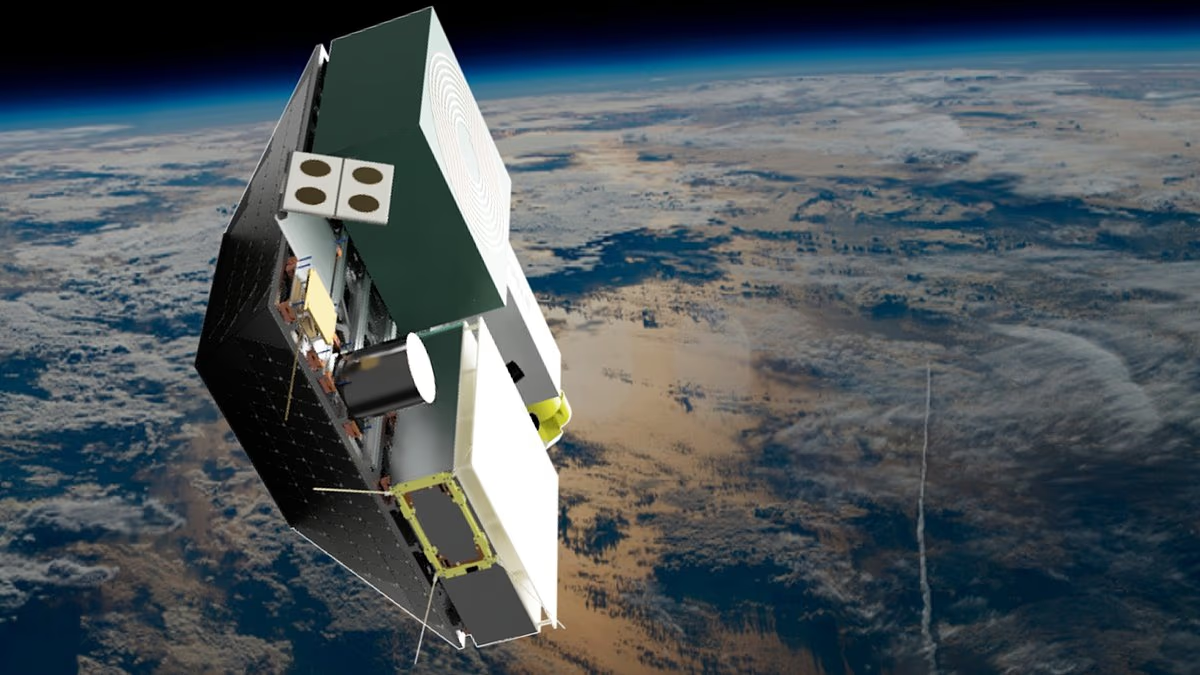

Britain has placed a cutting-edge military satellite into orbit with the capability to monitor Russian troop movements.
Known as Titania, the satellite was launched last month aboard one of Elon Musk’s SpaceX rockets.
Roughly the size of a washing machine, the spacecraft is designed to track military activity as it circles the Earth at an altitude of more than 300 miles.
According to the online tracking service Space Tracker, its orbit appears to take it over areas including China, Russia, the Arctic and Argentina.
Each is considered a potential area of concern for the UK. China continues to threaten Taiwan, while Russia has increased its deployment of submarines and spy ships towards Britain from the north. Meanwhile, Argentine President Javier Milei has maintained a confrontational stance over the Falkland Islands, the British territory invaded by Argentina in 1982 before it was retaken by the UK.
Titania is the second satellite in Britain’s expanding constellation of military spacecraft, following the launch of Tyche in August 2024. Two more satellites, Juno and Oberon, are due to join them.
Air Chief Marshal Sir Harv Smyth, head of the RAF, said the new spy satellites would “ensure our Armed Forces can fight and win wherever they are.”
“The ability to observe the Earth from space is critical to both national resilience and military advantage. This will be demonstrated by Tyche and Titania, alongside Juno and Oberon in the years ahead,” he added.

Dubbed ‘Titania’, the new piece of kit was fired into space on one of Elon Musk’s Space X rockets, last month.

The satellite will be able to monitor military movements, providing images similar to this
Titania will be operated by UK Space Command under the ISTARI programme, which aims to deliver new space-based intelligence, surveillance and reconnaissance capabilities by the end of 2033.
The satellite weighs about 100kg and completes an orbit of the Earth every 90 minutes, travelling at nearly 16,700mph.
It was launched on SpaceX’s Transporter-18 mission from Vandenberg Space Force Base in California on October 1.
The successful launch coincides with the Ministry of Defence’s creation of Project Inaros, which is testing an advanced network of ground-based sensors at three sites around the world to monitor activity in space.
Defence Secretary Wes Streeting said: “The new space age is here. Space underpins everything from weather forecasts and financial transactions to sat-navs and mobile phone connections, and it is critical for our national security and military operations.”
“Having Titania now in orbit and Project Inaros stepping up how we watch over our satellites means we can see threats sooner, making the UK safer.”
Titania was designed and built in Hampshire by the Defence Science and Technology Laboratory (Dstl) and BAE Systems under a £9.5million contract.
The satellite has now entered a commissioning period lasting several months, during which engineers will test and calibrate its onboard systems.

The hi-tech spy satellite is the second of a new series of British-builts spacecraft launched into orbit

The successful launch comes as the Ministry of Defence also stands up Project Inaros, which is testing out an advanced network of ground-based sensors (pictured) built to monitor space from three sites around the world.
Titania is expected to remain operational for at least five years before harmlessly burning up in the Earth’s atmosphere.
The technology carried by the satellite is being kept closely under wraps, with the Ministry of Defence withholding its specifications for security reasons.
The British military has long relied on its own advanced satellite communications network, known as Skynet.
However, access to surveillance and reconnaissance imagery from space has largely depended on requests to allies such as the United States.
Growing doubts among some European defence officials about America’s reliability as a partner have encouraged countries to develop their own sovereign space capabilities.
Those concerns intensified this week after an American company was awarded a £2.4billion contract to build the Skynet 6 satellite, prompting intervention by Andy Burnham.
The Prime Minister is reportedly reviewing the decision to award the lucrative contract to US defence company Lockheed Martin rather than its European rival, Airbus.
Airbus’s British division has long supplied the technology used to handle the UK’s most sensitive data. Supporters argue that excluding the company from the contract would represent a “betrayal” of British space technology and could put UK jobs at risk.
Those supporting Lockheed Martin, however, have pointed out that the technology giant is a European rather than a British company.