
Listening to Democrats and sympathetic commentators in the liberal media, one might think Haley Stevens, the former Democratic primary rival of Michigan Senate candidate Abdul El-Sayed, had lost her senses.
“I have been worried about her all last week,” Michigan Representative Debbie Dingell told CNN on Sunday.
“Something snapped in her. And it snapped in 24 hours,” former Michigan Governor Jim Blanchard said.
Some of Stevens’s critics have gone so far as to suggest that she needs psychiatric treatment. George Conway, the outspoken anti-Trump figure who now frequently backs Democrats, wrote on X that Stevens should check herself into the Lindner Center of Hope in Mason, Ohio.
That reaction captures the larger problem.
Since Stevens withdrew her endorsement of El-Sayed and announced her support for Republican Mike Rogers on Sunday, she has faced public condemnation, political isolation and threats of expulsion from the Democratic Party.
What has been most troubling, however, is the tone of the coordinated backlash against her.

Stevens’s critics have questioned her judgment and even suggested that she needs professional help

Representative Debbie Dingell, pictured with El-Sayed, said she had been worried about Stevens
James Carville offered one of the harshest attacks, telling Stevens that her political career was over and comparing her to a “used condom” in the eyes of Republicans.
The language was crude, personal and deeply inappropriate.
Carville continued, saying Democrats did not even consider Stevens worth a used condom. The remarks sounded less like a serious political argument than a relic from the rougher days of 1990s campaign rhetoric.
It is difficult to reconcile that treatment with a party that presents itself as a defender of women. Are female politicians still to be dismissed as too emotional or unstable whenever they challenge the party line?
That question is especially relevant as Stevens’s critics have shifted their attention to her personal life.
Some of her supposed friends have accused her fiancé, Jason Turkish, of influencing her decision. Jordan Acker, who said he has known Turkish for years, described him as a talented lawyer and advocate for disabled Americans before publicly expressing concern about his conduct.
“It is painful to watch someone you care about go through something like this,” Acker wrote on X. “It is even more painful to worry about the influence of those closest to her.”
But if Acker was genuinely concerned about Stevens, why broadcast the accusation publicly rather than contact her privately?
When asked why he had not sent her a private message, Acker claimed that Turkish had taken away her phone.
The claim only intensified the impression that Stevens’s critics were unwilling to accept her decision as her own.
Turkish is Jewish, and the insinuation that his identity or influence pushed Stevens away from El-Sayed has introduced an ugly undercurrent into the debate. Rather than engaging with her stated political reasons, critics have focused on the person closest to her.

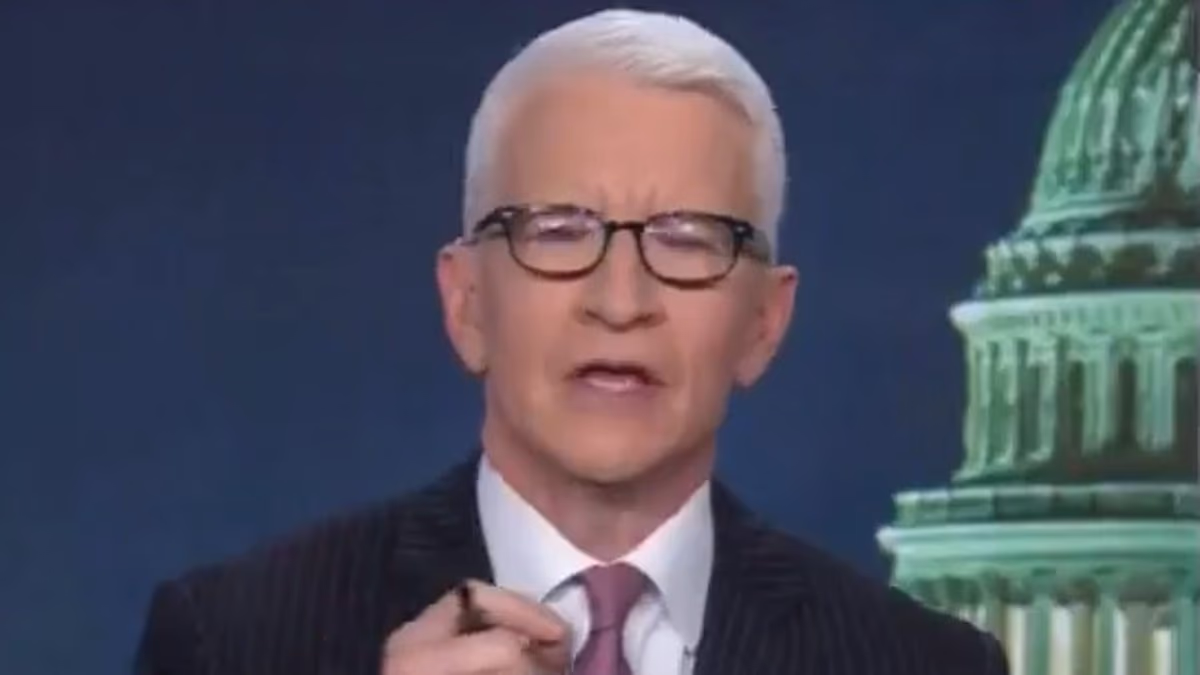
CNN’s Anderson Cooper appeared visibly frustrated during his Sunday interview with Stevens and repeatedly interrupted her explanation
This is the political environment voters may face if they challenge the prevailing Democratic orthodoxy: a combination of partisan pressure and media scrutiny designed to force them back into line.
Anyone who values independent political judgment should take note.
CNN’s Anderson Cooper appeared similarly frustrated during his Sunday interview with Stevens, repeatedly interrupting her as she tried to explain her decision.
Stevens: “Anderson, this is a broader point about what’s going on in our party.”
Cooper: “It’s actually not. It’s really just a question of why you changed your mind.”
By cutting her off, Cooper prevented Stevens from fully presenting what she described as a reasonable political explanation.
Unable to make her case on CNN, Stevens posted a statement Monday:
“After losing the Democratic primary for U.S. Senate, I did what I believed was right. Despite deep disappointment—mine and that of the thousands of people who worked so hard on our campaign—I endorsed Abdul. I put the party first and hoped we could move forward together.
“Instead, I was shut out. The endorsement was welcomed; the people behind it seemed to be forgotten. There was little effort to listen to the voters who supported me or bridge the real disagreements our primary had exposed.”
Addressing the decision to involve her fiancé, Stevens wrote: “Think about what that says. A woman can serve in Congress, run statewide and fight for her convictions, and still be told that when she makes a choice people dislike, someone else must be pulling the strings. That is sexism dressed up as political analysis.
“We cannot preach inclusion while punishing dissent. We cannot promise to heal a divided country if we cannot tolerate disagreement among ourselves.”
Her critics appear unwilling to consider the simplest explanation: Stevens reconsidered El-Sayed’s brand of far-left progressive politics and decided that she preferred an alternative.
The political stakes are obvious. The Michigan Senate race could play a major role in determining whether Democrats regain control of Congress. But electoral urgency does not justify personal attacks, and media outlets should not help enforce party discipline.
The Democratic Party has shown a willingness to support candidates whose views are far outside the mainstream if doing so helps it secure power. In that environment, dissent is treated less as a legitimate part of political debate than as a betrayal.
Haley Stevens’s experience offers a warning about what can happen when a politician crosses her party: her gender, religion and personal relationships can all become weapons in a sustained public campaign against her.