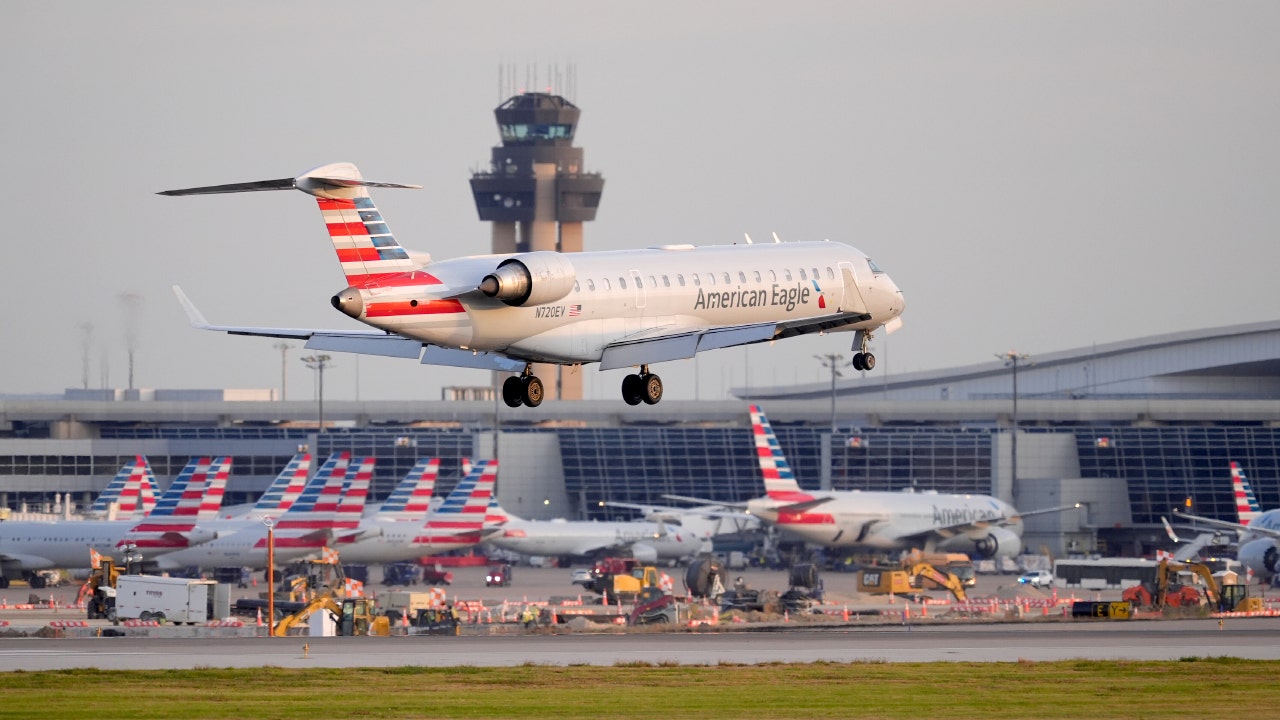

The nation’s air travel operations are expected to return to normal by the end of Sunday, the Federal Aviation Administration said.
FAA Administrator Bryan Bedford said Saturday that “the worst is behind us” after a nationwide ground stop disrupted flights for the longest period in 25 years.
Transportation Secretary Sean Duffy attributed the breakdown to work by contractor L3Harris Technologies Inc., which was upgrading the air traffic control network by replacing aging copper wiring with fiber-optic lines. The project triggered a system overload.

Transportation Secretary Sean Duffy addresses reporters during a briefing at the Department of Transportation headquarters in Washington, D.C., on Nov. 14, 2026. The briefing came after a nationwide communications failure grounded flights across the country the day before. (Aaron Schwartz / AFP via Getty Images)
The upgrade caused intermittent communication and radar failures, leading officials to halt air traffic nationwide for more than four hours. Duffy said investigators were determining whether the problem stemmed from contractor “incompetence” or a defective router.
“Our contractor didn’t meet the moment, or the equipment didn’t meet the moment,” Duffy said.
It was the first nationwide flight stoppage since January 2023, when a critical FAA computer system used to distribute pilot safety notices failed. It was also the second such shutdown since the terrorist attacks of Sept. 11, 2001.
MORE STORY: DHS: Twice-Deported Immigrant Accused of United Cockpit Bomb Threat

Transportation Secretary Sean Duffy, left, and Homeland Security Secretary Markwayne Mullin speak during a news conference in the James S. Brady Press Briefing Room at the White House in Washington, D.C., on Nov. 13, 2026. (Shawn Thew/EPA/Bloomberg via Getty Images)
The FAA ordered the nationwide ground stop Friday afternoon.
Although the order was lifted at 8:15 p.m. ET Friday, the disruption continued to ripple through airline schedules. Delays and cancellations affected crews, passengers and airport operations, with roughly 15,000 flights impacted on Friday and Saturday.
“You will continue to see some delays and cancellations as carriers reschedule flights and reposition aircraft/crews where they are needed most,” Duffy wrote in a weekend post on X.
He urged travelers to contact their airlines and monitor flight status updates directly for the latest information.

Aircraft remain parked on the tarmac at Chicago O’Hare International Airport on Nov. 13, 2026, after the U.S. Federal Aviation Administration ordered a nationwide ground stop. (KAMIL KRZACZYNSKI / AFP via Getty Images)
“Check those updates, stay in contact with your airline, visit its website and use online flight-monitoring tools,” Gary Leff, a Texas-based travel industry analyst and author of the blog “View From the Wing,” told News Outlet.


